
You typed a sentence, paused on one word, and now you’re not sure if it has one “m” or two. That hesitation is normal. Here’s the short version: “commit” is the correct spelling. “Comit” is not a word in standard English, no matter how it looks or sounds when you say it quickly.
Quick Answer: Which Spelling Is Correct?
“Commit” is always correct. “Comit” is always a misspelling.
There is no dictionary, style guide, or English variant (American or British) that recognizes “comit” as a legitimate word. It shows up mainly as a typo, usually because a writer drops one of the two m’s by accident or mishears the word when speaking fast.
If you remember nothing else from this article, remember this: double the m, and you’re safe.
What Does “Commit” Actually Mean?
Commit is a verb with a few related meanings, depending on context:
- To pledge or bind yourself to a course of action (“I commit to finishing this project by Friday”)
- To carry out or perform an act, often a crime (“commit a crime,” “commit fraud”)
- To place someone or something into a particular state or location (“commit a patient to a hospital,” “commit funds to a cause”)
- In computing, to save a set of changes permanently to a file or system (“commit the code to the repository”)
Across all these uses, the core idea stays the same: commit means to fully give, bind, or apply something (often yourself) to a specific action or outcome.
Why Do People Write “Comit” Instead of “Commit”?
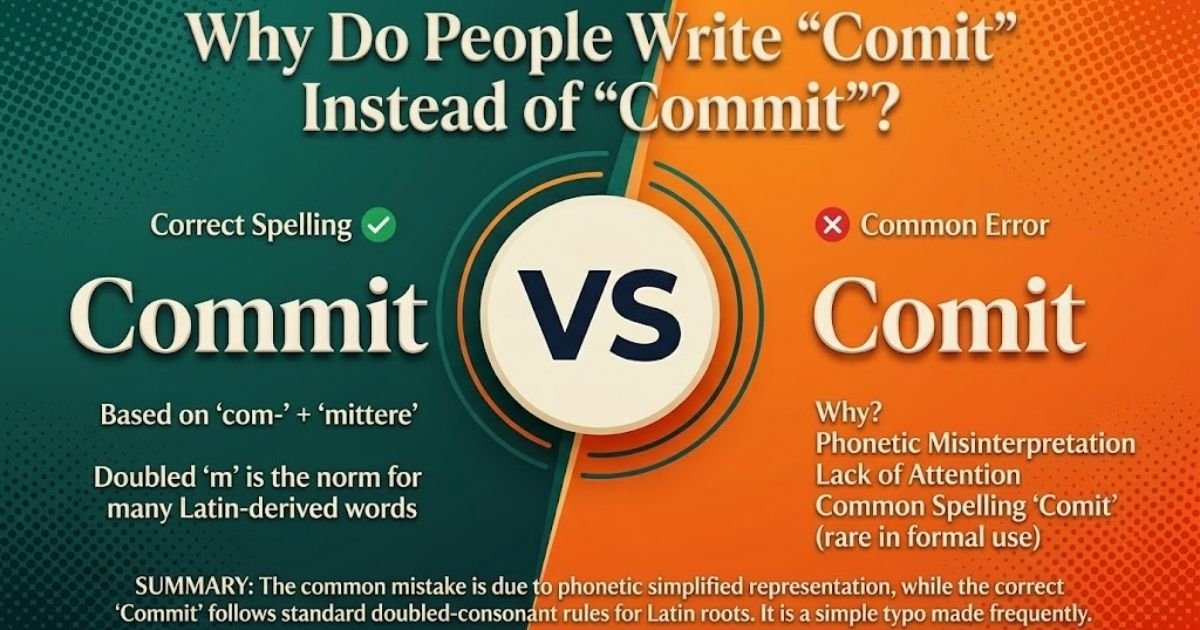
This mistake usually comes from one of three habits:
- Fast typing. Double letters are the easiest thing to drop when you’re typing quickly, especially on mobile keyboards.
- Sound based spelling. When you say “commit” out loud, the double m doesn’t sound dramatically different from a single m, so the ear doesn’t catch the error the way the eye would.
- Confusion with shorter related words. Some learners mentally blend “commit” with words like “comet” or “comic,” which do have a single consonant in that position, and the spelling leaks over.
None of these reasons make “comit” acceptable in writing. They just explain why the typo is common.
Read Related Post: Defence or Defense: Which Spelling Is Correct?
Comparison Table: Commit vs Comit
| Term | Correct? | Meaning | Use |
| Commit | Yes | To pledge, perform, or permanently apply an action | Standard English, all contexts (formal, informal, technical) |
| Comit | No | No accepted meaning | Never correct; treat as a spelling error |
Grammar Breakdown of “Commit”
Part of speech: Verb (transitive and intransitive, depending on the sentence)
Base form: commit Third person singular: commits Past tense: committed Past participle: committed Present participle / gerund: committing
Notice that when you add an ending like -ed or -ing, the final consonant doubles again: committed, committing. This follows a standard English spelling rule where a one syllable stress on the final syllable of a multi syllable word (com-MIT) causes the last consonant to double before a vowel suffix. This is the same pattern you see in words like “occur” becoming “occurred” or “admit” becoming “admitted.”
There is also a noun form, commitment, which refers to the state of being dedicated or bound to something (“She showed real commitment to the team”).
How to Pronounce “Commit”
“Commit” is pronounced kuh-MIT, with the stress on the second syllable. The double m is not pronounced as two separate sounds. It simply signals, in writing, that the vowel before it (the “o”) stays short rather than becoming a long “oh” sound.
This is actually a useful memory trick: the double m protects the short “uh” sound in the first syllable. A single m might visually suggest a different pronunciation pattern, even though native speakers rarely make that mistake out loud. The error almost always happens in writing, not speech.
Where Does “Commit” Come From?
“Commit” traces back to the Latin verb committere, formed from com- (together) and mittere (to send). The original sense was something like “to send together” or “to unite,” which evolved over time into the broader idea of entrusting, engaging, or binding something to a particular purpose.
The word entered English through Old French and Middle English usage around the 14th century, already carrying the double m from its Latin root. That history is exactly why the correct English spelling has always kept both m’s. “Comit” was never a recognized variant at any stage of the word’s development.
How to Use “Commit” Correctly in a Sentence
Here are natural, real world examples across different contexts:
Everyday conversation: “I really need to commit to a bedtime routine.”
Workplace communication: “The team is fully committed to hitting the Q3 deadline.”
Academic writing: “Researchers must commit to transparent reporting of their methods.”
Email: “Please confirm by Friday whether you can commit to the schedule outlined above.”
Business writing: “The company has committed significant resources to sustainability initiatives.”
Casual writing: “Once you commit, there’s no backing out now.”
Each of these sentences uses “commit” as either a present tense action or, in past participle form (“committed”), to describe a completed pledge or action. Notice the double m stays consistent across every tense and context.
Common Mistakes With “Commit” and “Comit”
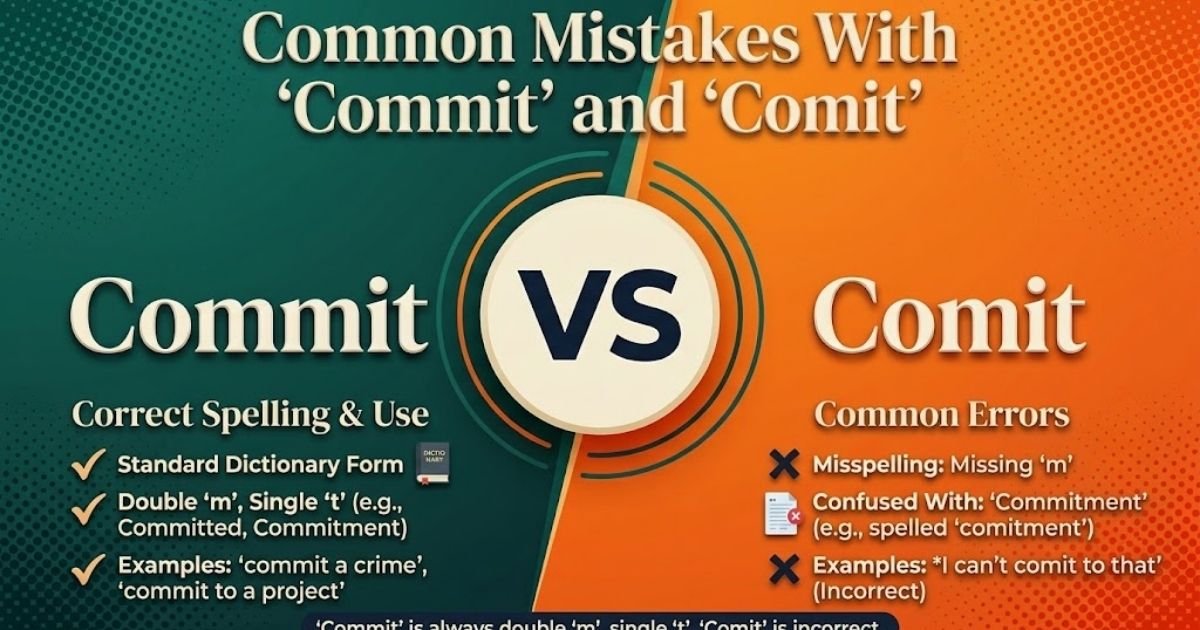
Incorrect: I will comit to the plan. Correct: I will commit to the plan. The single m version simply does not exist as a word, so this is a spelling error, not a grammar choice.
Incorrect: She has comited to the project. Correct: She has committed to the project. This mistake compounds two errors: dropping the second m and forgetting that the past tense doubles the final consonant before adding -ed.
Incorrect: He is comitting a mistake. Correct: He is committing a mistake. The -ing form needs both the double m from the base word and the standard doubling rule for the suffix.
Incorrect: Their comitment to the cause was clear. Correct: Their commitment to the cause was clear. The noun form follows the same spelling as the verb: two m’s, no exceptions.
Related Words and Terms
Understanding a few related words helps lock in the correct spelling:
- Commitment (noun): the state of being dedicated to something
- Committed (adjective/past tense): dedicated or pledged
- Committee (noun): a group appointed for a specific function, also double m
- Recommit (verb): to commit again
- Noncommittal (adjective): not expressing a clear opinion or promise
Notice that nearly every word in this family keeps the double m. That consistency is a helpful pattern to remember when you’re unsure how to spell a related term.
Is “Comit” Ever Acceptable?
No. Unlike some word pairs where both spellings exist for different meanings (like “affect” versus “effect”), “comit” is not a recognized alternate spelling, abbreviation, or regional variant of “commit.” It does not appear in Merriam-Webster, Oxford, Cambridge, or any other major English dictionary. If you see it in published writing, it is a typo that was missed during editing, not a stylistic choice.
Quick Tips to Avoid the Mistake
- Say the word slowly in your head as com-MIT, emphasizing both syllables, to reinforce the double m.
- Remember that related words like committee and commitment also double the m, which reinforces the pattern.
- If you’re typing quickly, use your device’s spell checker. Most autocorrect tools will flag “comit” immediately.
- Practice writing the past tense committed and the gerund committing, since these forms make the double m especially easy to drop if you’re rushing.
FAQ’s
Is “comit” a real word?
No. “Comit” has no meaning and is not recognized by any major English dictionary. It is a misspelling of “commit.”
How many m’s are in “commit”?
Two. The correct spelling is c-o-m-m-i-t.
What is the past tense of “commit”?
The past tense is committed, with a doubled m and a doubled t before the -ed ending.
How do I use “commit” in a sentence?
Use it to describe pledging to an action or completing one: “I commit to finishing this report by Monday.”
Why does “commit” double its final consonant when adding endings?
Because the stress falls on the last syllable of the base word, English spelling convention doubles the final consonant before adding a vowel suffix, as in committed and committing.
Conclusion
“Commit” is the only correct spelling, and “comit” has no legitimate use in English writing. Keep the double m in mind, especially when adding endings like -ed, -ing, or forming the noun commitment, and you’ll spell this word correctly every time.

Smith Jason is an SEO expert with 2–3 years of experience, sharing grammar tips, confusing words, vocabulary and writing advice.










1 thought on “Commit vs Comit: Correct Spelling and Usage Guide”