You want to write “we’re meeting in person” or “an in person meeting,” and suddenly you’re staring at the screen wondering if a hyphen belongs in there. You’re not imagining the confusion. Both forms are correct English, they’re just used in different grammatical jobs. Here’s the short version: use “in-person” (with a hyphen) before a noun, and use “in person” (no hyphen) everywhere else.
Quick Answer: In-Person vs In Person
Both spellings are correct. The difference is grammatical, not a matter of one being right and one being wrong.
- In-person is a hyphenated adjective. It describes a noun directly, as in “an in-person interview.”
- In person is an unhyphenated adverbial phrase. It describes how an action happens, as in “let’s talk in person.”
If the phrase sits right before a noun, hyphenate it. If it comes after a verb, leave the hyphen out. That single rule covers almost every situation you’ll run into.
What Does In Person Mean?
“In person” (two words, no hyphen) means physically present, face to face, rather than by phone, video, mail, or another remote method. It functions as an adverbial phrase, which means it modifies a verb by explaining how or where something happens.
For example:
- “I’d rather apologize in person.”
- “Please pick up the package in person.”
- “She prefers to vote in person instead of by mail.”
In each sentence, “in person” tells you how the action (apologizing, picking up, voting) takes place. It answers the question “how?” not “what kind?”
What Does In-Person Mean?
“In-person” (hyphenated) is an adjective. It describes a noun that follows it, telling you what kind of thing you’re talking about.
For example:
- “The company held an in-person training session.”
- “We switched from virtual to in-person classes.”
- “In-person voting starts at 7 a.m.”
Notice that in every case, “in-person” sits directly in front of a noun (training session, classes, voting) and describes it. Remove the hyphen in these sentences and the grammar becomes shaky, because a compound adjective placed before a noun is normally hyphenated in American English.
Read Related Post: Authorized or Authorised: Which Spelling Is Correct?
In-Person vs In Person: The Key Grammar Difference
The real difference comes down to part of speech and position in the sentence, not meaning. Both forms describe physical presence. What changes is the job each form does.
Think of it this way: if you can swap the phrase for a single adjective like “virtual” or “remote,” it needs a hyphen. If you can swap it for an adverb like “personally” or “directly,” it doesn’t.
- “An in-person meeting” works the same way as “a virtual meeting.” (adjective, hyphenated)
- “We met in person” works the same way as “we met personally.” (adverb, no hyphen)
This is a common pattern in English called a phrasal adjective or compound modifier: two or more words that act as a single adjective get a hyphen only when they appear before the noun they describe.
Where the Phrase In Person Comes From
“In person” has been part of English for centuries, formed from the simple preposition “in” plus “person,” meaning one’s own physical self. It shows up in formal and legal writing going back to early Modern English, often in contexts like appearing “in person” before a court, as opposed to sending a representative.
The hyphenated adjective form, “in-person,” is a more modern development. As phrases like “in person” started being used to describe nouns (in-person event, in-person service), writers naturally applied the standard hyphenation rule for compound adjectives. This shift became especially common as workplaces and schools began contrasting in-person options with remote or virtual ones.
How to Pronounce In-Person and In Person
Both forms are pronounced the same way: “in PER-suhn,” with the stress on the second syllable. The hyphen is a written convention only. It has no effect on pronunciation, spoken emphasis, or rhythm. You will never hear the difference in conversation, only see it on the page.
In-Person vs In Person at a Glance
| Term | Correct? | Part of Speech | Meaning | Typical Use |
| In person | Yes | Adverbial phrase | Physically present, face to face | After a verb: “meet in person” |
| In-person | Yes | Compound adjective | Describing something as face to face | Before a noun: “in-person meeting” |
How to Use In-Person in a Sentence
Use “in-person” whenever the phrase is directly describing a noun that follows it.
- Workplace: “HR scheduled an in-person orientation for new hires.”
- Academic: “The university resumed in-person lectures this semester.”
- Email: “Would you prefer an in-person consultation or a phone call?”
- Casual: “I signed up for the in-person cooking class.”
In every example, “in-person” sits before a noun (orientation, lectures, consultation, class) and answers “what kind.”
How to Use In Person in a Sentence
Use “in person” whenever the phrase comes after a verb and describes how something is done.
- Everyday conversation: “Can we finish this conversation in person?”
- Business writing: “Clients who sign in person receive priority processing.”
- Formal writing: “The applicant must appear in person to submit fingerprints.”
- Academic: “Students who attend in person score slightly higher on average.”
Here, “in person” follows the verb (finish, sign, appear, attend) and explains the method, not the noun.
Common Mistakes With In-Person and In Person
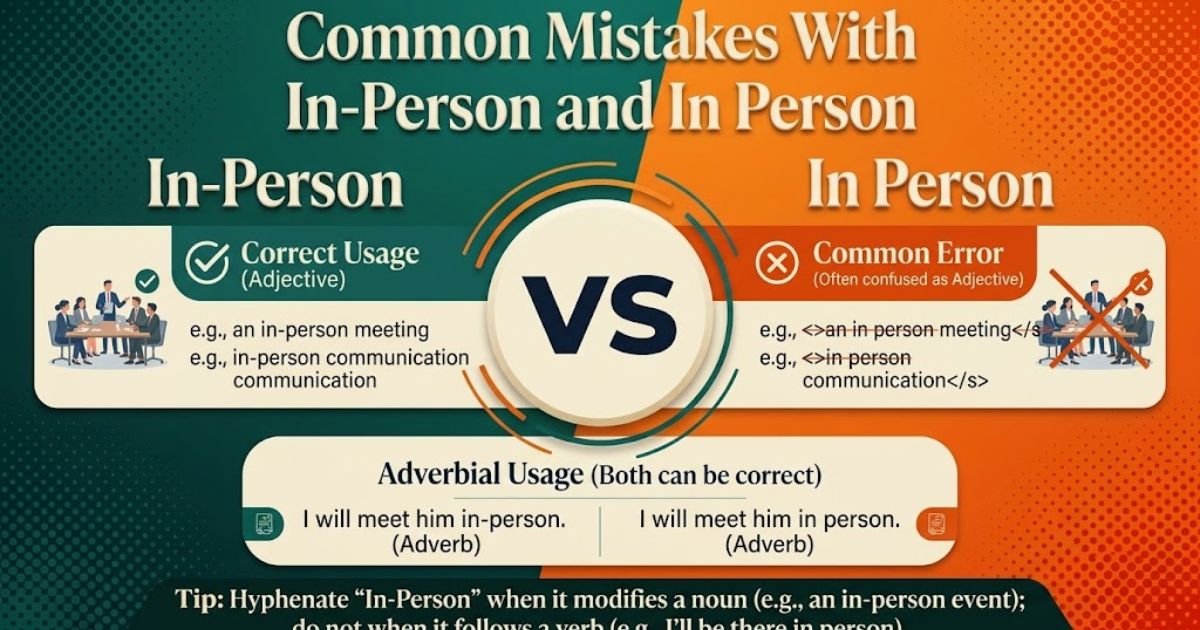
Mixing these up is one of the most common small errors in professional writing. Here are the patterns to watch for.
Incorrect: “We had an in person meeting yesterday.” Correct: “We had an in-person meeting yesterday.” The phrase sits before the noun “meeting,” so it needs the hyphen.
Incorrect: “Let’s talk about this in-person.” Correct: “Let’s talk about this in person.” The phrase follows the verb “talk,” so no hyphen is needed.
Incorrect: “The class is inperson only.” Correct: “The class is in-person only.” or “The class is in person only.” Both forms exist as two or three separate words; “inperson” as one solid word is not standard English.
These slip-ups are easy to make because the sound never changes, only the written form. A quick mental test helps: if a noun comes right after the phrase, hyphenate it.
Related Words and Phrases to Know
A few related terms often show up alongside “in-person” and “in person”:
- Face-to-face, a close synonym that follows the same hyphenation pattern (a face-to-face meeting vs. meet face to face).
- Virtual and remote, common opposites used to contrast with in-person formats.
- On-site, another compound adjective describing physical presence at a specific location.
- In-person only or hybrid, common phrases in event and workplace descriptions.
Learning these together makes it easier to spot when a hyphen belongs, since they all follow the same before-the-noun rule.
Quick Tips to Remember Which One to Use
- Ask what word comes right after the phrase. A noun means hyphenate; a verb, comma, or end of sentence means don’t.
- Try replacing the phrase with “virtual” (hyphenate) or “personally” (don’t hyphenate) and see which one fits.
- Read the sentence aloud. If it sounds like you’re describing a type of thing, use “in-person.” If it sounds like you’re describing how something happens, use “in person.”
FAQ’s
Is “in-person” or “in person” correct?
Both are correct. “In-person” is correct before a noun, and “in person” is correct after a verb.
Is “in-person” one word or two?
Neither. It’s two words joined by a hyphen when used as an adjective, or two separate words with no hyphen when used as an adverbial phrase. “Inperson” as a single unhyphenated word is not standard.
Do the British and Americans write this differently?
No meaningful difference exists. British English follows the same hyphenation logic for compound adjectives, so “in-person” before a noun and “in person” after a verb apply in both varieties of English.
How do I use “in-person” in a sentence correctly?
Place it directly before the noun it describes, such as “The store offers in-person returns.”
Can “in-person” ever appear without a hyphen?
Style guides sometimes vary in strictness, but standard American English guidance keeps the hyphen whenever “in-person” functions as an adjective before a noun. Dropping it there is considered a minor but noticeable error.
Once you spot the pattern, this distinction becomes second nature. Check what comes right after the phrase: a noun means “in-person,” anything else usually means “in person.” That one habit will keep both forms straight every time you write.
Conclusion
The choice between “in-person” and “in person” comes down to one simple check: what word follows it. If a noun comes right after, hyphenate it, as in an in-person meeting. If the phrase follows a verb instead, drop the hyphen, as in we met in person.
Both spellings are correct English, just suited to different jobs in the sentence. Keep that one test in mind, and you’ll never second-guess the hyphen again.

Smith Jason is an SEO expert with 2–3 years of experience, sharing grammar tips, confusing words, vocabulary and writing advice.










1 thought on “In-Person vs In Person: What’s the Difference?”