
If you have ever paused before typing this greeting, you are not alone. The confusion usually comes from how naturally the two words blend together when we say them out loud, which makes them feel like a single word. Here is the short answer: “good morning” (two words) is correct. “Goodmorning” is not a recognized word in standard English.
The Direct Answer: “Good Morning” Is Correct
“Good morning” is always written as two separate words in standard English. It functions as a greeting made up of an adjective (“good”) and a noun (“morning”). “Goodmorning,” written as one word, is a common misspelling and does not appear in any major dictionary, including Merriam-Webster or the Oxford English Dictionary.
You will still see “goodmorning” used in texts, social media captions, and casual chats. That does not make it grammatically correct. It simply reflects how quickly people type when they are not thinking about spelling.
What Does “Good Morning” Actually Mean?
“Good morning” is a greeting used to say hello to someone during the early part of the day, typically from sunrise until around noon. It works as a shortened form of a wish, such as “I hope you have a good morning.”
The phrase can also stand alone as an exclamation, or it can be part of a longer sentence, such as “Good morning, everyone.”
Why Do People Write It as One Word?
This mistake happens for a few understandable reasons:
- Spoken English blends “good” and “morning” together, so the pause between them is barely noticeable.
- Autocorrect on some devices does not always catch it, especially in casual messaging apps.
- English has many closed compound words, like “breakfast” or “weekend,” so learners naturally assume “goodmorning” might follow the same pattern.
The difference is that “good morning” is not a compound word. It is a two word phrase, similar to “good night,” “good afternoon,” and “good evening,” all of which stay separated.
Grammar Breakdown of “Good Morning”
Understanding the grammar makes the rule easier to remember.
Part of speech: “Good” is an adjective. “Morning” is a noun. Together, they form a noun phrase used as a greeting or an interjection.
Spelling: Always two words, with a space between them. No hyphen is used in standard American or British English.
Capitalization: Capitalize both words only when they begin a sentence or appear in a title. In the middle of a sentence, lowercase is correct: “She said good morning to her neighbor.”
Plural form: The phrase does not have a plural form. You do not say “good mornings” when greeting more than one person; you would instead say “good morning, everyone.”
Punctuation: When used as a standalone greeting, it is typically followed by a comma if a name follows it, as in “Good morning, Sarah.”
Read Related Post: In-Person vs In Person: What’s the Difference?
Where Does “Good Morning” Come From?
The greeting developed from Old English and Middle English phrases that combined a wish for wellbeing with the time of day. Similar time-based greetings, such as “good day” and “good evening,” appear throughout the history of English as polite, formal ways to acknowledge someone.
The structure has stayed consistent for centuries: an adjective describing a positive quality, paired with a noun that names the part of the day. This same pattern explains why “good afternoon” and “good night” also remain two separate words.
How Do You Pronounce “Good Morning”?
In natural speech, most US English speakers pronounce it as “good MOR-ning,” with a slightly stronger stress on the first syllable of “morning.” The two words often blend together in casual conversation, which is part of why the one word spelling feels intuitive even though it is incorrect.
Good Morning vs Goodmorning: Comparison Table
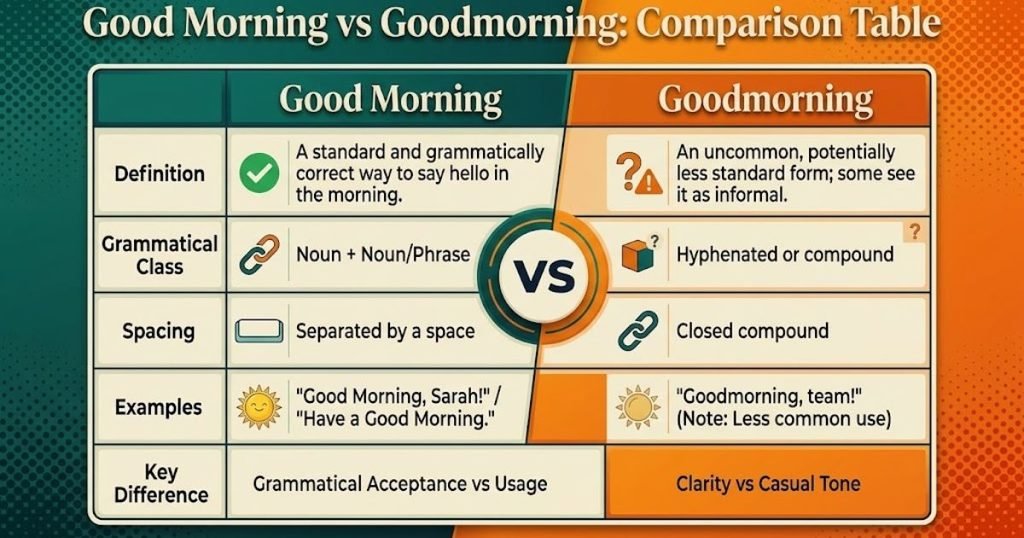
| Term | Correct? | Meaning | Use |
| Good morning | Yes | A greeting used during the morning hours | Standard in all writing, from texts to formal letters |
| Goodmorning | No | Not a recognized word | Common misspelling, should be avoided in writing |
| Good-morning | No | Not standard | Occasionally seen but not accepted in modern English |
How to Use “Good Morning” Correctly
As a greeting on its own: “Good morning! Did you sleep well?”
Followed by a name: “Good morning, Mr. Alvarez. Your 9 a.m. appointment is confirmed.”
In a full sentence: “I always try to say good morning to my coworkers before checking my email.”
In workplace communication: “Good morning, team. Here is a quick update on today’s schedule.”
In formal writing: “Good morning, and thank you for joining us for this presentation.”
In academic or professional emails: “Good morning, Professor Kim. I wanted to follow up on yesterday’s lecture.”
Each of these examples uses the two word spelling, which is appropriate across every level of formality.
Common Mistakes to Avoid
Incorrect: Goodmorning! Hope you have a great day. Correct: Good morning! Hope you have a great day. The two words must stay separated regardless of tone or setting.
Incorrect: She said goodmorning before leaving the room. Correct: She said good morning before leaving the room. Even in the middle of a sentence, the phrase keeps its two word spelling and drops only the capital letters.
Incorrect: Good-morning, everyone! Correct: Good morning, everyone! A hyphen is not used to connect these two words in standard English.
These mistakes are easy to make, especially for fast typers or English learners adjusting to how spoken and written English differ. Recognizing the pattern is the fastest way to avoid repeating it.
Related Greetings That Follow the Same Rule
The same two word structure applies to other time-based greetings in English:
- Good afternoon: used from around noon until early evening
- Good evening: used from early evening until nighttime
- Good night: used when parting ways at night or before sleep, not as a greeting when meeting someone
- Good day: a more formal or old-fashioned greeting, more common in British English
Notice that none of these phrases combine into a single word. If you remember that “good afternoon” and “good evening” are always separated, “good morning” becomes easy to remember by the same logic.
Is “Good Morning” Formal or Informal?
“Good morning” works well in both formal and informal contexts, which makes it one of the more flexible greetings in English. In casual conversation, it can be shortened to “morning” among friends or close coworkers. In formal writing, business emails, and academic settings, the full phrase “good morning” is expected.
Shortened versions, like “mornin’,” are acceptable only in very casual spoken contexts and should not appear in professional writing.
American English vs British English
There is no meaningful difference between American and British English when it comes to spelling this phrase. Both varieties treat “good morning” as two separate words, use the same capitalization rules, and consider “goodmorning” a spelling error rather than a regional variation.
Practical Tip for Remembering the Correct Spelling
A simple way to check yourself is to compare it with “good night.” Since almost no one writes “goodnight” as a single word without noticing it looks off, applying that same instinct to “good morning” helps the correct spelling stick. If you would not write “goodnight” as one word in a formal message, do not write “goodmorning” that way either.
FAQ’s
Is “goodmorning” ever correct?
No. “Goodmorning” is not a standard English word in any context, formal or informal. The correct form is always “good morning,” written as two words.
What does “good morning” mean?
It is a greeting used to say hello during the morning hours, generally understood to mean “I hope you have a good morning.”
How do I use “good morning” in a sentence?
You can use it as a standalone greeting, such as “Good morning!” or as part of a sentence, such as “She greeted us with a warm good morning before the meeting started.”
Is “good morning” capitalized in the middle of a sentence?
No. Only capitalize it when it starts a sentence or appears in a title. Mid-sentence, it should be lowercase: “He mumbled good morning and grabbed his coffee.”
Can I shorten “good morning” to just “morning”?
Yes, but only in casual, spoken contexts among people you know well. In professional or formal writing, use the full phrase “good morning.”
Conclusion
“Good morning” is the only correct spelling, written as two separate words with no hyphen. “Goodmorning” is a common typing habit, not an accepted English word.
The next time you type this greeting, remember the space between the two words and you will always get it right.

Smith Jason is an SEO expert with 2–3 years of experience, sharing grammar tips, confusing words, vocabulary and writing advice.








1 thought on “Goodmorning or Good Morning: Which One Is Correct?”