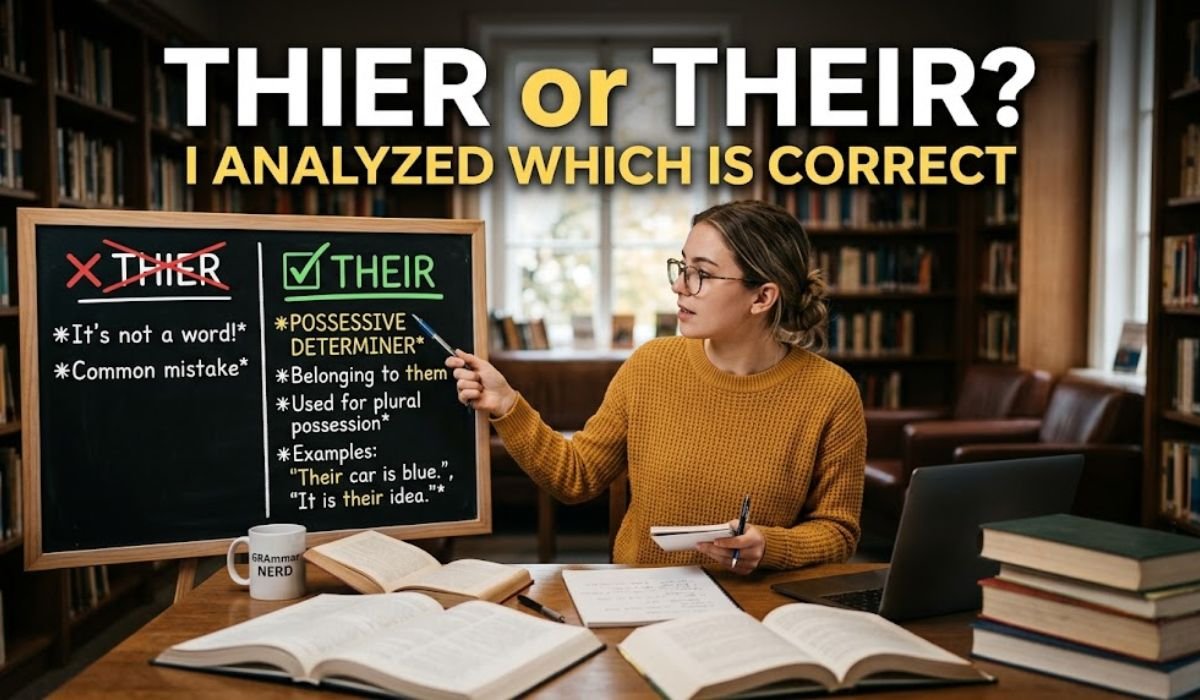
Many writers pause mid-sentence and wonder whether the spelling is “thier” or “their.” The confusion comes from the “ie” and “ei” pattern, which trips up almost everyone. “Their” is the correct spelling. “Thier” is a common misspelling and is not a word in English. Below, you’ll see what “their” means, how to use it, and a simple trick to spell it right every time.
Which Is Correct: Thier or Their?
Their is correct. Thier is always a spelling error.
“Their” is a possessive word that shows something belongs to a group of people, animals, or things. If you can replace it with “belonging to them,” you have the right word.
The misspelling happens because English has two competing patterns: “i before e” and “e before i.” Since “their” breaks the classic rhyme, the letters get swapped easily, even by confident writers.
| Term | Correct? | Meaning | Use |
| their | Yes | Belonging to them | Shows possession |
| thier | No | None (misspelling) | Never use it |
What Does Their Mean?
“Their” means belonging to or associated with them. It points to a group, or to a person whose identity or gender is unknown or unspecified.
You can test it quickly. If “belonging to them” fits the sentence, “their” is your word.
- The students forgot their notebooks.
- My neighbors painted their fence blue.
- Both teams celebrated their wins.
In each case, something belongs to the plural noun that came before it.
Why Is Thier Wrong?
“Thier” does not appear in standard dictionaries as a word, so it has no meaning to look up. It is simply “their” with the middle letters reversed.
I found no legitimate use for it as an English word. Spellcheck will flag it, and readers will notice it right away, which can distract from an otherwise strong email, resume, or essay.
The good news is that this is one of the most forgivable errors in English. Even experienced writers make it when typing fast.
Their vs. There vs. They’re: What’s the Difference?
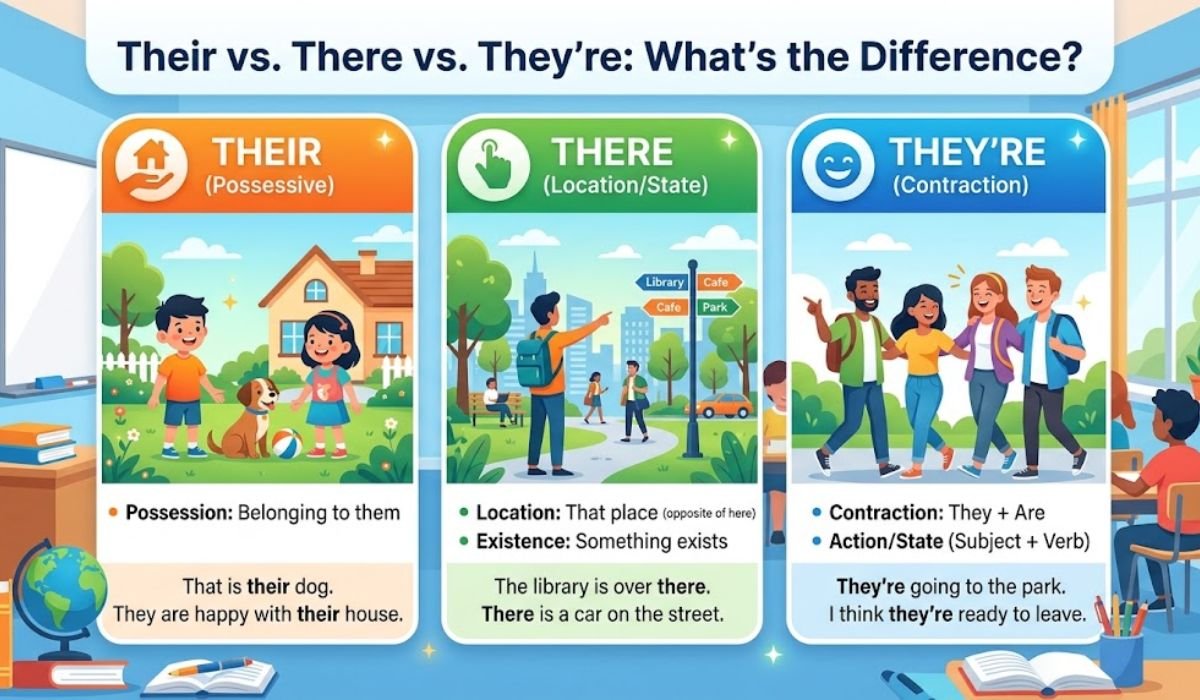
Part of the trouble is that “their” sounds exactly like two other words. These three are homophones, meaning they sound alike but differ in spelling and meaning.
| Word | Part of Speech | Meaning | Example |
| their | Possessive determiner | Belonging to them | Their car is red. |
| there | Adverb or pronoun | In that place, or used to introduce a statement | Put it over there. |
| they’re | Contraction | They are | They’re almost here. |
A quick check helps. Try replacing the word with “they are.” If the sentence still works, use they’re. If it points to a place, use there. If it shows ownership, use their.
Read Related Post: Resignate or Resonate? The Bold Guide to the Right Word
What Part of Speech Is Their?
“Their” is a possessive determiner, sometimes called a possessive adjective. It appears before a noun and tells the reader who owns or is connected to that noun.
It belongs to the same family as “my,” “your,” “his,” “her,” “its,” and “our.” Each one comes before a noun.
- My book
- Our house
- Their garden
A related form is theirs, which is a possessive pronoun. It stands alone without a noun after it.
- The garden is theirs.
- That table is ours, and this one is theirs.
Notice that “theirs” has no apostrophe. Writing “their’s” is a mistake.
How Do You Pronounce Their?
In American English, “their” is pronounced like “thair,” rhyming with “care” and “air.” It has one syllable and starts with the voiced “th” sound, the same as in “the” and “this.”
Because “there” and “they’re” are usually pronounced the same way, you cannot rely on your ear. Spelling is the only way to tell them apart, which is why the mistake appears mostly in writing.
Where Does the Word Their Come From?
“Their” entered English from Old Norse, the language of the Vikings who settled in parts of England. The Old Norse form “þeirra” served as the possessive of “þeir,” meaning “they.”
English gradually adopted it during the Middle English period. Before that, English had its own older forms for “their,” which were eventually replaced. That is why “they,” “them,” and “their” all begin with “th” today.
The odd spelling with “ei” reflects the long, uneven path English spelling has taken. The word does not follow the “i before e” rule, and it is one of many exceptions.
How Do You Use Their in a Sentence?
Place “their” directly before the noun it describes. The noun can be a person, an object, an idea, or a place.
Everyday conversation
- They left their umbrellas at the restaurant.
- My cousins love their new apartment.
Workplace communication
- The sales team exceeded their quarterly targets.
- Please ask the vendors to send their invoices by Friday.
Academic writing
- Researchers published their findings in a peer-reviewed journal.
- Students must submit their essays before the deadline.
- Thanks to everyone who shared their feedback on the draft.
Formal writing
- The board members presented their recommendations to the committee.
In each example, “their” refers back to a plural group mentioned earlier in the sentence.
Can Their Refer to One Person?
Yes. “Their” can refer to a single person, especially when the person’s gender is unknown, irrelevant, or when someone uses they/them pronouns. This is called the singular “they.”
- Everyone should bring their own lunch.
- If a customer has a complaint, their feedback should go to support.
- Alex said their flight was delayed.
This usage has a long history in English, and major style guides, including AP style and the Chicago Manual of Style, now accept it. Some older or very formal contexts may still prefer rephrasing, such as “all customers should bring their own lunch.”
Both approaches are acceptable. Choose the one that reads most naturally for your audience.
What Are the Most Common Mistakes With Their?
Here are the errors readers see most often. They are normal parts of learning English, and each has a simple fix.
Mistake 1: Swapping the letters
Incorrect: The employees finished thier reports.
Correct: The employees finished their reports.
The correct spelling is “e” before “i” in this word, and there is no exception to this specific spelling.
Mistake 2: Using “there” for ownership
Incorrect: The kids left there shoes by the door.
Correct: The kids left their shoes by the door.
“There” points to a place. Ownership needs “their.”
Mistake 3: Using “they’re” for ownership
Incorrect: They’re dog barks all night.
Correct: Their dog barks all night.
“They’re” always means “they are.” Read the sentence aloud with “they are” and you’ll hear the mistake.
Mistake 4: Adding an apostrophe to theirs
Incorrect: The victory was their’s.
Correct: The victory was theirs.
Possessive pronouns like “hers,” “ours,” and “theirs” never take apostrophes.
Mistake 5: Using “there” for both
Incorrect: There going to bring there own tools.
Correct: They’re going to bring their own tools.
This is the classic triple mix-up. Say each word’s meaning in your head to sort them out.
How Can You Remember the Spelling?
The easiest trick is to spot a smaller word hiding inside: t-HEIR. An heir is someone who inherits things, so “their” belongs to people who own or inherit possessions. The spelling and the meaning match.
A second trick is the “here” test for “there.” The word “there” contains “here,” and both refer to places. If your word does not point to a location, it is probably not “there.”
A third option is to slow down when you proofread. Search your document for “thier” using the find function. It takes seconds and catches every instance at once.
FAQ’s
Is “thier” ever correct?
No. “Thier” is not a valid English word. The correct spelling is “their.”
What does “their” mean?
“Their” means belonging to or connected with them. It comes before a noun, as in “their house” or “their ideas.”
How do I use “their” in a sentence?
Put it before the noun that belongs to the group. Example: “The volunteers brought their own gloves.”
What is the difference between “their” and “there”?
“Their” shows possession, while “there” refers to a place or introduces a statement. Example: “Their car is parked over there.”
Can “their” refer to one person?
Yes. It works as a singular pronoun when the person’s gender is unknown or when the person uses they/them. Example: “Someone left their jacket here.”
Conclusion
The correct spelling is their, and “thier” is only a typo. When you need to show that something belongs to a group, use “their.” When you mean a place, use “there.” When you mean “they are,” use “they’re.”
If you forget everything else, remember the hidden word: t-heir. Owners and heirs go together, and so do the spelling and the meaning.

Smith Jason is an SEO expert with 2–3 years of experience, sharing grammar tips, confusing words, vocabulary and writing advice.










2 thoughts on “Thier or Their? I Analyzed Which Is Correct”