You typed a thank you message, paused, and suddenly second guessed yourself. Should it be “I appreciate it” or “I appreciated it”? The confusion makes sense because both phrases look almost identical and both express gratitude. The real difference comes down to timing. “Appreciate it” refers to gratitude you feel right now, while “appreciated it” refers to gratitude about something that already happened.
The Quick Answer: Which One Should You Use?
Both phrases are grammatically correct. Neither one is a mistake. The choice depends entirely on when the gratitude applies.
Use “appreciate it” when you are thanking someone in the present moment, for something happening now or something ongoing. Use “appreciated it” when you are describing gratitude for something that already took place in the past.
If someone just handed you a coffee, you say “I appreciate it.” If you are telling a friend how grateful you felt about help they gave you last month, you say “I appreciated it.” That single distinction solves almost every case of confusion.
What Does “Appreciate It” Mean?
“Appreciate it” is a present tense verb phrase. It means you are grateful for something right now, at the moment you are speaking or writing.
The verb appreciate is in its base present tense form here, paired with the pronoun it, which refers to whatever the other person just did or said. This phrase feels immediate and active, almost like a direct reaction.
Example: “Thanks for covering my shift, I appreciate it.”
Here, the gratitude is happening in real time, right after the favor was mentioned.
What Does “Appreciated It” Mean?
“Appreciated it” is the past tense form of the same verb. It describes gratitude tied to an event, action, or gesture that already occurred, sometimes recently, sometimes long ago.
Example: “I appreciated it when you stayed late to help me finish the report.”
The gratitude still exists, but the sentence is placing it in the context of a completed event. This form is common when telling a story, giving feedback, or reflecting on something after the fact.
The Real Difference Between “Appreciate It” and “Appreciated It”
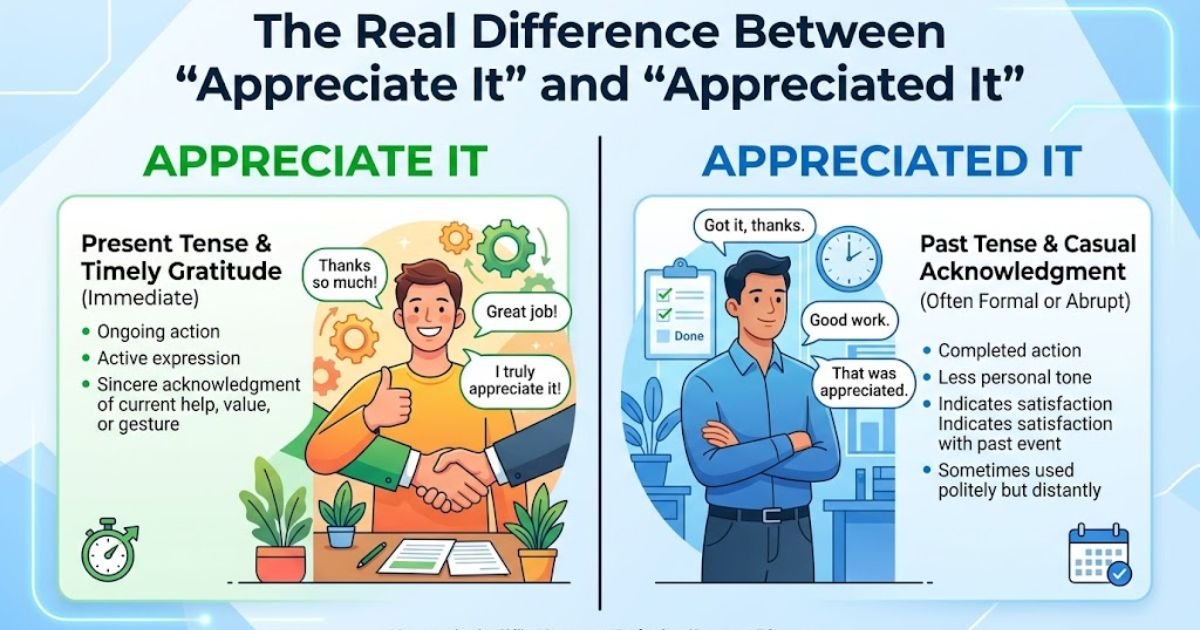
The difference is not about correctness. It is about verb tense and timing.
“Appreciate it” works for:
- Something happening right now
- A general, ongoing truth
- A quick reaction to a favor
“Appreciated it” works for:
- Something that already happened
- A memory or reflection
- A completed action you are referencing later
Think of it like the difference between “I like this” and “I liked that.” Same emotion, different point in time.
Grammar Breakdown: Verb Tense and Sentence Structure
Both phrases follow a simple structure: subject plus verb plus object.
- I appreciate it = subject (I) + present tense verb (appreciate) + object pronoun (it)
- I appreciated it = subject (I) + past tense verb (appreciated) + object pronoun (it)
The verb appreciate is regular, meaning its past tense is formed by simply adding -ed. There is no irregular spelling change to worry about, which makes this one easier than many other English verbs.
As a verb, appreciate can mean two related things: to feel grateful for something, or to recognize the value or quality of something. Both meanings follow the same tense rules described above.
American English usage treats both phrases identically to British English in terms of grammar. There is no regional difference in which form is correct, only in how often each is used in casual speech.
Read Related Post: Submission vs Submittion: Learn The Correct Spelling
Pronunciation Guide
Both words are pronounced the same way except for the ending.
- Appreciate: uh-PREE-shee-ayt
- Appreciated: uh-PREE-shee-ay-tid
The added syllable at the end of “appreciated” often trips up English learners because the “-ed” ending sounds like its own beat, “tid,” rather than a quiet “d” or “t” sound as it would after some other verbs.
Appreciate It vs Appreciated It: Comparison Table
| Term | Correct? | Meaning | Best Use |
| Appreciate it | Yes | Gratitude felt in the present moment | Thanking someone right after they help you |
| Appreciated it | Yes | Gratitude for something that already happened | Reflecting on or referencing a past favor |
When to Use “Appreciate It” (With Examples)
Reach for “appreciate it” any time gratitude is tied to the present moment, including favors happening right now or ones you expect soon.
Everyday conversation: “Can you grab my mail while I’m away? I’d appreciate it.”
Workplace communication: “Please send the revised file by Friday. I appreciate it.”
Email closing: “Thanks again for your patience, I really appreciate it.”
Formal request: “If you could confirm receipt of this document, I would appreciate it.”
That last example uses “would appreciate it,” a polite conditional form common in professional writing. It softens a request while still expressing present tense gratitude.
When to Use “Appreciated It” (With Examples)
Reach for “appreciated it” when describing gratitude connected to something that has already concluded.
Casual storytelling: “When my car broke down last week, my neighbor drove me to work. I really appreciated it.”
Academic or reflective writing: “The mentorship program gave students individual attention, and many appreciated it more than the lectures.”
Business feedback: “Our client appreciated it when the team followed up personally after the delivery delay.”
Formal writing: “The committee appreciated the additional documentation provided during the review period.”
Notice how each example references a specific completed event rather than something ongoing.
Common Mistakes to Avoid
Incorrect: “Thanks for helping me yesterday, I appreciate it.” Correct: “Thanks for helping me yesterday, I appreciated it.”
The word “yesterday” signals a completed past event, so the verb needs to match in past tense.
Incorrect: “I appreciated it, can you send me the file now?” Correct: “I would appreciate it if you could send me the file now.”
Mixing past tense gratitude with a present request creates a confusing timeline. Match the verb tense to the action you are describing.
Incorrect: “I appreciate it so much when you helped me last year.” Correct: “I appreciated it so much when you helped me last year.”
If the sentence already contains a past tense clause like “when you helped me,” the main verb should agree with that same timeframe.
These mix ups are extremely common, even among fluent speakers, because both phrases sound so similar in casual conversation.
Related Words and Phrases
A few related forms show up often alongside this topic:
- Appreciation (noun): the feeling of being grateful, as in “I want to express my appreciation.”
- Appreciative (adjective): describing someone who feels grateful, as in “She was appreciative of the gesture.”
- Much appreciated: a shortened, informal way to say “it is much appreciated,” often used at the end of a message.
- Would appreciate: a polite, softened version used for requests, as in “I would appreciate a quick response.”
- Thankful and grateful: close synonyms that can sometimes replace “appreciate” depending on tone.
Practical Guidance: How to Choose the Right Form Every Time
A simple test: ask yourself whether the favor or event has already finished.
If it is happening now, ongoing, or hasn’t happened yet, use appreciate it. If you are looking back on something that is already done, use appreciated it.
Another shortcut: check the rest of your sentence. Words like “yesterday,” “last week,” “when you,” or “back then” usually call for the past tense form. Words like “right now,” “always,” or no time marker at all usually call for the present tense form.
FAQ’s
Is “appreciate it” or “appreciated it” correct?
Both are correct. The right choice depends on timing: use “appreciate it” for present gratitude and “appreciated it” for gratitude about something that already happened.
Can I use “appreciate it” for something in the past?
Generally no. If the event has already concluded, especially with a specific past time reference, “appreciated it” is the grammatically consistent choice.
Is “much appreciated” the same as “I appreciate it”?
They express the same idea, but “much appreciated” is a shortened, more informal phrase often used at the end of a message or request.
How do I use “appreciated it” in a sentence?
Use it to reference a completed favor or event, such as: “I appreciated it when you checked in on me after the surgery.”
Is “would appreciate it” more polite than “appreciate it”?
Yes. “Would appreciate it” softens a request and is common in professional emails, such as “I would appreciate it if you could confirm the details.”
Conclusion
Both “appreciate it” and “appreciated it” are correct. The only thing that changes is timing: present gratitude calls for “appreciate it,” while gratitude about a finished event calls for “appreciated it.” Once you check whether the moment has already passed, choosing the right form becomes automatic.

Smith Jason is an SEO expert with 2–3 years of experience, sharing grammar tips, confusing words, vocabulary and writing advice.










1 thought on “Appreciate It or Appreciated It? The Ultimate Guide To Choosing The Right Phrase”