
Many writers type “seing” because the word looks like it should follow the silent e rule. It doesn’t. The correct spelling is seeing, with two e’s. The verb “see” ends in a double e, so adding “ing” keeps both letters. Below you’ll find the meaning, the spelling rule, and plenty of examples.
Which Is Correct: Seing or Seeing?
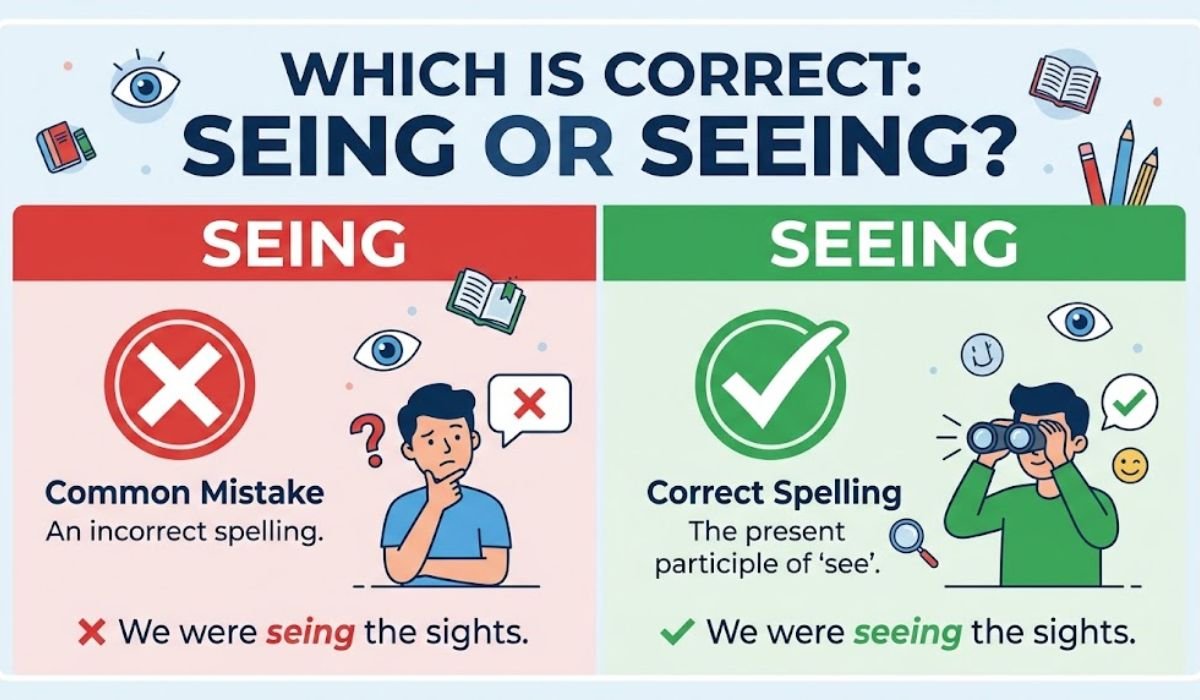
Seeing is the correct spelling. Seing is not a standard English word. Seeing is the present participle and gerund of the verb “see.” It means perceiving with the eyes, understanding, meeting someone, or dating someone, depending on context.
If you are writing in English and want the “-ing” form of “see,” always write seeing. Spell-check will flag “seing” almost every time, and editors will correct it.
What Does Seeing Mean?
Seeing has several related meanings, all connected to the verb “see.”
- Perceiving with your eyes: “I’m seeing a bright light in the sky.”
- Understanding: “I’m seeing your point now.”
- Meeting or visiting someone: “She is seeing her doctor on Friday.”
- Dating someone: “He’s been seeing someone from work.”
- Making sure of something: “Please keep seeing to it that the doors are locked.”
- The ability to see: “Seeing is harder at night.”
As a noun, seeing can also mean the act of sight. In astronomy, “seeing” describes how steady the atmosphere is for observing stars.
Is Seing Ever Correct, and Why Do People Write It?
In English, seing is simply a misspelling. It does not appear as a standard English word in major dictionaries. It does exist in French, where “seing” means a signature, as in the legal phrase “sous seing privé.” That is a French term, not an English one.
So why does the mistake happen? Many English verbs that end in a silent e lose it before “ing.” Think of “make” becoming “making” or “write” becoming “writing.” Writers apply that rule to “see” and end up with “seing.” The trouble is that “see” doesn’t end in a silent e. Its final “ee” is a vowel pair that represents one long vowel sound, so both letters stay.
This is a very common slip, and it makes sense why it happens. The rule just has a few exceptions.
How Do You Spell Seeing Correctly?
Keep both e’s when you add “ing” to a verb that ends in “ee.” Only a single silent e at the end of a word gets dropped.
Here is the pattern:
| Base verb | Ending | Add “ing” | Result |
| make | single silent e | drop the e | making |
| write | single silent e | drop the e | writing |
| see | double e | keep both | seeing |
| agree | double e | keep both | agreeing |
| flee | double e | keep both | fleeing |
| free | double e | keep both | freeing |
A few other verbs also keep their final e before “ing,” such as “be” (being), “dye” (dyeing), and “singe” (singeing). They avoid confusion with other words, like “dying” and “singing.”
A simple memory trick: see has two e’s, so seeing has three. If your spelling has fewer than three e’s, check it again.
How Does Seeing Work in Grammar?
Seeing is a form of the irregular verb “see.” Here are all five of its forms:
- Base form: see
- Third person singular: sees
- Past tense: saw
- Past participle: seen
- Present participle and gerund: seeing
You use seeing in several ways.
As a present participle in continuous tenses:
“I am seeing the results now.” (present continuous)
“They were seeing each other for months.” (past continuous)
As a gerund, which works like a noun:
“Seeing is believing.”
As a participial phrase:
“Seeing the storm clouds, we headed home.”
As a conjunction in the phrase “seeing that” or “seeing as”:
“Seeing that it’s late, let’s finish tomorrow.”
One more point: “see” is usually a stative verb when it means perceive, so we often say “I see a bird” rather than “I am seeing a bird.” The continuous form is common when “see” means meet, date, or understand over time, as in “I’m seeing my dentist tomorrow.”
Seeing is spelled the same in American and British English, so there is no regional difference here.
Read Related Post: How Long Until 3:15? Instant Time Calculator & Countdown Guide
How Do You Pronounce Seeing?
Seeing has two syllables and is pronounced SEE-ing (/ˈsiːɪŋ/). The first syllable rhymes with “tea” and the second sounds like “ing” in “sing.”
Say it slowly: “see” then “ing.” Both sounds are clear, which is a handy reminder that the word needs both e’s.
Where Does the Word See Come From?
The verb “see” comes from Old English “sēon,” which is related to similar words in other Germanic languages, such as German “sehen” and Dutch “zien.” The word has been part of English for well over a thousand years.
The “-ing” ending is a standard English suffix used to form participles and gerunds. Spelling conventions shifted over the centuries, but modern English settled on “seeing” as the standard form.
Seing Vs Seeing at a Glance
| Term | Correct in English? | Meaning | Use |
| Seeing | Yes | The “ing” form of “see” | Use in all English writing |
| Seing | No | Not a standard English word (French for “signature”) | Avoid in English |
How Do You Use Seeing in Sentences?
Here are natural examples from different settings.
Everyday conversation:
“I’m seeing my cousin this weekend.”
“Are you seeing what I’m seeing?”
Workplace communication:
“We’re seeing strong interest in the new product.”
“I’m seeing a few errors in the spreadsheet.”
Email:
“Thanks for seeing me on short notice.”
“I look forward to seeing you at the meeting.”
Academic writing:
“Seeing the data in context changes the interpretation.”
“The researchers are seeing consistent patterns across all samples.”
Casual writing:
“Seeing him again after ten years was surreal.”
“Long time no seeing!” (Playful. The standard version is “long time no see.”)
In “Thanks for seeing me on short notice,” seeing works as a participle after the preposition “for,” so it takes the “ing” form.
What Are the Most Common Mistakes With Seeing?

These mistakes are normal, and they happen to native speakers too.
Mistake 1: Dropping an e
Incorrect: I’m seing you tomorrow.
Correct: I’m seeing you tomorrow.
The base verb “see” ends in a double e, so both letters stay.
Mistake 2: Using “seen” instead of “seeing”
Incorrect: I’m seen a lot of progress.
Correct: I’m seeing a lot of progress.
“Seen” is the past participle and needs a helper like “have.” Use seeing with “am,” “is,” or “are.”
Mistake 3: Confusing “seeing” with “sighting” or “scene”
Incorrect: The seeing of the movie was great.
Correct: Seeing the movie was great.
Gerunds work best directly at the start of a sentence.
Mistake 4: Using “saw” with a helper verb
Incorrect: I was saw that coming.
Correct: I saw that coming. (or “I was seeing it coming.”)
“Saw” is a simple past form and doesn’t pair with “was.”
Mistake 5: Writing “seeing” when you mean “see” after “to”
Incorrect: I want to seeing you.
Correct: I want to see you.
After “to,” use the base form.
What Related Forms and Phrases Should You Know?
Several forms and phrases built from “see” and “seeing” come up often.
- Sees: “She sees the problem clearly.”
- Saw: “We saw it yesterday.”
- Seen: “Have you seen this?”
- Seer: a person who sees the future
- Sight: the ability to see (noun)
- Seeing that / seeing as: because or since
- Seeing is believing: you trust what you witness yourself
- Seeing eye dog: a dog trained to guide people who are blind (the preferred general term is “guide dog”)
- Seeing double: perceiving two images of one object
- Seeing red: being extremely angry
- Seeing someone: dating
- Seeing things: imagining something that isn’t there
- See you later: a common goodbye
Related words for similar ideas include “viewing,” “noticing,” “observing,” “spotting,” and “watching.”
FAQ’s
Is seing correct?
No. Seing is not correct in English. The correct spelling is seeing, with two e’s.
What does seeing mean?
Seeing is the “ing” form of “see.” It can mean looking at something, understanding, meeting someone, or dating someone.
How do I use seeing in a sentence?
Use it with a helper verb or as a gerund. For example: “I’m seeing my doctor on Tuesday,” or “Seeing the results made her smile.”
Why isn’t the second e dropped in seeing?
Only a single silent e is dropped before “ing.” Because “see” ends in a double e, both letters stay.
What is the difference between seeing and seen?
Seeing is the present participle and needs “am,” “is,” “are,” “was,” or “were.” Seen is the past participle and needs “have,” “has,” or “had.”
Conclusion
Always write seeing. The word “see” already has two e’s, and they both stay when you add “ing.” If you remember that seeing has three e’s in total, you will rarely misspell it again.

Smith Jason is an SEO expert with 2–3 years of experience, sharing grammar tips, confusing words, vocabulary and writing advice.










1 thought on “Seing Vs Seeing: What’s The Correct Spelling To Use?”