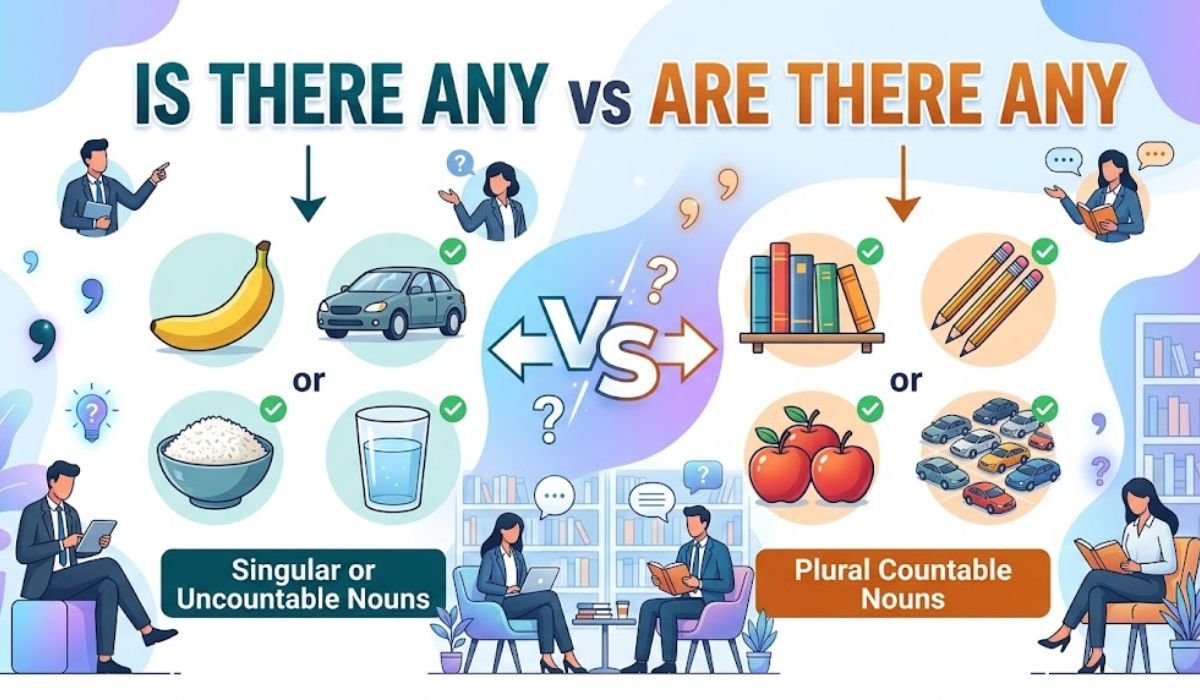
You are typing a question and freeze: is it “is there any” or “are there any”? The confusion makes sense, because both phrases ask the same thing and both contain “any.” The difference is the noun that follows. Use “is there any” with uncountable or singular nouns, and “are there any” with plural nouns. Once you see the pattern, the choice takes about two seconds.
Is It “Is There Any” or “Are There Any”? The Short Answer
Use “is there any” before an uncountable noun or a singular countable noun. Use “are there any” before a plural countable noun.
- Is there any milk left? (uncountable)
- Is there any reason to wait? (singular countable)
- Are there any cookies left? (plural countable)
Both phrases are correct. Neither one is a mistake in itself. The only error is matching the verb to the wrong kind of noun.
What Do “Is There Any” and “Are There Any” Mean?
Both phrases ask whether something exists or is available. They are existence questions, and the answer is usually yes, no, or a quantity.
“Is there any” asks about something you treat as one thing or as a mass: water, time, hope, a problem, an update. “Are there any” asks about several separate things you can count: seats, errors, messages, options.
The word “any” does the same job in both. It means “even one” or “even a little,” which is why it shows up so often in questions and negatives.
Is There Any vs Are There Any: Side-by-Side Comparison

| Phrase | Noun type that follows | Example | Typical use |
| Is there any | Uncountable or singular | Is there any parking nearby? | Asking about a mass, amount, or single item |
| Are there any | Plural countable | Are there any parking spaces nearby? | Asking about several countable items |
| Is there any (with plural noun) | Plural | Is there any questions? | Nonstandard in writing, heard in casual speech |
| Are there any (with uncountable noun) | Uncountable | Are there any milk? | Incorrect |
The last row matters most. “Are there any” never works with an uncountable noun. You cannot count milk, so the plural verb has nothing to agree with.
Why Does the Verb Come Before “There” in These Questions?
In a statement, the order is “There is a problem.” In a question, English flips the verb forward: “Is there a problem?” This flip is called subject-verb inversion.
Here, “there” is a placeholder (grammarians call it an existential “there”). It fills the subject slot but carries no meaning of its own. The real subject comes after the verb, and the verb agrees with that real subject.
So in “Are there any problems?”, the real subject is “problems,” which is plural, so the verb is “are.” In “Is there any trouble?”, the real subject is “trouble,” which is uncountable and takes a singular verb.
A quick trick: ignore “there” and “any,” find the noun, and ask whether it is one thing or many.
Read Related Post: Seing Vs Seeing: What’s The Correct Spelling To Use?
How Do Countable and Uncountable Nouns Change the Choice?
Countable nouns can take a number: one chair, three chairs. Uncountable nouns cannot: advice, information, furniture, traffic, rice, patience.
Uncountable nouns always take a singular verb, so they pair with “is there any.”
- Is there any advice you would give a new manager?
- Is there any rice left in the pantry?
- Is there any traffic on the bridge?
Plural countable nouns take “are there any.”
- Are there any open tables?
- Are there any updates on the schedule?
- Are there any students who need extra time?
Some nouns can be both, depending on meaning. “Is there any chicken?” asks about meat as a mass. “Are there any chickens?” asks about birds you can count. The noun decides the verb, not the other way around.
Can You Use “Is There Any” With a Plural Noun?
In careful writing, no. “Is there any questions?” is nonstandard, and editors will change it to “Are there any questions?”
In fast, casual speech, though, people do say things like “Is there any other options?” This happens because the speaker starts the question before choosing the noun, and “is there” feels like a ready-made chunk. It is common enough to hear, but it is not what you should use in an email, essay, or report.
One more case is worth knowing. When “any” is followed by “of the” and a plural noun, you can often go either way: “Are there any of the files left?” sounds natural, and “Is there any of the cake left?” works because “cake” is a mass. Match the verb to the noun that follows “of the” when you can.
Where Does “Any” Come From?
“Any” comes from Old English ǣnig, which is built from ān, meaning “one.” That origin explains its sense of “even one.” The word “there” in existential sentences also has Old English roots and has been used as a placeholder subject for centuries. Nothing in the history changes how you use the phrases today, but it helps explain why “any” often carries the flavor of “at least one.”
How Do You Pronounce “Is There Any” and “Are There Any”?
In natural American speech, the words run together.
- Is there any: roughly “iz-THAIR-en-ee,” with stress on “there” and the first syllable of “any.”
- Are there any: roughly “er-THAIR-en-ee,” where “are” is often reduced and the stress lands on “there” and “an.”
Because “is” and “are” are so soft in fast speech, listeners rely on the noun that follows to confirm which verb you meant. That is one reason mistakes slip into speech more easily than into writing.
How Do You Use “Is There Any” and “Are There Any” in Real Sentences?
Everyday conversation
- Is there any coffee, or should I make a fresh pot?
- Are there any good tacos near here?
Workplace and email
- Is there any feedback on the draft before it goes to the client?
- Are there any blockers I should know about before Friday’s launch?
Academic writing
- Is there any evidence that the effect holds across age groups?
- Are there any limitations in the sample that readers should consider?
Customer service
- Is there any chance I could change my reservation?
- Are there any seats left on the afternoon flight?
Notice “Is there any chance” in the customer service example. “Chance” is singular, so “is” is correct, even though the sentence is about possibilities. The same goes for “Is there any way,” “Is there any reason,” and “Is there any difference.”
What Mistakes Do People Make With These Phrases?
These slips are normal, even for native speakers. Here are the most common ones.
Mistake 1: Plural noun with a singular verb
- Incorrect: Is there any seats available?
- Correct: Are there any seats available?
The noun “seats” is plural, so the verb must be “are.”
Mistake 2: Uncountable noun with a plural verb
- Incorrect: Are there any information about the deadline?
- Correct: Is there any information about the deadline?
“Information” is uncountable and always singular in standard English.
Mistake 3: Being pulled by the nearest word
- Incorrect: Is there any of my emails in your inbox?
- Correct: Are there any of my emails in your inbox?
The noun “emails” is plural, even though the phrase “any of my” sounds singular.
Mistake 4: Adding a plural “s” to an uncountable noun
- Incorrect: Are there any advices you can give me?
- Correct: Is there any advice you can give me?
“Advice” has no plural form in standard English.
What About “There Isn’t Any,” “Is There Some,” and Other Related Forms?
The same logic applies to negatives. Use “there isn’t any” with uncountable and singular nouns, and “there aren’t any” with plural nouns.
- There isn’t any time left.
- There aren’t any tickets left.
“There is no” and “there are no” mean the same thing and sound a bit more formal: “There is no time left.”
In everyday English, “any” appears in questions and negatives, while “some” appears in positive statements: “There is some milk in the fridge.” Offers and requests can use “some” in questions when you expect a yes: “Is there some way I can help?” In that case “some” suggests you expect or hope for a positive answer.
Related forms you may also see:
- Is there anyone / anything / anywhere: these are single words, so they always take “is”: “Is there anyone home?”
- Is there any other: “Is there any other option?” (singular) versus “Are there any other options?” (plural)
- Contractions: “Is there” rarely contracts in questions, but in statements you will see “there’s any” in casual speech, which is also nonstandard with plural nouns.
British and American English follow the same rule here. The main difference is a preference for “Have you got any…?” in British speech, which does not change the agreement pattern.
FAQ’s
Is “is there any” grammatically correct?
Yes. “Is there any” is correct with uncountable nouns and singular countable nouns, such as “Is there any water?” or “Is there any reason?”
Is “are there any” grammatically correct?
Yes. “Are there any” is correct with plural countable nouns, such as “Are there any questions?”
How do I choose between them quickly?
Find the noun after “any.” If you can count it and there could be several, use “are.” If it is a mass or a single thing, use “is.”
Can I say “is there any questions”?
It appears in casual speech, but standard English calls for “Are there any questions?” because “questions” is plural.
Do I use “is there any” with the word “other”?
It depends on the noun after “other.” Say “Is there any other way?” for singular and “Are there any other ways?” for plural.
Conclusion
Both phrases are correct, and the noun decides which one you need. Singular or uncountable nouns take “is there any,” and plural nouns take “are there any.” If you ever hesitate, look past “there” and “any,” find the noun, and ask whether it is one thing or many.

Smith Jason is an SEO expert with 2–3 years of experience, sharing grammar tips, confusing words, vocabulary and writing advice.










1 thought on “Is There Any vs Are There Any: Use Correctly (Updated 2026)”