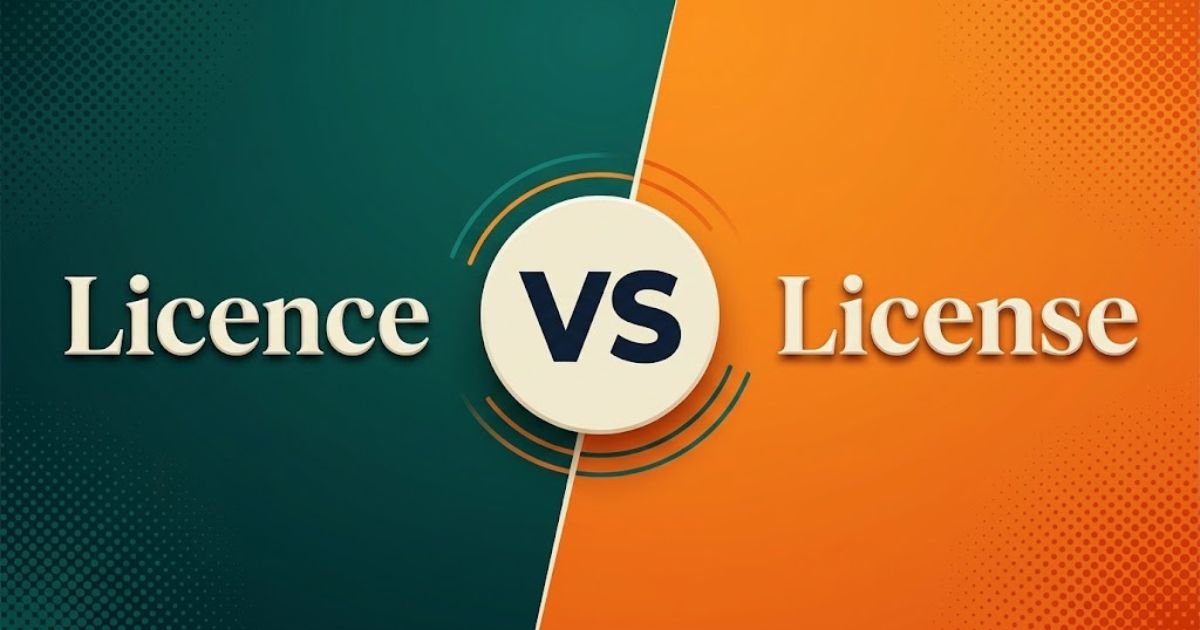
If you have ever paused halfway through typing “driver’s licence” and wondered whether that “c” belongs there, you are not alone. Both “licence” and “license” are correct, but they belong to different varieties of English and, in British English, to different parts of speech. American English uses “license” for everything. British English uses “licence” as a noun and “license” as a verb.
The Quick Answer: Which Spelling Should You Use?
In American English, always use “license.” It works as both the noun (a driver’s license) and the verb (to license a business), with no exceptions.
In British English, the spelling depends on the word’s job in the sentence. Use “licence” for the noun (a fishing licence) and “license” for the verb (the council will license the vendor).
If you write for a US audience, this section is really all you need. If you write for a UK, Canadian, Australian, or international audience, keep reading, because the noun and verb distinction matters.
Licence vs License: The Core Difference
The difference comes down to region and grammatical function, not correctness. Neither spelling is a typo or an error when used in its proper context.
License (with an “s”) is the standard American spelling for both the noun and the verb. It is also the only spelling used in Canadian and Australian legal and business contexts for the verb form.
Licence (with a “c”) is the British English noun. It refers to an official document, permit, or permission, such as a business licence or a licence to practice medicine.
This pattern is not unique to this word pair. British English often uses “c” for nouns and “s” for verbs in similar word families, including “practice” versus “practise” and “advice” versus “advise.”
Comparison Table: Licence vs License
| Term | Region | Part of Speech | Meaning | Example |
| License | American English | Noun and verb | Official permit; to grant permission | “She renewed her driver’s license.” / “The state will license the clinic.” |
| Licence | British English | Noun only | Official permit or document | “He applied for a fishing licence.” |
| License | British English | Verb only | To grant official permission | “The council will license the new pub.” |
What Does “License” Actually Mean?
As a noun, a license (or licence) is official permission, granted by an authority, to own, use, or do something that would otherwise be restricted. A driver’s license, a business license, and a software license are all documents or agreements that grant this kind of permission.
As a verb, “to license” means to give someone formal permission to do something, usually through a legal or official process. A city might license a restaurant to serve alcohol, or a company might license its software to other businesses.
Grammar Breakdown: Noun vs Verb Forms
Understanding the part of speech is the fastest way to pick the right spelling in British English.
American English grammar:
- Noun: “I lost my license.” (single spelling for everything)
- Verb: “They license contractors in this state.”
- Verb forms: license, licenses, licensed, licensing
British English grammar:
- Noun: “I lost my licence.” (uses “c”)
- Verb: “They license contractors in this country.” (uses “s”)
- Verb forms follow the same pattern: license, licenses, licensed, licensing
A simple trick many British writers use: if you can replace the word with “practice” or “practise,” check which spelling fits. If “practice” (the noun) sounds right, use “licence.” If “practise” (the verb) sounds right, use “license.”
Read Related Post: Reenforce vs Reinforce: Which Spelling Is Correct?
Where Does “License” Come From?
The word traces back to the Latin verb licere, meaning “to be allowed” or “to be permitted.” It passed into Old French as “licence,” which English borrowed in the 1300s with that same “c” spelling for both noun and verb uses.
The verb spelling later shifted to “license” in English, following a broader pattern where English distinguished related nouns and verbs by swapping “c” for “s.” American English eventually dropped the distinction entirely, standardizing on “license” for both roles, likely influenced by Noah Webster’s push toward simplified, consistent American spellings in the early 1800s.
How Do You Pronounce “License” or “Licence”?
Both spellings are pronounced the same way: LY-suhns (rhymes with “silence”). The spelling difference is purely visual and grammatical. It does not change how the word sounds in speech, so pronunciation will never help you choose between them.
Correct Usage: Real Examples in Context
American English (always “license”):
- Everyday: “Can I see your license, please?”
- Workplace: “HR confirmed that our software license covers ten users.”
- Academic: “The study examined how license suspension affects repeat offenders.”
- Email: “Attached is a copy of our business license for your records.”
British English (noun “licence,” verb “license”):
- Everyday: “I need to renew my TV licence before Friday.”
- Workplace: “The company plans to license its technology to overseas partners.”
- Formal writing: “Under the new licence, the venue may serve alcohol until midnight.”
- Business: “Regulators will license only three new operators this year.”
Notice that in the British examples, “licence” appears whenever a document or permission is being named, while “license” appears whenever someone is performing the action of granting permission.
Common Mistakes with Licence and License
Incorrect: “She holds a valid drivers license.” (missing apostrophe, separate issue, but also check regional spelling) Correct (US): “She holds a valid driver’s license.” Correct (UK): “She holds a valid driver’s licence.”
Incorrect: “The government will licence the new pharmacy.” (British writer using the noun spelling as a verb) Correct: “The government will license the new pharmacy.” This mistake happens because “licence” looks more familiar to British writers, but the verb always takes an “s” in British English.
Incorrect: “He needs a license to practice medicine.” (mixing US noun spelling into a British sentence) Correct (UK): “He needs a licence to practise medicine.” This error usually happens when writers unconsciously mix American and British spelling conventions in the same sentence.
Incorrect: “Our software licence expires next month.” (British noun spelling used by an American writer) Correct (US): “Our software license expires next month.” American English never uses “licence,” so this version is simply the wrong regional spelling for a US audience.
Related Words and Similar Spelling Patterns
The same noun-versus-verb spelling pattern shows up in several other British English word pairs:
- Practice / practise: a medical practice (noun) versus to practise law (verb)
- Advice / advise: good advice (noun) versus to advise a client (verb)
- Device / devise: a clever device (noun) versus to devise a plan (verb)
- Licensee: a person or business that holds a license or licence
- Licensor: the party that grants the license or licence
- Unlicensed: lacking proper permission or documentation
Learning one of these pairs makes the others easier to remember, since they all follow the same underlying logic.
Practical Guidance: How to Choose the Right Spelling
Follow this simple process when you are unsure:
- Identify your audience. Writing for American readers, a US company, or US legal documents means “license” every time.
- Identify the part of speech. If your audience is British, Australian, or otherwise follows UK conventions, ask whether the word is a noun (thing) or a verb (action).
- Use the noun test. If you could say “the licence,” “a licence,” or “my licence,” use “licence” (UK only).
- Use the verb test. If you could say “to license,” “will license,” or “licensed,” use “license” in any variety of English.
- Check your style guide. Many publications and companies specify a preferred variety of English regardless of the writer’s personal habits.
Frequently Asked Questions
Is “licence” or “license” correct?
Both are correct, depending on region and grammar. American English uses “license” for everything. British English uses “licence” for the noun and “license” for the verb.
Is “licence” British or American spelling?
“Licence” is British English, used only as a noun. American English does not use “licence” at all; it uses “license” for both the noun and the verb.
What is the plural of “license” or “licence”?
The plural follows regular spelling rules: “licenses” in American English and “licences” in British English, since both simply add an “s” to the singular noun.
How do you spell “driver’s license” in the UK?
In British English, it is spelled “driving licence,” using the noun spelling with a “c,” since it refers to the official document rather than the act of licensing.
Can “license” ever be a noun in British English?
No. In standard British English, “license” is reserved for the verb form. Using it as a noun is considered a spelling error under British conventions, even though it is standard in American English.
The Bottom Line
If you write American English, use “license” for every meaning and never worry about it again. If you write British English, remember one simple rule: “licence” is the thing you hold, “license” is the action you take. Keep that noun-and-verb distinction in mind, and you will never mix them up again.

Smith Jason is an SEO expert with 2–3 years of experience, sharing grammar tips, confusing words, vocabulary and writing advice.