If you have ever paused mid sentence wondering whether to type “customize” or “customise,” you are not alone. Both spellings look correct, both sound identical, and both show up in professional writing. The confusion comes down to one simple factor: which English you are writing in. Here is the short answer, then the full explanation.
Quick Answer: Customize or Customise, Which One Should You Use?
Both “customize” and “customise” are correct. “Customize” is the standard spelling in American English, while “customise” is the standard spelling in British English, Australian English, and most other Commonwealth varieties of English. Neither spelling is a typo or a grammar mistake. The choice depends entirely on the audience and regional style you are writing for.
What Does Customize (or Customise) Actually Mean?
Both spellings share the exact same meaning. “Customize” is a verb that means to modify or design something according to specific requirements, preferences, or individual needs.
For example, you can customize a phone’s settings, a car’s interior, or a software dashboard. The word describes the act of tailoring a general product or system into something more personal or specific.
There is no difference in meaning between “customize” and “customise.” The spelling changes, but the definition stays identical across both American and British English.
Customize vs Customise: What Is the Real Difference?
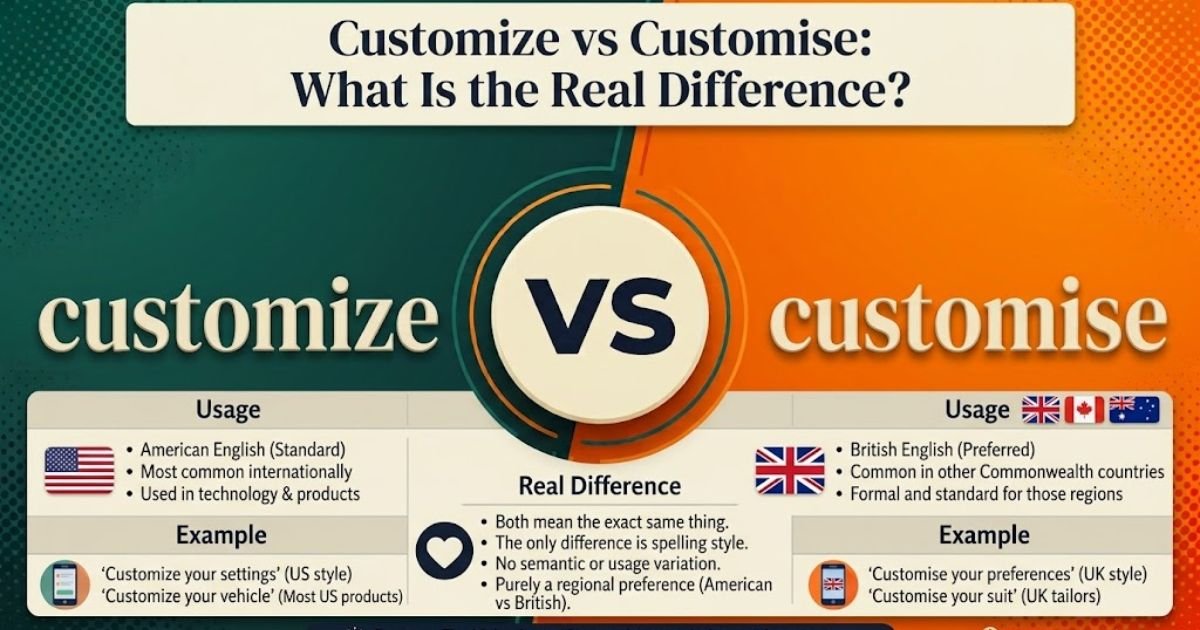
The only difference between these two words is regional spelling convention, not meaning, grammar, or usage rules. This pattern is part of a much larger spelling split that affects many English verbs.
Words that end in -ize in American English often end in -ise in British English. This includes pairs like organize/organise, realize/realise, and recognize/recognise.
Customize follows the American -ize pattern. Customise follows the British -ise pattern.
Neither version is more “correct” in a global sense. Each is correct within its own regional standard.
Comparison Table: Customize vs Customise
| Term | Correct? | Region | Meaning |
| Customize | Yes | American English (US, and often Canada) | To modify something to fit specific needs |
| Customise | Yes | British English (UK, Australia, New Zealand, South Africa, India) | To modify something to fit specific needs |
Read Related Post: Todays or Today’s: Which One Is Correct? (Full Grammar Guide)
Where Does the Word Customize Come From?
The word traces back to the noun “custom,” which entered English through Old French and ultimately from the Latin word “consuetudo,” meaning habit or usual practice.
The verb form “customize” developed in American English in the early 20th century, originally used in manufacturing and automotive contexts to describe modifying a standard product for an individual buyer. Over time, its use expanded into technology, retail, and everyday language.
The -ize versus -ise spelling split itself dates back much further, rooted in differing choices made by British dictionary editors and printers over the 18th and 19th centuries, with American English later standardizing around Noah Webster’s spelling reforms.
How Do You Pronounce Customize or Customise?
Both spellings are pronounced the same way: KUHS-tuh-myz. The pronunciation does not change based on spelling, since the “s” and “z” sounds in this word are both realized as a “z” sound in speech, regardless of which letter appears on the page.
Grammar Breakdown: Part of Speech and Word Forms
“Customize” and “customise” are both verbs, and they follow regular verb conjugation patterns within their own spelling systems.
Base form: customize / customise Third person singular: customizes / customises Past tense: customized / customised Present participle: customizing / customising Noun form: customization / customisation Adjective form: customizable / customisable
Every one of these forms follows the same American versus British spelling rule. If you use “customize,” stay consistent and use “customized,” “customizing,” and “customization” throughout the same piece of writing. Mixing spelling systems within one document looks inconsistent, even though each individual word is technically valid somewhere.
When Should You Use Customize?
Use customize when:
- You are writing for a US audience, publication, or company.
- Your style guide follows American English (AP Style, Chicago Manual of Style).
- You are writing software, app, or tech documentation for a primarily American user base.
- You are unsure of your audience and want the more globally common spelling, since American English has broader reach online.
When Should You Use Customise?
Use customise when:
- You are writing for a UK, Australian, New Zealand, Indian, or South African audience.
- Your organization follows British English conventions (Oxford style or similar).
- You are localizing content specifically for a Commonwealth market.
- Your existing document, brand voice, or client already uses British spelling.
Real Life Examples in Context
Everyday conversation (American English): “I want to customize my running shoes with a different color scheme.”
Everyday conversation (British English): “I’d like to customise my trainers with a different colour scheme.”
Workplace email (American English): “Please customize the report template before sending it to the client.”
Business writing (British English): “Please customise the report template before sending it to the client.”
Academic writing (American English): “Researchers customized the survey questions to match each participant group’s background.”
Formal writing (British English): “Researchers customised the questionnaire to reflect each participant group’s background.”
Each pair of sentences means exactly the same thing. The only change is the spelling convention, which shifts based on the region the writing is intended for.
Common Mistakes to Avoid
Incorrect: “I customised my American English resume for the London office, then switched to customize halfway through.” Correct: “I customised my resume for the London office and kept British spelling throughout.”
The mistake here is switching spelling systems mid document. Pick one convention and stay consistent from start to finish.
Incorrect: “Customise is a misspelling of customize.” Correct: “Customise is the standard British English spelling, not a misspelling.”
This is a common misunderstanding, especially among writers who only use American spellcheck tools, which often flag “customise” as an error even though it is completely standard elsewhere.
Incorrect: “You should always use customize because it’s more correct.” Correct: “You should use whichever spelling matches your target audience’s regional English.”
There is no universally superior spelling. Correctness depends entirely on context.
Related Words and Spelling Variations
The same American versus British spelling pattern applies to many related words:
- Organize / Organise
- Recognize / Recognise
- Realize / Realise
- Standardize / Standardise
- Customization / Customisation
- Customizable / Customisable
Learning this one rule for “customize” versus “customise” helps you correctly spell dozens of other similar verbs across both English varieties.
Practical Guidance for Writers and Businesses
If you write for a global audience, the most practical approach is to identify your primary readership first, then apply that spelling consistently across your entire website, app, or document set.
Many international companies choose American spelling as a default because it has wider search visibility, then create separate localized versions for UK and Australian audiences using British spelling. If you use a spellchecker, set the language preference to match your intended audience so it does not flag the correct regional spelling as an error.
FAQ’s
Is “customise” a real word?
Yes. “Customise” is a fully legitimate word and the standard spelling in British English, Australian English, and other Commonwealth varieties of English.
Is “customize” only used in America?
Mostly. “Customize” is the standard American English spelling, and it is also commonly accepted in Canadian English, though Canada sometimes mixes American and British conventions.
Which spelling should I use for a website?
Choose based on your primary audience. Use “customize” for a US focused site and “customise” for a UK, Australian, or other Commonwealth focused site.
Does Microsoft Word or Google Docs prefer one spelling?
The spellchecker flags whichever spelling does not match your selected language setting. If your document is set to English (US), it will flag “customise.” If set to English (UK), it will flag “customize.”
Can I use both spellings in the same document?
You should not. Pick one spelling convention based on your target audience and use it consistently for every related word form throughout the document.
Conclusion
Both “customize” and “customise” are correct, and the only real difference is regional spelling: American English uses “customize,” while British and Commonwealth English use “customise.”
Pick the version that matches your audience, stay consistent throughout your writing, and you will never get this one wrong again.

Smith Jason is an SEO expert with 2–3 years of experience, sharing grammar tips, confusing words, vocabulary and writing advice.










1 thought on “Customize or Customise: Which Spelling Is Correct? Usage, Meaning & Grammar Guide”