If you have ever paused mid sentence wondering whether something is written “bellow” or “below,” you are not alone. These two words look almost identical, differ by a single letter, and sound nothing alike once you know how to say them. That small spelling gap causes a surprising number of typos, even among confident writers.
The correct word for indicating a lower position (such as “see the details below”) is “below.” “Bellow” is a completely different word that means to shout loudly or make a deep roaring sound. They are not variations of the same term. They are two unrelated words that happen to share most of their letters.
What Does “Below” Mean?
Below is a preposition and adverb that means in a lower place, position, or level than something else. It describes physical position, rank, or measurement.
Examples:
- The mailbox is below the window.
- Her score was below average.
- Please see the attached image below.
“Below” is one of the most common words in English writing, especially in emails, instructions, reports, and everyday conversation.
What Does “Bellow” Mean?
Bellow is a verb (and sometimes a noun) that means to shout in a loud, deep voice, often out of anger, pain, or urgency. It can also describe the deep sound an animal, such as a bull, makes.
Examples:
- The coach began to bellow instructions from the sideline.
- He let out an angry bellow when he stubbed his toe.
- The bull’s bellow echoed across the field.
Unlike “below,” which describes position, “bellow” describes sound and volume.
Bellow vs Below: Key Differences
| Term | Correct? | Meaning | Common Use |
| Below | Yes | In a lower position or level | “The answer is listed below.” |
| Bellow | Yes (different word) | To shout loudly or make a deep sound | “He began to bellow across the room.” |
Both words are correct English, but they are not interchangeable. Confusing them usually happens because of their similar spelling, not because either word is wrong.
Read Related Post: Customize or Customise: Which Spelling Is Correct?
Why Do People Confuse These Two Words? Bellow or Below.
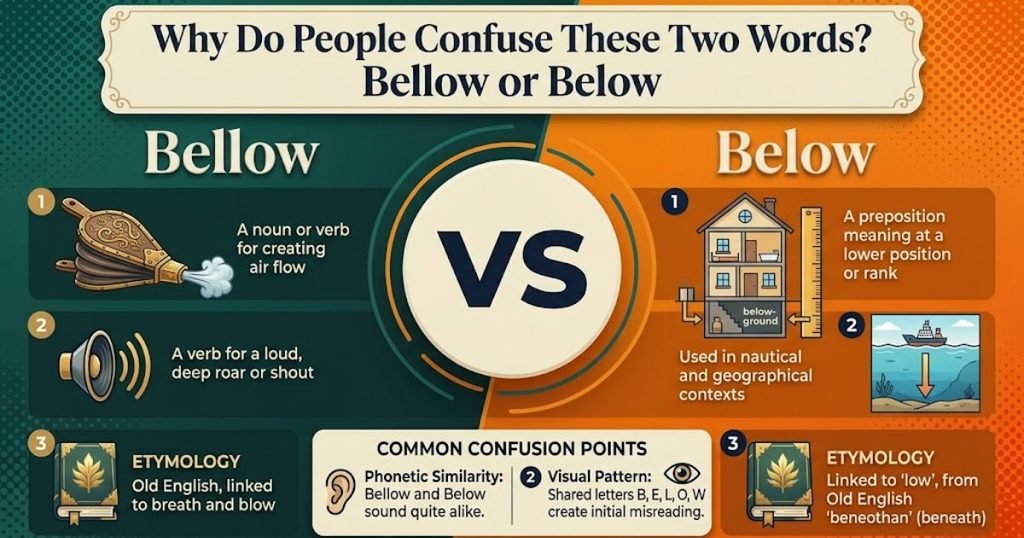
The confusion is almost entirely visual. “Below” and “bellow” contain the same letters except for one extra “l.” When people type quickly, autocorrect and muscle memory sometimes swap the words without the writer noticing.
There is no meaningful grammar overlap between them. Once you separate the meanings, the mix up becomes easy to avoid.
Grammar Breakdown
Below
- Part of speech: preposition or adverb
- Function: shows position, rank, or measurement
- Common phrases: “below average,” “below the surface,” “mentioned below”
Bellow
- Part of speech: verb or noun
- Verb forms: bellow, bellows, bellowed, bellowing
- Function: describes shouting or a loud deep sound
Because “below” does not change form for tense (it is not a verb), while “bellow” does, checking whether the sentence needs an action word or a position word is a quick way to choose correctly.
Where Do These Words Come From?
Below comes from Middle English, formed by combining “by” and “low,” meaning literally “by a low position.” This straightforward origin explains why it has always referred to physical or figurative lower placement.
Bellow traces back to Old English “bylgan,” related to bull noises and loud animal sounds. Over time, the meaning expanded to include any loud, deep human shout.
Their origins are unrelated, which reinforces that these are two separate words that only look alike by coincidence.
How to Pronounce Each Word
Pronunciation is actually the easiest way to tell these words apart, since they do not sound similar at all.
- Below: buh-LOH (rhymes with “glow” or “grow”)
- Bellow: BEL-oh (rhymes with “fellow” or “yellow”)
If you say both words out loud, the difference becomes obvious immediately. The written similarity is the only source of confusion.
Correct Usage in Real Sentences
Everyday conversation “Can you grab the box below the counter?”
Workplace communication “Please review the notes below before our meeting.”
Academic writing “The results shown below indicate a significant change in temperature.”
Business email “As mentioned below, the invoice is due by Friday.”
Describing sound “The crowd began to bellow with excitement when the team scored.”
Casual speech “My dad will bellow if we’re late again.”
Each sentence works because the word matches its intended meaning: position for “below,” sound for “bellow.”
Common Mistakes to Avoid
Incorrect: See the chart bellow for more details. Correct: See the chart below for more details. Explanation: The sentence is describing where the chart is located, not a sound, so “below” is needed.
Incorrect: He began to below at the referee. Correct: He began to bellow at the referee. Explanation: This sentence describes shouting, which requires the verb “bellow.”
Incorrect: The temperature dropped bellow freezing. Correct: The temperature dropped below freezing. Explanation: “Freezing” is a measurement point, and “below” is the word used for levels or amounts.
These mistakes are extremely common, especially in fast typing or autocorrect situations. They do not reflect a lack of skill, just a quick mix up between similar looking words.
Related Words Worth Knowing
- Beneath: similar to “below,” meaning under or in a lower position.
- Underneath: also related to physical position, often more casual than “below.”
- Roar: a near synonym for “bellow” when describing loud sound.
- Yell: a common synonym for “bellow” in everyday speech.
- Lower: related to “below” when comparing position or amount.
Recognizing these related terms can help reinforce which category each word belongs to: position or sound.
Quick Way to Remember the Difference
If the sentence is about location, choose below. If the sentence is about sound, choose bellow.
A simple trick: “Bellow” has an extra “l,” just like the word “loud.” That small memory hook can help you recall that “bellow” relates to noise, not position.
FAQ’s
Is “bellow” a real word?
Yes. “Bellow” is a real English word meaning to shout loudly or produce a deep roaring sound.
Is “below” ever used as a verb?
No. “Below” functions only as a preposition or adverb. It does not have verb forms.
Can “bellow” and “below” ever mean the same thing?
No. They are unrelated in meaning. One refers to position, and the other refers to sound.
Which word should I use in formal writing?
Use “below” for formal writing when referring to something mentioned later in a document, such as “the details below.” Use “bellow” only when describing loud shouting or sound, which is less common in formal writing.
What is the easiest way to avoid mixing them up?
Say the word out loud. If it should rhyme with “glow,” you need “below.” If it should rhyme with “yellow,” you need “bellow.”
Conclusion
“Below” and “bellow” are both correct English words, but they serve completely different purposes. “Below” refers to position or level, while “bellow” refers to a loud shout or deep sound.
The next time you are unsure which one to use, just remember: position goes below, and shouting makes you bellow.

Smith Jason is an SEO expert with 2–3 years of experience, sharing grammar tips, confusing words, vocabulary and writing advice.










1 thought on “Bellow or Below: Which One Is Correct?”