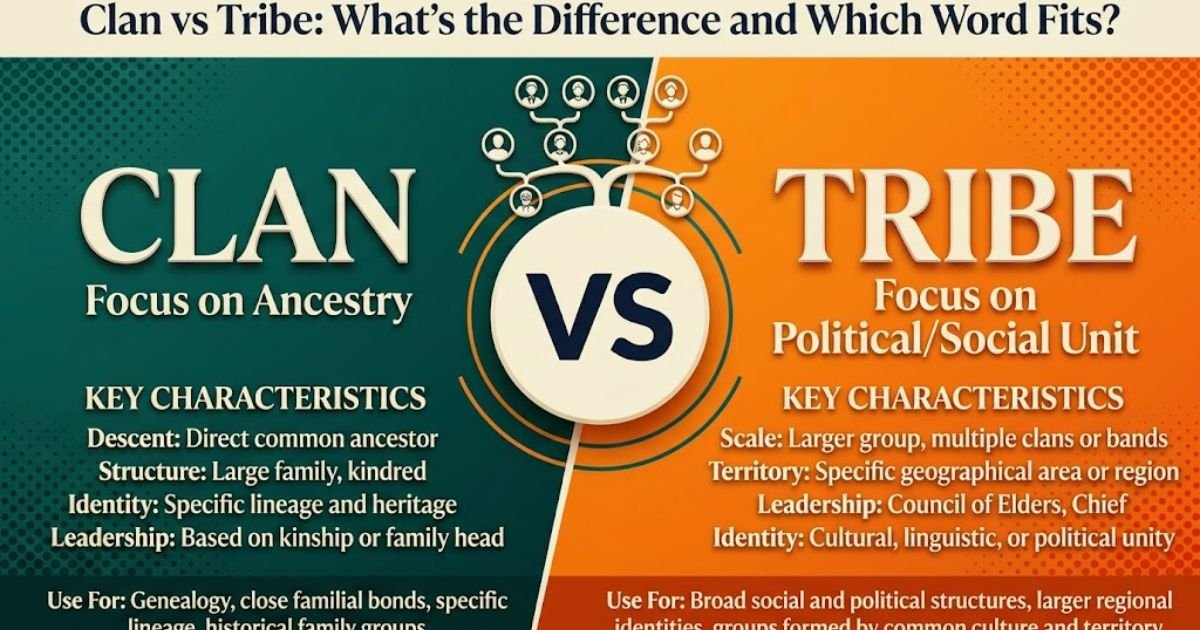
You’ve probably heard both words used to describe groups of people connected by family or culture, and it’s easy to assume they mean the same thing. They don’t quite. A clan is a group of people who claim descent from a common ancestor, often through family or kinship ties, while a tribe is a broader social and political group that can include multiple clans, united by shared language, culture, territory, or leadership. In short, a clan is usually smaller and family based, and a tribe is usually larger and community based.
Once you understand that core distinction, the rest of the differences fall into place naturally.
What Does “Clan” Mean?
A clan is a group of related families who share, or believe they share, a common ancestor. The word comes from a strong sense of kinship. Members of a clan often carry the same surname, crest, or family identity, even generations after the original ancestor lived.
Clans are common in Scottish and Irish history, where family groups like Clan MacDonald or Clan Campbell held territory and identity based on bloodline. But the concept isn’t limited to Europe. Many cultures around the world, including Native American nations, African societies, and East Asian communities, organize smaller family units into clans.
A clan typically functions as:
- A kinship group tied by blood or marriage
- A subunit within a larger tribe or nation
- A source of shared name, symbol, or tradition
What Does “Tribe” Mean?
A tribe is a larger social group, usually made up of several clans or families, united by shared culture, language, territory, or leadership. Where a clan is about direct ancestry, a tribe is about shared identity and community structure.
Tribes often have their own governance systems, traditions, and defined territory. A single tribe can include many clans, each with its own smaller family lineage, all operating under the tribe’s broader cultural and political identity.
In everyday English, “tribe” is also used more loosely and informally to describe any close-knit group of people, such as a friend group or an extended family gathering. That casual usage is common, but it isn’t the anthropological meaning of the word.
Clan vs Tribe: Key Differences at a Glance
| Term | Definition | Size | Basis of Unity |
| Clan | A group descended from a shared ancestor | Smaller | Blood or kinship ties |
| Tribe | A larger group made of multiple clans or families | Larger | Shared culture, language, or territory |
Think of it this way: a tribe is the larger structure, and clans are the smaller family units that often exist inside it.
Read Related Post: Labelling or Labeling: Which Spelling Is Correct?
Grammar and Usage of “Clan” and “Tribe”
Both clan and tribe are common nouns. They follow standard English pluralization rules:
- Clan → clans
- Tribe → tribes
Both words can also function as adjectives when combined with other nouns, such as “clan loyalty” or “tribal customs.” Notice that the adjective form of “tribe” is tribal, not “tribish” or “triby.” The adjective form of “clan” is simply clan, used directly before a noun (as in “clan chief” or “clan gathering”), though “clannish” also exists as an informal adjective describing a group that is tightly knit or exclusive.
Neither word has an irregular plural, and neither changes form based on tense, since they’re nouns rather than verbs. In American English, both are used the same way as in British English, though “clan” appears more often in historical or Scottish and Irish contexts, while “tribe” shows up more frequently in anthropological, Indigenous, and cultural discussions.
Where Do “Clan” and “Tribe” Come From?
The word clan comes from the Scottish Gaelic word clann, meaning “children” or “family.” This root explains why clans are so closely tied to bloodline and descent. The term entered English through Scottish Highland culture, where clans were both family units and political powers tied to specific land.
The word tribe comes from the Latin tribus, which originally referred to one of the three divisions of the early Roman people. Over time, “tribe” broadened in meaning to describe any group of people united by common ancestry, culture, or social structure, well beyond its Roman origins.
Both words evolved from describing very specific historical structures into more general terms used across many cultures and contexts today.
How to Pronounce “Clan” and “Tribe”
Pronunciation for both words is straightforward in American English:
- Clan: pronounced “klan” (rhymes with “plan”)
- Tribe: pronounced “trybe” (rhymes with “vibe”)
Neither word has silent letters or unusual stress patterns, which makes them easy to say correctly once you’ve heard them a single time.
When to Use “Clan” in a Sentence
Use “clan” when you’re talking about a family based group connected by shared ancestry, name, or tradition.
- Everyday conversation: “Every summer, our whole clan gets together for a family reunion.”
- Historical or cultural writing: “Clan MacGregor was once one of the most powerful clans in the Scottish Highlands.”
- Business or workplace (informal): “The founders built the company almost like a family clan, with loyalty passed down through generations of employees.”
In each example, the emphasis is on family connection, not broader political or cultural structure.
When to Use “Tribe” in a Sentence
Use “tribe” when referring to a larger group united by shared culture, language, governance, or territory, or when using the informal sense of a close social circle.
- Academic writing: “The Navajo Nation is one of the largest federally recognized tribes in the United States.”
- Formal writing: “Tribal leaders met to discuss new policies affecting reservation land.”
- Casual usage: “My tribe” is what she calls her closest group of friends who support her through everything.”
That last example shows the informal, modern use of “tribe,” which has become common in casual American English even outside its traditional anthropological meaning.
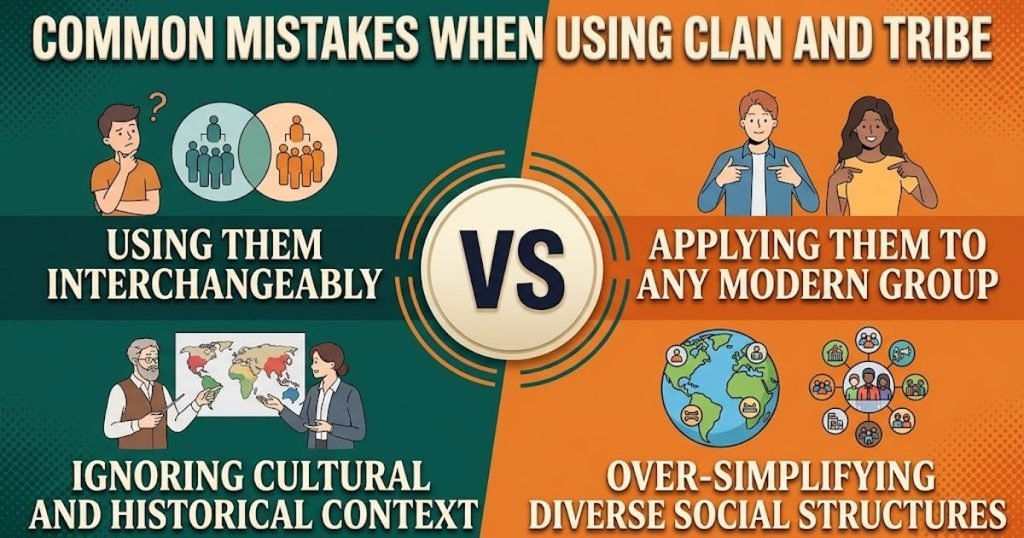
Common Mistakes When Using Clan and Tribe
Incorrect: The Cherokee clan has thousands of members across the country.
Correct: The Cherokee tribe has thousands of members across the country.
Here, “tribe” is correct because the Cherokee Nation is a large, organized group with shared governance and culture, not a single family lineage.
Incorrect: My tribe includes my parents, grandparents, and cousins who all share our family name.
Correct: My clan includes my parents, grandparents, and cousins who all share our family name.
This sentence describes a specific family lineage, which makes “clan” the better fit.
Incorrect: The Scottish tribe wore tartan patterns to represent their family.
Correct: The Scottish clan wore tartan patterns to represent their family.
Tartan patterns are historically tied to specific Scottish family clans, not to the broader concept of a tribe.
These mistakes are easy to make since both words describe group identity, but paying attention to whether you’re describing a family lineage or a broader cultural group will usually point you to the right one.
Related Words and Terms
A few related terms can help round out your understanding:
- Kinship: the state of being related by blood or marriage, the foundation of clan identity
- Lineage: a direct line of descent from an ancestor
- Nation: often used interchangeably with “tribe” in modern contexts, especially for Indigenous groups (such as the “Navajo Nation”)
- Tribal: the adjective form describing something related to a tribe
- Clannish: an informal adjective describing a group that is close-knit or exclusive, sometimes with a slightly negative connotation
Practical Tips for Choosing the Right Word
If you’re unsure which word to use, ask yourself two quick questions:
- Is this group defined mainly by shared ancestry or family lineage? If so, clan likely fits better.
- Is this group larger, with shared governance, culture, or territory, possibly made up of multiple family lines? If so, tribe is the better choice.
When discussing modern Indigenous nations in the United States, “tribe” is the standard and widely accepted term, often paired with the specific nation’s name, such as “the Cherokee tribe” or “the Navajo Nation.”
FAQ’s
Is “clan” the same as “tribe”?
No. A clan is a smaller group based on shared ancestry, while a tribe is a larger group that can include multiple clans, united by culture, language, or territory.
Can a tribe be made up of multiple clans?
Yes. Many tribes are structured around several clans, each representing a different family line within the larger tribal community.
Is it correct to call a group of friends a “tribe”?
Informally, yes. Many English speakers use “tribe” casually to describe a close group of friends, though this differs from the traditional anthropological meaning.
What is the adjective form of “tribe”?
The adjective form is tribal, as in “tribal traditions” or “tribal council.”
Does “clan” only apply to Scottish families?
No. While the word is closely associated with Scottish and Irish history, clan structures exist in many cultures worldwide, including Native American, African, and Asian societies.
Conclusion
The simplest way to remember the difference: a clan is about family lineage, while a tribe is about a larger shared community that often includes multiple clans. Once you’re clear on that distinction, choosing the right word in any sentence becomes much easier.

Smith Jason is an SEO expert with 2–3 years of experience, sharing grammar tips, confusing words, vocabulary and writing advice.










1 thought on “Clan vs Tribe: What’s the Difference and Which Word Fits?”