You typed a word that looks right, then a spell checker underlined it. Was it “emaculate” or “immaculate”? The confusion makes sense, because the first syllable sounds like “em” or “ih” in everyday speech. Immaculate is the correct spelling. It means perfectly clean, spotless, or free from flaws. Here is how to use it with confidence.
Which Is Correct, Emaculate or Immaculate?
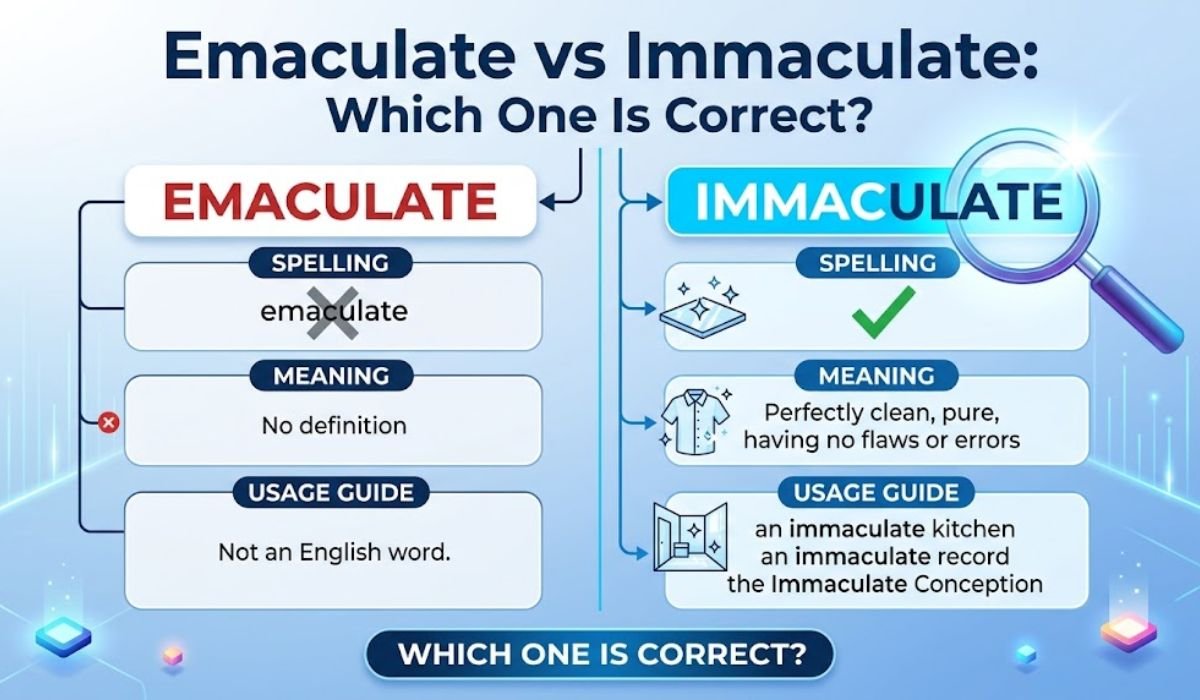
“Immaculate” is the correct spelling. “Emaculate” is a misspelling and should not be used in modern writing.
Immaculate is an adjective meaning perfectly clean, neat, or without any error or flaw. It starts with “im-,” not “em-” or “e-.”
Quick check: if you meant “spotless,” “flawless,” or “perfectly tidy,” the word you want is immaculate.
What Does Immaculate Mean?
Immaculate has two main meanings in everyday American English.
1. Perfectly clean and neat. This is the most common use. It describes homes, cars, clothing, kitchens, and anything kept in excellent condition.
2. Free from mistakes or flaws. It can describe performances, records, work, or behavior, such as an immaculate driving record or an immaculate performance.
A third, more specialized use appears in religious contexts, such as the Immaculate Conception. That use is covered in its own section below.
The core idea in every sense is the same: nothing is out of place, stained, or wrong.
Is Emaculate Ever Correct? Quick Comparison
Short answer: not in everyday English. Modern writers should treat “emaculate” as a typo or misspelling. If you use it in an email, essay, or résumé, readers will likely assume you meant immaculate.
| Term | Correct? | Meaning | Use |
| Immaculate | Yes | Spotless, perfectly clean, flawless | Use in all contexts, formal or casual |
| Emaculate | No | Not a standard modern word | Replace with “immaculate” |
| Immaculately | Yes | In a spotless or flawless way | Use to describe how something is done or kept |
| Immaculateness | Yes, but uncommon | The state of being spotless | Rare, formal or literary |
The pairing of “e-” and “-maculate” is not a pattern you will find in normal modern vocabulary, so you can safely drop it.
Why Do People Misspell Immaculate, and How Can You Remember It?
Three things cause most of the confusion.
Sound. In fast speech, the first syllable of “immaculate” can sound like “ih” or a soft “em.” Your ear hears one thing, and your fingers type another.
Familiar prefixes. English has many words that start with “em-” or “e-,” such as “emphasize,” “emerge,” and “emaciated.” Your brain may reach for a pattern it already knows.
Double letters. Words with a double “m,” like “immaculate,” are easy to type with a single “m.” That slip makes the word look different, and sometimes a vowel gets swapped too.
Here is a simple memory trick. Immaculate begins with im-, which means “not,” and the rest of the word relates to “spots.” So immaculate literally means “not spotted.” Think “no spots” and remember the double “m.”
Another trick: the word has two m’s in the middle, “im” plus “m,” like a tidy pair. Two m’s, no mess.
Read Related Post: How Long Until 3:10? Instant Time Calculator and Countdown Guide
How Does Immaculate Work as a Word? Grammar and Word Forms
Immaculate is an adjective. It describes a noun, such as a house, uniform, record or reputation.
Here are the related forms:
- Immaculate (adjective): “an immaculate kitchen”
- Immaculately (adverb): “She dressed immaculately.”
- Immaculateness (noun): rare, formal
Immaculate has no plural, since adjectives do not change for number. It also has no verb form in standard modern use.
It is a gradable-sounding but absolute-leaning adjective. Strictly, something is either spotless or it is not, so “very immaculate” can sound a little odd to careful editors. In casual speech, people say “totally immaculate” or “absolutely immaculate” all the time, and it is perfectly understandable.
Immaculate is spelled the same in American and British English. There is no regional difference.
Where Does Immaculate Come From?
Immaculate comes from Latin. The Latin word immaculatus combines in- (not) with maculatus (spotted or stained), which comes from macula, meaning “spot” or “blemish.”
English borrowed it in the 1400s, and it was used for things free of stain or blemish, both physical and moral.
You can see the same Latin root in other English words:
- Macula: a small spot, used in medical terms such as the macula of the eye
- Maculate: a rare word meaning spotted or stained
- Immaculate: not spotted or stained
Knowing the origin helps with both meaning and spelling. The “im-” is a negative prefix, just like in “impossible” or “imperfect.”
How Do You Pronounce Immaculate?
The standard American pronunciation is ih-MAK-yuh-lit.
- Stress falls on the second syllable: ih-MAK-yuh-lit.
- The “c” is a hard “k” sound.
- The last syllable is short and soft, like “lit.”
Some speakers blur the first syllable, which is part of why “emaculate” shows up in writing. Practice saying the first syllable clearly: “ih,” not “em.”
How Do You Use Immaculate in a Sentence?
These examples show immaculate in different contexts.
Everyday conversation
- “Her apartment is always immaculate, even when she has guests over.”
- “The old truck looked immaculate after he spent the whole weekend detailing it.”
Workplace communication
- “The lab was left in immaculate condition after the inspection.”
- “Our new hire has an immaculate attendance record.”
- “Thank you for returning the equipment in immaculate shape.”
Academic writing
- “The author presents an immaculate argument, supported by precise evidence.”
Here, immaculate means free from logical flaws, not physically clean.
Business writing
- “The hotel is known for its immaculate rooms and attentive service.”
Casual writing
- “That fade was immaculate. Where did you get your hair cut?”
In informal American English, immaculate is also used as slang for “excellent,” as in “immaculate vibes.” This is a casual extension of the “flawless” sense.
Adverb example
- “The waiters were immaculately dressed in crisp white shirts.”
Notice the “-ly” ending. You use the adverb to describe how someone is dressed, and the adjective to describe the thing itself.
What Is the Immaculate Conception?
The phrase “Immaculate Conception” is a doctrine in the Catholic Church. It teaches that Mary, the mother of Jesus, was conceived free from original sin. Pope Pius IX formally defined the doctrine in 1854.
A very common misunderstanding is that the Immaculate Conception refers to the birth of Jesus. It does not. The virgin birth refers to Jesus’s birth. The Immaculate Conception refers to Mary’s own conception.
The word “immaculate” here keeps its Latin sense of “without stain.” That is why the religious phrase fits the same meaning as the everyday word. Spelling still matters: “Emaculate Conception” is incorrect.
What Are Common Mistakes With Immaculate?
Everyone makes spelling mistakes, and this word is a tricky one. Here are the most common slips.
Mistake 1: Using “emaculate”
- Incorrect: Her house was emaculate.
- Correct: Her house was immaculate.
The word begins with “im-,” meaning “not.”
Mistake 2: Using only one “m”
- Incorrect: The garden looked imaculate.
- Correct: The garden looked immaculate.
Remember the double “m”: “im” plus “m.”
Mistake 3: Mixing up the adjective and adverb
- Incorrect: She dressed immaculate.
- Correct: She dressed immaculately.
Use the adverb to describe an action, and the adjective to describe a noun.
Mistake 4: Confusing it with “immaculate” meaning “innocent”
- Incorrect: The Immaculate Conception refers to the birth of Jesus.
- Correct: The Immaculate Conception refers to Mary’s conception.
Mistake 5: Mixing it up with “emaciated”
- Incorrect: The emaciated lobby impressed every visitor.
- Correct: The immaculate lobby impressed every visitor.
“Emaciated” means extremely thin, usually from hunger or illness. It is a different word entirely, and it is probably one reason “emaculate” looks familiar.
What Are Synonyms, Antonyms, and Related Words?
Using varied vocabulary keeps your writing fresh. Here are close alternatives.
Synonyms for immaculate
- Spotless
- Pristine
- Flawless
- Spick-and-span
- Unblemished
- Impeccable
- Squeaky clean (informal)
Antonyms for immaculate
- Stained
- Dirty
- Messy
- Flawed
- Blemished
- Sullied
Words that are close but not identical
- Impeccable focuses on perfection, especially in behavior, taste, or work.
- Pristine suggests something untouched or in original condition.
- Spotless is the most literal match for physical cleanliness.
Choose “immaculate” when you want a polished, slightly formal tone that works for both cleanliness and quality.
FAQ
Is emaculate a correct word?
No. Emaculate is a misspelling. The correct word is immaculate, spelled with “im-” at the start and a double “m.”
What does immaculate mean?
Immaculate means perfectly clean, neat, or free from flaws. It can describe a space, a record, or a performance.
How do you use immaculate in a sentence?
Use it as an adjective before a noun or after a linking verb. For example: “The kitchen was immaculate after the deep clean.”
What is the adverb form of immaculate?
The adverb is immaculately, as in “The room was immaculately arranged.”
Is immaculate formal or informal?
It works in both. It sounds polished in business and academic writing, and it also appears in casual slang meaning “excellent.”
Conclusion
Use immaculate, never “emaculate.” The word begins with “im-,” meaning “not,” and comes from a Latin root meaning “spotted.” So immaculate means “without a spot.”
If you ever doubt the spelling, picture two tidy m’s and remember: no spots, no mess, no “e.”

Smith Jason is an SEO expert with 2–3 years of experience, sharing grammar tips, confusing words, vocabulary and writing advice.