
You typed “tripple” into a search bar, and something felt off. Was it one P or two? This mix-up happens because the word sounds like it should have a double consonant, the way “ripple” and “nipple” do. It doesn’t. The correct spelling is triple, with one P. Tripple is always incorrect, in any context.
The Quick Answer: Triple Is Correct, Tripple Is Not
Triple is the only accepted spelling in standard English. Tripple is a common misspelling, not an alternate form, a regional variant, or an informal option. Dictionaries, style guides, and professional publications recognize only “triple.”
If you remember one thing from this article, remember this: whenever you mean “three times” or “three of something,” write triple.
What Does Triple Mean?
Triple describes something that consists of three parts, happens three times, or is multiplied by three. It works as an adjective, a noun, and a verb, which is part of why people second guess the spelling. The core meaning stays the same across all three uses: three.
A few quick examples of the meaning in action:
- A triple scoop of ice cream has three scoops.
- Sales tripled last quarter (grew to three times the original amount).
- He hit a triple in the ninth inning (a three base hit in baseball).
Why Do People Write “Tripple” Instead of “Triple”?
The mistake usually comes from sound association. Words like “ripple,” “nipple,” and “cripple” all have a short vowel sound followed by a doubled consonant. “Triple” sounds similar when spoken quickly, so the brain assumes the same spelling pattern applies.
It doesn’t. “Triple” comes from a different word family, and English spelling doesn’t always follow sound patterns consistently. This is a common trap for English learners and native speakers alike, so if you have made this mistake, you are in good company.
Triple vs Tripple at a Glance
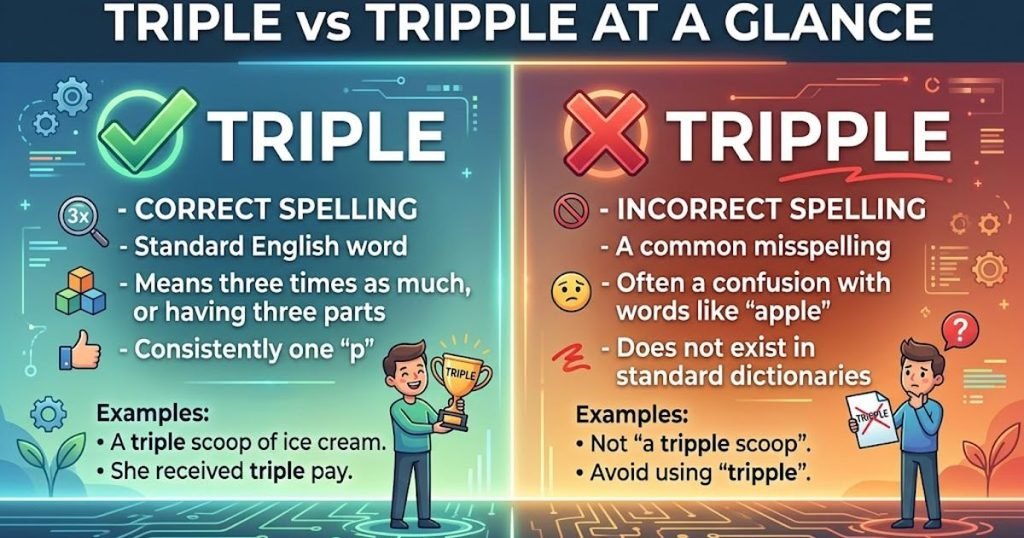
| Term | Correct? | Meaning | Use |
| Triple | Yes | Three times, three parts, or a set of three | Standard English, all contexts |
| Tripple | No | No accepted meaning | Never correct; treat as a typo |
There is no situation, formal or informal, American or British, where “tripple” is the accepted spelling.
Read Related Post: Niece or Neice (2026): Clear and Simple Guide for Everyone
Where Does the Word Triple Come From?
Triple traces back to the Latin word triplus, meaning threefold, which itself combines tri- (three) and -plus (fold or multiply). It entered English through French in the late Middle Ages and has kept a consistent spelling ever since.
This Latin root also explains why “triple” shares a pattern with other multiplication words like “double” (from duplus) and “quadruple” (from quadruplus). None of these words double their final consonant, which is a helpful memory anchor.
How Do You Pronounce Triple?
Triple is pronounced TRIH-pul, with the stress on the first syllable. In IPA, it’s written /ˈtrɪp.əl/. The vowel sound is short, similar to the “i” in “trip,” which is exactly why it can be confused with words that double their consonant.
There is no separate or alternate pronunciation for “tripple,” since it isn’t a real word to begin with.
Triple as Different Parts of Speech
Understanding how triple functions grammatically makes it easier to use correctly in any sentence.
As an adjective, it describes something with three parts or components:
- We booked a triple room for the trip.
As a verb, it means to become three times as large, or to multiply something by three. It follows regular verb rules: triple, triples, tripled, tripling.
- The company plans to triple its revenue by next year.
- Attendance has tripled since last year’s event.
As a noun, it refers to a group of three or a specific three-part item, such as a triple in baseball or a “triple” in music (three notes played together).
- He drove in the winning run with a triple.
There is no plural spelling issue to worry about here, since “triples” is simply the regular plural or verb conjugation, still with one P.
Triple in a Sentence: Real Examples
Seeing the word used naturally helps cement the correct spelling in memory.
Everyday conversation:
“Can I get a triple espresso? I did not sleep last night.”
Workplace communication:
“We need to triple check these numbers before the report goes out.”
This sentence works because “triple check” functions as an intensified way of saying “check very carefully,” a common informal phrase in business English.
Academic writing:
“The study used a triple blind methodology to reduce researcher bias.”
Email:
“Just a heads up, the client wants to triple the order size for next month.”
Business writing:
“Our marketing spend needs to triple if we want to hit the new growth targets.”
Casual writing:
“That movie was a triple threat: funny, scary, and weirdly touching.”
Common Mistakes People Make With Triple
Incorrect: She ordered a tripple scoop of ice cream.
Correct: She ordered a triple scoop of ice cream.
The extra P has no grammatical or historical basis. It’s a spelling slip, not a stylistic choice.
Incorrect: Profits tripplied over five years.
Correct: Profits tripled over five years.
The verb form follows the same single P pattern as the base word, even when conjugated.
Incorrect: We need a tripple check on this data.
Correct: We need a triple check on this data.
Doubling the consonant here doesn’t change the meaning, it just makes the word incorrect.
If autocorrect keeps flagging “tripple,” trust it. That red squiggly line is right.
Words Related to Triple
A few related terms can help build out your vocabulary around multiplication and grouping:
- Double (two times, or a pair)
- Quadruple (four times)
- Threefold (a synonym for triple, often used in formal writing)
- Triplet (one of three offspring born at the same time, or a group of three)
- Triplicate (existing in three copies, often used for forms and documents)
None of these words double their consonants either, which reinforces the pattern: multiplication words built from Latin roots (duplus, triplus, quadruplus) keep a single consonant in English.
Quick Tips to Never Misspell Triple Again
- Think of “triple” as “tri” (three) plus “ple,” not as a rhyme with “ripple.”
- Remember that “double” doesn’t double its B, so “triple” shouldn’t double its P either.
- If you’re typing quickly, let spellcheck catch it, but don’t rely on it as your only check in professional writing.
FAQ’s
Is “tripple” ever correct?
No. “Tripple” is not a recognized spelling in any English dictionary or style guide. It is always a typo or misspelling of “triple.”
What does “triple” mean?
Triple means three times as much, made up of three parts, or a group of three. It can function as an adjective, noun, or verb depending on the sentence.
How do you use “triple” in a sentence?
Use it to describe something with three parts (“a triple layer cake”) or to describe multiplying something by three (“we tripled our output”). Example: “The team tripled its ticket sales this season.”
Is “triple” British or American English?
Triple is used identically in both American and British English. There is no regional spelling difference for this word.
Why do I keep wanting to spell it “tripple”?
It’s a common pattern-matching error. Words like “ripple” and “nipple” double their consonant, and “triple” sounds similar when spoken, even though it follows a different spelling rule rooted in Latin.
Conclusion
The bottom line is simple: triple has one P, and tripple is not a word. Whether you’re describing a triple scoop of ice cream, tripling a recipe, or hitting a triple in baseball, the spelling stays the same in every context. Next time you type it, remember: three means “triple,” not “tripple.”

Smith Jason is an SEO expert with 2–3 years of experience, sharing grammar tips, confusing words, vocabulary and writing advice.









1 thought on “Triple vs Tripple: Which Is the Correct Spelling? The Complete Guide”