
You typed one version, your spell checker flagged it, and now you are not sure which one is actually right. Here is the short version: both spellings are correct. “Defense” is the standard spelling in American English, and “defence” is the standard spelling in British English. Neither one is a typo. The difference comes down to which country’s English you are writing in, not which word is grammatically wrong.
The Quick Answer: Defense vs Defence
If you are writing for a US audience, use “defense.” If you are writing for a UK, Australian, Canadian, or other Commonwealth audience, use “defence.” Both words are pronounced the same way and mean the same thing. This is a regional spelling difference, similar to “color” versus “colour” or “organize” versus “organise.”
There is one exception worth knowing early: even in American English, the word “defence” sometimes shows up in the name of official British institutions, like the UK’s Ministry of Defence. In that case, you would keep the British spelling because it is part of a proper name.
What Does Defense (or Defence) Actually Mean?
Both spellings refer to the same core ideas. As a noun, the word describes:
- The act of protecting someone or something from attack or harm
- A legal argument or strategy used to respond to an accusation
- The players or strategy in a sport dedicated to stopping the opposing team from scoring
- A justification or explanation for an action or belief
So whether you write “national defense” or “national defence,” you are talking about the same concept: protection against threat or attack.
Why Do Two Spellings Exist for the Same Word?
This split did not happen by accident. It traces back to differences in how American and British English standardized spelling over time.
The word comes from the Old French “defens” or “defense,” which itself came from the Latin “defensa,” a form of the verb “defendere” (to defend). English absorbed the word from French during the Middle Ages, and for a long time, both “defence” and “defense” appeared in British writing without much consistency.
The clearer split happened in the 1800s, largely because of Noah Webster. Webster, the American lexicographer behind Webster’s Dictionary, pushed for simplified and more phonetic American spellings. He favored the “-se” ending in words like “defense,” “offense,” and “license,” while British English kept the older “-ce” ending in “defence,” “offence,” and “licence” (as a noun).
That single decision is why Americans and the British still spell these words differently today.
Read Related Post: Lable or Label: Which Spelling Is Correct?
Grammar Breakdown: Part of Speech and Forms
“Defense” and “defence” are nouns. Neither spelling changes based on grammar rules like tense or number in the way a verb would, but there are a few related forms worth knowing.
Plural form: defenses (American) or defences (British). Example: “The team strengthened its defenses” versus “The team strengthened its defences.”
Verb form: The verb is spelled the same in both dialects: “defend.” There is no American or British version of the verb itself.
Adjective form: “Defensive” is used in both American and British English with the same spelling. There is no “defencive.”
Related noun: “Defender” is also spelled the same way in both dialects.
This matters because English learners sometimes assume every related word will follow the “-ce” or “-se” pattern. It does not. Only the base noun “defense/defence” changes between dialects.
American English vs British English: A Side-by-Side Look
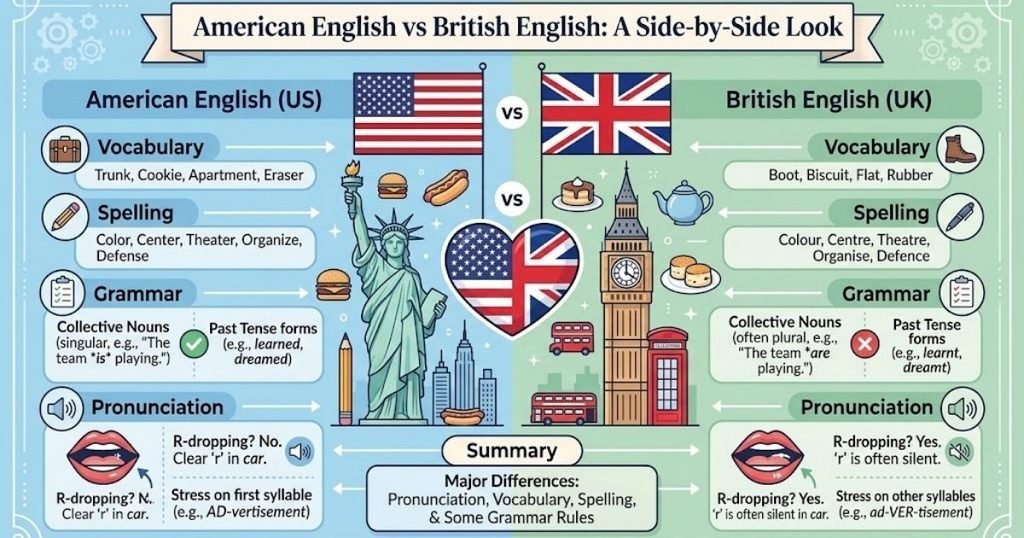
| Term | US Spelling | UK Spelling | Meaning |
| Noun | Defense | Defence | Protection against attack |
| Plural noun | Defenses | Defences | More than one defense |
| Verb | Defend | Defend | To protect or guard |
| Adjective | Defensive | Defensive | Related to protecting |
| Person | Defender | Defender | One who defends |
Notice that only the base noun changes. This is a helpful pattern to remember for other American and British spelling pairs, since the difference is usually limited to specific noun forms rather than the entire word family.
How to Pronounce Defense or Defence
Both spellings are pronounced the same way in everyday speech: dih-FENSS. The stress falls on the second syllable in both American and British English.
There is one notable exception in sports commentary. In American English, especially at sporting events, fans and announcers often shift the stress to the first syllable, saying DEE-fense, as a kind of chant or emphasis. This is informal and specific to spoken, casual contexts like a stadium crowd, not something you would use in writing.
When to Use Defense (American English)
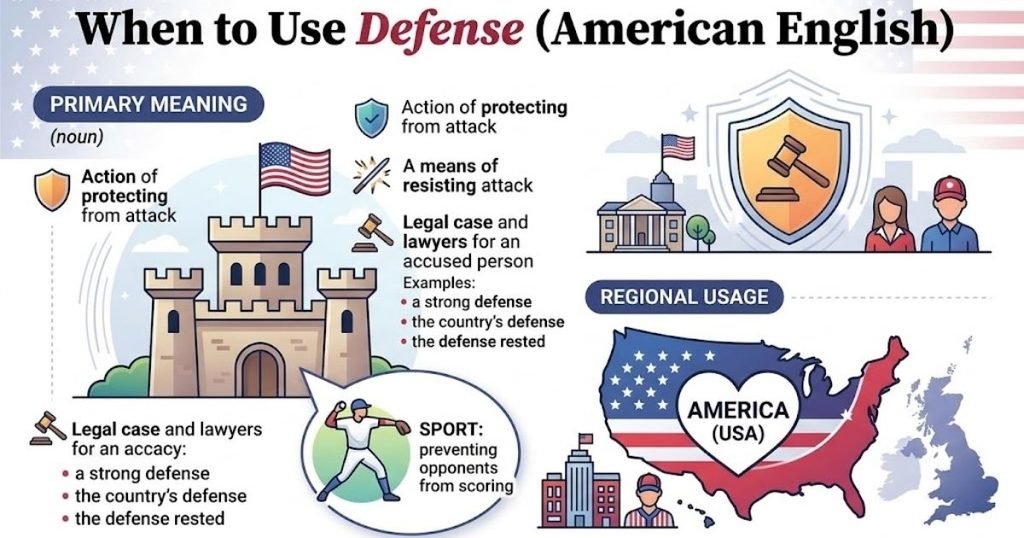
Use “defense” when:
- You are writing for a US publication, company, or audience
- You are following American style guides like AP or Chicago
- You are writing academic or business content intended for American readers
- You work in a field, like US law or the US military, where “defense” is the standard term (for example, the US Department of Defense)
Example (business email): “Our legal team is preparing a defense against the claim filed last week.”
Example (sports, US): “The defense held strong in the fourth quarter, preventing any late scoring.”
Example (academic writing): “The dissertation defense is scheduled for next Thursday.”
When to Use Defence (British English)
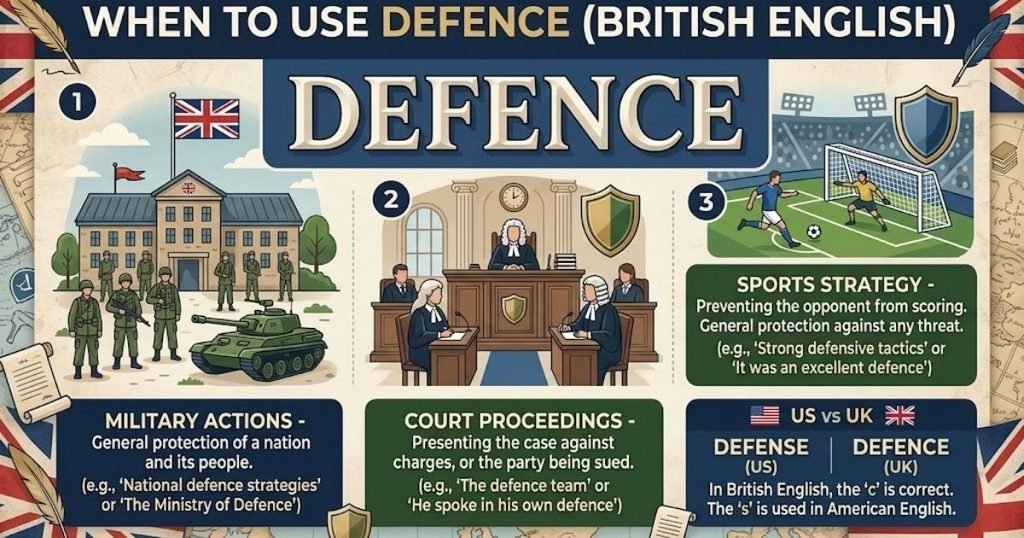
Use “defence” when:
- You are writing for a UK, Australian, Canadian, Irish, or other Commonwealth audience
- You are following British style guides
- You are referring to British institutions or terminology, such as the Ministry of Defence
- You are writing formal UK legal or academic documents
Example (UK business writing): “The company issued a formal defence of its pricing policy.”
Example (British sports commentary): “Their defence looked shaky in the opening minutes of the match.”
Example (UK news writing): “The Ministry of Defence confirmed the announcement on Tuesday.”
Is One Version Ever Actually Wrong?
Generally, no. Both spellings are considered correct within their respective dialects. The mistake is not using “defence” or “defense” itself. The mistake is mixing the two dialects inconsistently within the same piece of writing.
If you start an article using “defense” and later switch to “defence” without reason, that inconsistency reads as an error to a careful reader or an editor, even though each individual spelling is technically valid somewhere in the English-speaking world.
Common Mistakes to Avoid
Incorrect: The team’s defence was strong, and their defense coordinator made smart calls. Correct: The team’s defense was strong, and their defense coordinator made smart calls. Explanation: Pick one dialect and stay consistent throughout the entire piece.
Incorrect: He works for the US Department of Defence. Correct: He works for the US Department of Defense. Explanation: Official proper names keep their actual spelling. The US agency is officially called the Department of Defense, so “Defence” is incorrect here regardless of which English you normally use.
Incorrect: She wrote a strong defencive argument. Correct: She wrote a strong defensive argument. Explanation: The adjective is always “defensive,” never “defencive,” in either dialect.
Incorrect: Their defenses spelling looks wrong on this UK client’s website. Correct: Their defences spelling matches the UK client’s website style. Explanation: When writing for a specific regional audience or client, match their expected dialect rather than defaulting to your own habit.
Related Words and Terms Worth Knowing
A few related words follow similar American versus British spelling patterns, which can help you recognize the pattern elsewhere:
- Offense (US) / Offence (UK)
- License (US, noun and verb) / Licence (UK, noun only) and License (UK, verb only)
- Pretense (US) / Pretence (UK)
Recognizing this shared pattern makes it easier to guess the correct regional spelling for similar words, even ones you have not looked up before.
Practical Guidance for Writers
If you are unsure which spelling to use, ask yourself who your audience is. A few quick rules of thumb:
- Writing for a US company, client, or publication: use “defense”
- Writing for a UK, Australian, or Commonwealth audience: use “defence”
- Quoting an official name or title: keep the original spelling exactly as it appears
- Writing for a global or mixed audience: pick one dialect and apply it consistently across the entire document
Most word processors and style checkers will flag the “wrong” spelling based on your language settings, so double check that your document’s language setting matches your intended audience before you rely on spell check to catch dialect issues.
FAQ’s
Is “defence” a misspelling of “defense”?
No. “Defence” is not a misspelling. It is the standard British English spelling, while “defense” is the standard American English spelling. Both are correct in their respective regions.
Which spelling should I use in the United States?
Use “defense” for US audiences, US publications, and American style guides like AP or Chicago.
Which spelling should I use in the United Kingdom?
Use “defence” for UK audiences, British publications, and UK style guides.
Why is the US Department of Defense spelled with an “s” even in formal writing?
Because it is an official proper name. The correct legal name of the US federal department uses “Defense,” so that spelling stays fixed regardless of context or dialect.
Does the verb “defend” change between American and British English?
No. The verb “defend,” along with related words like “defensive” and “defender,” is spelled the same way in both American and British English. Only the base noun form changes.
Conclusion
Both “defense” and “defence” are correct, and the right choice depends entirely on your audience: American English uses “defense,” and British English uses “defence.” The one rule to keep in mind is consistency. Pick the spelling that matches your intended readers, stick with it throughout your writing, and keep official names spelled exactly as they officially appear.

Smith Jason is an SEO expert with 2–3 years of experience, sharing grammar tips, confusing words, vocabulary and writing advice.










1 thought on “Defence or Defense: Which Spelling Is Correct?”