If you have ever paused mid sentence wondering whether it is “lable” or “label,” you are not alone. The confusion usually happens because the word is spoken quickly, and the way it sounds does not match the way it looks on paper. Here is the short answer: “label” is the correct spelling. “Lable” is not a word in standard English.
Is It Lable or Label? The Quick Answer
Label is always correct. Lable is always a misspelling. There is no context, formal or informal, American or British, where “lable” is an accepted variant. It simply swaps the order of the “l” and “e,” which is a common typing slip rather than an alternate spelling.
What Does Label Mean?
A label is a piece of paper, fabric, or digital tag that identifies something. It can also work as a verb, meaning to attach such a tag or to describe something with a specific term.
As a noun, examples include:
- The label on the jar lists the ingredients.
- She peeled the price label off the mug.
As a verb, examples include:
- Please label each box before the movers arrive.
- Critics tend to label the film a disappointment.
Why Do People Misspell Label as Lable?
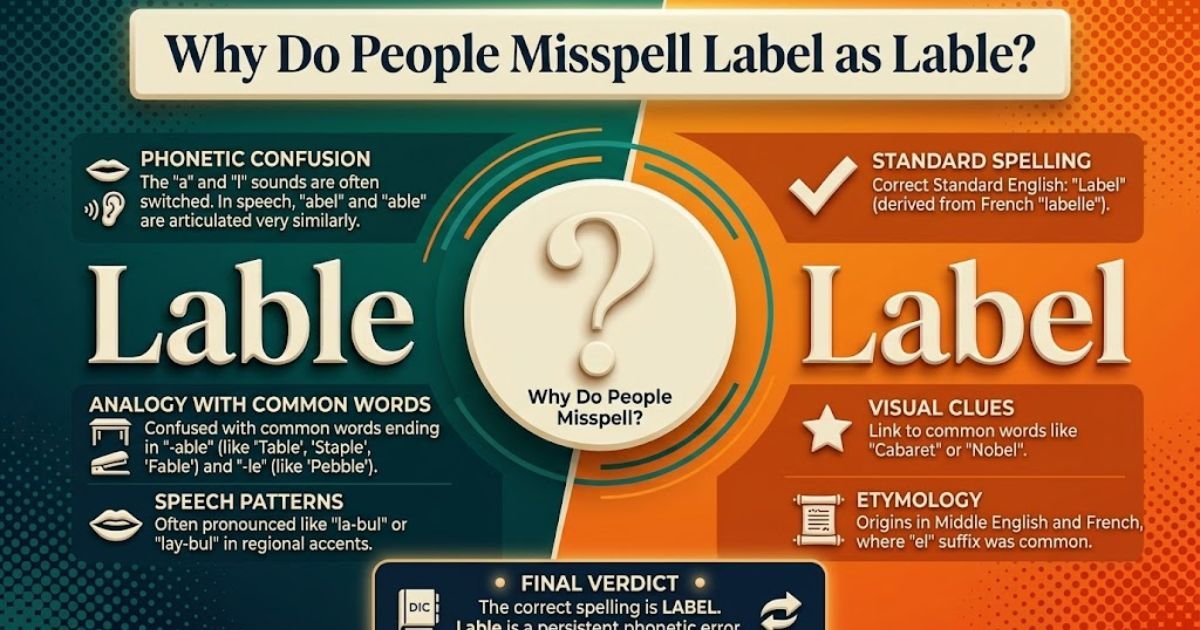
This mistake happens for a simple reason: English spelling does not always match pronunciation. When you say “label” out loud, the ending sounds a bit like “bul,” and some writers guess at the letter order instead of recalling the correct spelling. Autocorrect usually catches it, but handwritten notes, quick texts, and rushed emails are where “lable” tends to slip through.
Grammar Breakdown of the Word Label
Understanding the grammar behind “label” makes it much easier to use correctly in any sentence.
Part of speech: Label functions as both a noun and a verb.
Singular and plural noun forms: The singular form is “label.” The plural form is “labels,” formed with a simple “s,” as in regular English nouns.
Verb forms: As a verb, “label” follows regular conjugation patterns:
- Present tense: label / labels (he labels the folders)
- Past tense: labeled (in American English) or labelled (in British English)
- Present participle: labeling (American English) or labelling (British English)
Adjective form: The word “labeled” can also function as an adjective, as in “a clearly labeled shelf.”
Read Related Post: Totalling or Totaling: Which Spelling to Use?
American English vs British English Spelling
This is one area where region genuinely matters, unlike the “lable” mistake, which is wrong everywhere.
| Form | American English | British English |
| Base word | label | label |
| Past tense | labeled | labelled |
| Present participle | labeling | labelling |
| Person who labels | labeler | labeller |
Notice that the base word “label” stays identical in both varieties. The difference only appears when adding “-ed” or “-ing,” because British English typically doubles the final consonant in words like this, while American English does not.
Where Does the Word Label Come From?
The word “label” traces back to Middle English, borrowed from the Old French word “label” or “lambel,” which referred to a narrow band or strip of cloth. That original French term likely developed from a Germanic root related to strips or ribbons used as decorative or identifying bands. Over time, the meaning shifted in English from a literal strip of fabric to any tag or marker used for identification, which is the meaning we use today.
How to Pronounce Label Correctly
“Label” is pronounced LAY-buhl, with the stress on the first syllable. The “a” makes a long sound, similar to the “a” in “table” or “cable.” This pronunciation pattern is actually a helpful memory trick, since none of those related words are spelled with the letters reversed either.
Lable vs Label at a Glance
| Term | Correct? | Meaning | Use |
| Label | Yes | A tag or marker identifying something; also a verb meaning to tag or describe | Standard in all writing contexts |
| Lable | No | Not a recognized English word | Should never be used; always a spelling error |
Correct Usage in Real Sentences
Seeing “label” used naturally in different settings makes the correct spelling easier to remember.
Everyday conversation: “Can you check the label to see if this shirt is cotton?”
Workplace communication: “Please label each file with the client’s last name before uploading it.”
Academic writing: “Researchers labeled the samples according to collection date and location.” This sentence uses the American past tense form correctly, with a single “l” before the “-ed” ending.
Email: “I’ve attached the shipping labels for tomorrow’s orders.”
Business writing: “The product label must include the full list of allergens under current regulations.”
Casual writing: “I always forget to label my leftovers, so I end up with mystery containers in the fridge.”
Common Mistakes When Spelling and Using Label
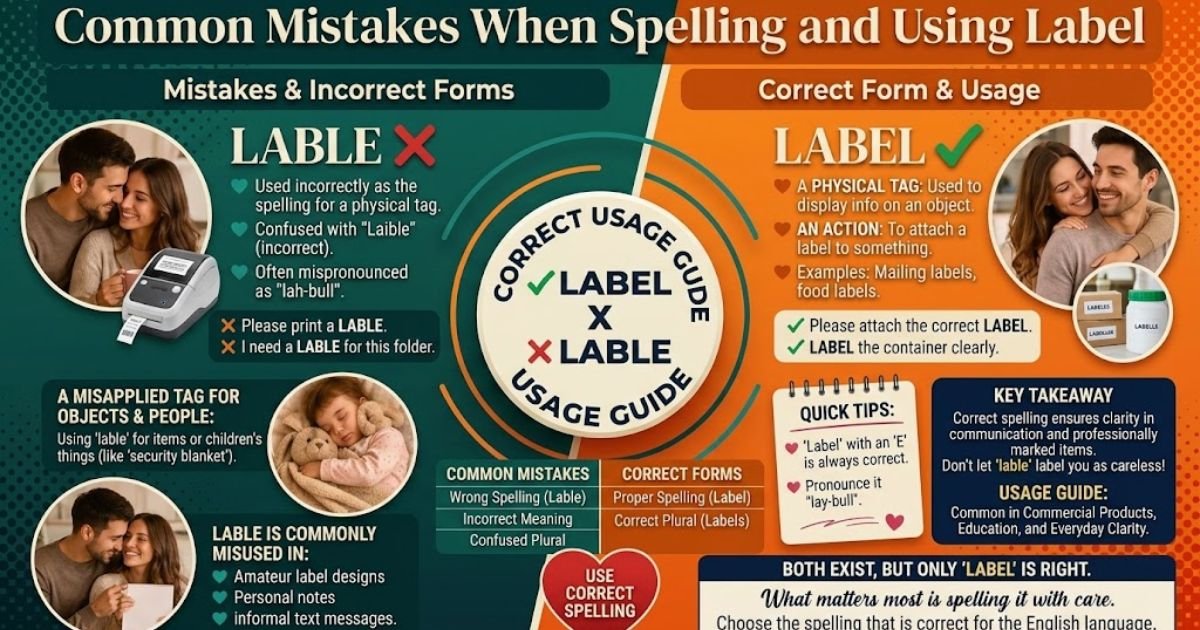
Even confident writers slip up occasionally. Here are the most frequent errors and how to fix them.
Incorrect: Don’t forget to lable the boxes before we move. Correct: Don’t forget to label the boxes before we move. The letters “a” and “b” need to stay in their original order, followed by “e” and “l.”
Incorrect: She lableed the drawer with a sticky note. Correct: She labeled the drawer with a sticky note. This example combines two mistakes at once: the base spelling error and an incorrect past tense ending.
Incorrect: The warning lable says to keep it away from children. Correct: The warning label says to keep it away from children. This is one of the most common contexts for the error, since product packaging language gets typed quickly and often without careful proofreading.
There is no scenario, formal or casual, where “lable” becomes acceptable. Treating it as a simple letter swap, similar to mixing up “recieve” and “receive,” can help you catch it before hitting send.
Related Words and Terms
A few related terms often come up alongside “label” in everyday writing:
- Tag, a close synonym often used interchangeably with label
- Mark, sometimes used as a verb alternative to “label”
- Labeling (or labelling), the ongoing action of attaching labels
- Mislabel, meaning to label something incorrectly
- Relabel, meaning to label something again with new information
- Brand label, a common phrase in retail and marketing contexts
None of these related words share the “lable” misspelling pattern, but recognizing the family of terms helps reinforce the correct base spelling.
Practical Tips to Remember the Correct Spelling
A few simple tricks can help the correct spelling stick permanently.
- Remember that “label” rhymes with “table” and “cable,” both of which are spelled with the letters in the same order.
- Break the word into two parts: “la” and “bel,” rather than trying to spell it as one long sound.
- If you are ever unsure while typing, most spell checkers will flag “lable” immediately, so pause and let autocorrect confirm it.
FAQ’s
Is lable a real word?
No. “Lable” is not recognized in any standard English dictionary. It is a common misspelling of “label.”
Is label spelled with one L or two?
The base word “label” has a single “l” at the start and a single “l” at the end. The doubling only appears in British English forms like “labelled” and “labelling.”
What is the past tense of label?
In American English, the past tense is labeled, with one “l.” In British English, it is labelled, with two.
How do you use label in a sentence?
Use it as a noun for a tag, as in “Read the nutrition label,” or as a verb meaning to tag or describe something, as in “Please label the folder correctly.”
Why do people confuse lable and label?
The confusion usually comes from the way the word sounds when spoken aloud, which does not clearly indicate the correct letter order, leading some writers to guess incorrectly.
Conclusion
“Label” is the only correct spelling, and “lable” is simply a common typing mistake with no legitimate use in English. The next time you’re unsure, just remember that “label” rhymes with “table,” and the correct letter order will be much easier to recall.

Smith Jason is an SEO expert with 2–3 years of experience, sharing grammar tips, confusing words, vocabulary and writing advice.










1 thought on “Lable or Label: Which Spelling Is Correct?”