You typed one version, your spell checker flagged it, and now you’re not sure if you made a mistake at all. Here’s the short version: you didn’t. Both “totalling” and “totaling” are correct, and the right one depends on which English you’re writing in. Use totaling (one L) for American English and totalling (two Ls) for British English. Neither spelling is a typo. They’re regional twins of the same word.
The Quick Answer: Totaling vs. Totalling
If you only read one section, read this one. Totaling is the standard American English spelling. Totalling is the standard British English spelling. Both come from the verb “total” plus the ending “-ing,” and both describe the same action: adding numbers together to reach a sum, or something that adds up to a certain amount.
There is no meaning difference. There is no formality difference. The only difference is geography.
What Does “Totaling” or “Totalling” Actually Mean?
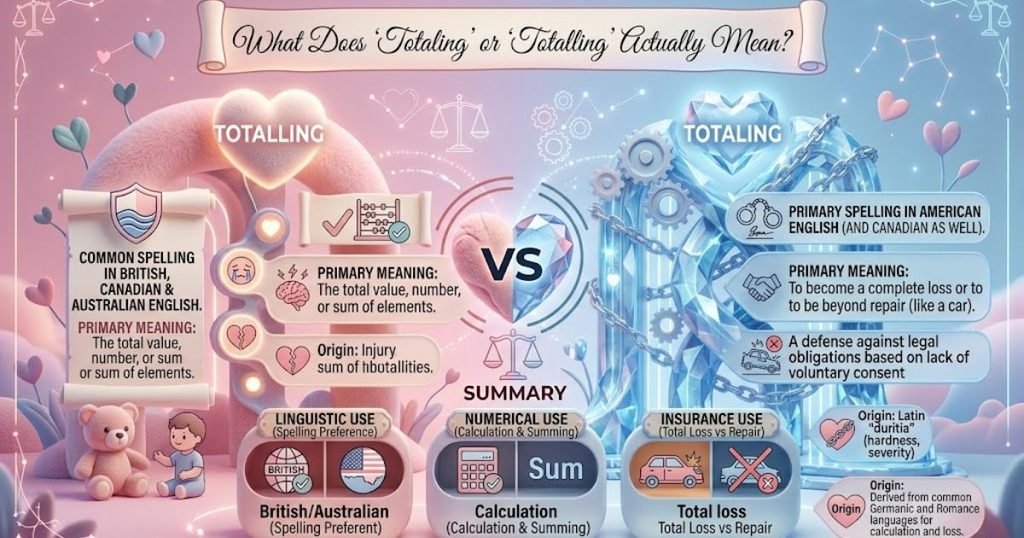
As a verb, “total” means to add up numbers to find a complete sum, or to amount to a certain figure overall. When you attach “-ing” to describe an ongoing action, you get totaling or totalling depending on your dialect.
You’ll see it used in two main ways:
- Describing an action in progress: “She is totaling the receipts before the meeting.”
- Describing a running amount: “The costs are totalling more than expected.”
In both cases, the word points to numbers coming together into one figure.
Why Are There Two Spellings for the Same Word?
This split isn’t random. It comes from a broader pattern between American and British spelling conventions, especially around verbs ending in a single vowel followed by “l.”
In traditional British spelling rules, when a short verb ends in a vowel plus “l” (like total, travel, or cancel), the final “l” gets doubled before adding a suffix such as “-ing” or “-ed,” regardless of where the stress falls in the word. That’s why British English gives you totalling, travelling, and cancelling.
American English, largely shaped by Noah Webster’s 19th century spelling reforms, moved away from that automatic doubling. Webster favored simpler, more phonetic spellings, which is also why American English uses color instead of colour and center instead of centre. Under that pattern, total plus -ing stays as totaling, with a single L.
Neither approach is more “correct” in an absolute sense. They’re two spelling systems that developed along separate paths after British and American English began drifting apart.
Read Related Post: Appreciate It or Appreciated It?
Totaling vs. Totalling: Side-by-Side Comparison
| Spelling | Region | Correct? | Example |
| Totaling | American English | Yes, standard | The invoices are totaling $2,300. |
| Totalling | British English | Yes, standard | The invoices are totalling £2,300. |
Both rows are right. The only variable is your audience.
How Do You Pronounce Totaling and Totalling?
They sound identical. Both are pronounced TOH-tuh-ling, with the stress on the first syllable. The extra L in the British spelling doesn’t change how the word is spoken, only how it looks on the page. If you’re writing for the ear, such as a script or spoken presentation, this distinction won’t matter at all.
Grammar Breakdown: Part of Speech and Form
“Totaling” and “totalling” are the present participle (or gerund) forms of the verb “total.” Depending on the sentence, they can function two ways:
- As a verb in a continuous tense: “The clerk is totaling the order.”
- As an adjective modifying a noun: “The totaling process takes ten minutes.”
The base verb “total” also has a past tense form, which follows the same regional split: totaled (American) and totalled (British). If you’ve settled on one spelling style for “totaling,” carry that same choice through to “totaled,” so your writing stays consistent.
When to Use Totaling
Choose totaling when:
- You’re writing for a US audience, publication, or company style guide.
- Your document is set to American English in your word processor.
- You want the more globally recognized spelling for a mixed international audience, since American spelling tends to dominate in international business and tech writing.
Example sentences:
- The accountant spent the afternoon totaling last quarter’s expenses.
- Total sales are totaling close to five thousand units this month.
- Please double check the numbers before totaling the final invoice.
When to Use Totalling
Choose totalling when:
- You’re writing for a UK, Australian, Irish, or other Commonwealth audience.
- Your publication follows British English style conventions.
- Your spell checker is set to UK English (it will flag “totaling” as an error in that mode).
Example sentences:
- The shop assistant was totalling the till at closing time.
- Donations are now totalling over ten thousand pounds.
- She kept totalling the figures until the report balanced.
Totaling and Totalling in Everyday, Business, and Academic Writing
Casual conversation: “I’m just totaling up what we spent on the trip.”
Workplace email (American): “I’m currently totaling the Q3 budget numbers and will send the report by Friday.”
Workplace email (British): “I’m currently totalling the Q3 budget figures and will circulate the report by Friday.”
Academic writing: “The dataset, totaling 4,200 responses, was analyzed for regional trends.” Here, “totaling” works as an adjective phrase describing the dataset’s size, a common pattern in research and reports.
Notice that the sentence structure and tone don’t change between spellings. Only the letter count does.
Common Mistakes With Totaling and Totalling
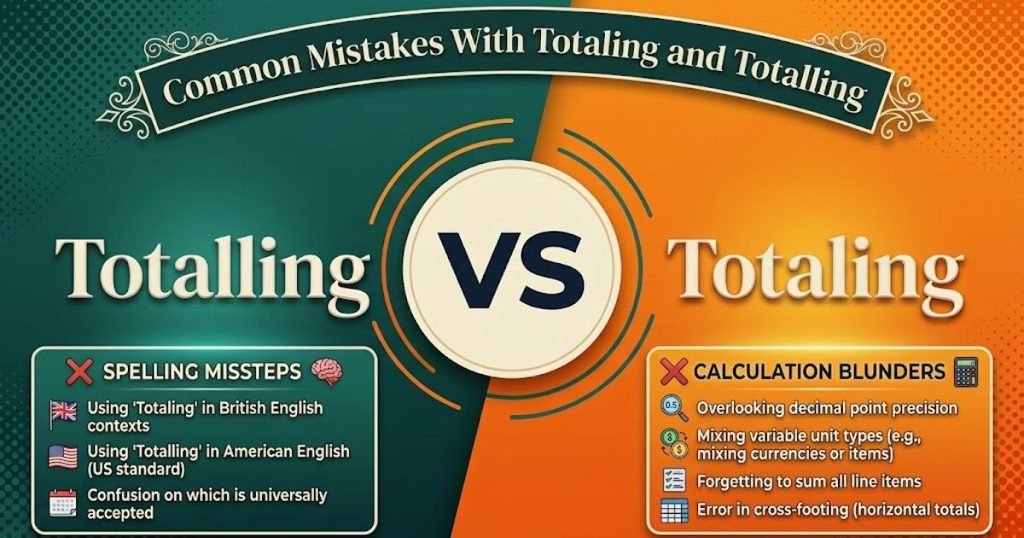
Mistake 1: Mixing both spellings in the same document.
Incorrect: The report shows costs totalling $500, and the department is now totaling its remaining budget.
Correct: The report shows costs totaling $500, and the department is now totaling its remaining budget.
Pick one regional spelling and use it consistently throughout a single piece of writing. Switching back and forth looks like a proofreading slip, even though both spellings are technically valid on their own.
Mistake 2: Assuming one spelling is simply wrong.
Incorrect assumption: “Totalling has an extra letter, so it must be a typo.”
Correct understanding: Totalling is the standard British spelling. It’s not an error, just a different regional convention.
Mistake 3: Ignoring your document’s language setting.
If your software is set to UK English and you type “totaling,” it may get underlined as incorrect, and vice versa. Check your language setting before assuming your spelling is wrong.
Related Words That Follow the Same Pattern
This American versus British spelling split isn’t unique to “total.” You’ll find the same one-L versus two-L pattern in several other common verbs:
- Traveling (US) / Travelling (UK)
- Canceling (US) / Cancelling (UK)
- Labeling (US) / Labelling (UK)
- Modeling (US) / Modelling (UK)
Once you recognize this pattern, you can apply the same logic to other words that trip up writers switching between American and British English.
A Practical Tip for Choosing the Right Spelling
If you’re not sure which audience you’re writing for, check three things: your word processor’s language setting, your style guide (if you have one, such as AP or a company handbook), and the primary location of your readers. When in doubt and writing for a global or unknown audience, totaling (American English) is generally the safer default, since it’s the more widely used spelling in international digital content and business writing.
Whichever you choose, consistency matters more than which one you pick. A single document that mixes both looks careless, even though each spelling is correct on its own.
FAQ’s
Is “totalling” a real word?
Yes. Totalling is the standard British English spelling of the present participle of “total.” It’s just as correct as “totaling” in American English.
Is “totaling” or “totalling” used in Canada and Australia?
Canadian English often mixes American and British conventions, though “totalling” is more common there. Australian English generally follows British spelling, so “totalling” is the standard choice.
Do “totaling” and “totalling” mean different things?
No. They mean exactly the same thing: adding numbers to reach a sum, or amounting to a certain figure. The only difference is spelling convention by region.
Which spelling should I use in a business email to an international audience?
Totaling is usually the safer choice for a broad or international audience, since American spelling is more widely recognized in global business and digital writing. Still, match your reader’s dialect when you know it.
Is “totaled” the same kind of split as “totaling”?
Yes. The past tense follows the identical pattern: totaled in American English and totalled in British English. If your writing includes both forms, keep them consistent with the same regional style.
Conclusion
Totaling and totalling are the same word for wearing two different regional outfits. Use totaling for American English and totalling for British English, and stick with whichever one matches your audience throughout your document. Once you remember that this is a spelling convention rather than a grammar rule, you’ll never second-guess it again.

Smith Jason is an SEO expert with 2–3 years of experience, sharing grammar tips, confusing words, vocabulary and writing advice.










1 thought on “Totalling or Totaling: Which Spelling to Use?”