You typed the word, stared at it for a second too long, and now you’re not sure if it looks right. That flicker of doubt is common, because this word behaves differently depending on where you learned English. Here’s the short version: “totaling” is the correct spelling in American English, and “totalling” is the correct spelling in British English. Neither one is a typo. They’re regional variants of the same word.
Totaling vs Totalling: The Quick Answer
If you’re writing for a US audience, use totaling (one L). If you’re writing for a UK, Australian, or Canadian audience, use totalling (two Ls). Both spell the present participle or gerund form of the verb “total,” meaning to add up to a certain amount or to calculate a sum.
There’s no grammar error hiding here. This is purely a spelling convention that splits along regional lines, similar to “traveling” versus “travelling” or “canceled” versus “cancelled.”
What Does “Total” Actually Mean?
Before comparing the spellings, it helps to nail down the base word. Total can function as a noun, an adjective, or a verb.
As a verb, “to total” means to add numbers together to reach a sum, or to amount to a certain figure. For example, “The invoice totals $450” means the invoice adds up to $450.
When you add “-ing” to form the present participle or gerund, you get either “totaling” or “totalling,” depending on your dialect.
Why Do Two Spellings Exist for the Same Word?
The difference comes down to a spelling rule about doubling consonants before adding a suffix like “-ing” or “-ed.”
In American English, a final consonant is doubled only when the stress falls on the last syllable of the base word. Since “total” is stressed on the first syllable (TOH-tul), American style keeps a single L: totaling.
In British English, the rule is different. A final L is doubled before a suffix regardless of where the stress falls. That’s why British spelling produces totalling, along with related pairs like “traveller” and “modelling.”
This isn’t a modern inconsistency. It traces back to spelling reforms in the 19th century, largely influenced by Noah Webster, who simplified American spelling by removing what he saw as unnecessary doubled letters. British English never adopted that change, so the older doubling pattern stuck.
Totaling vs Totalling: Comparison Table
| Term | Correct? | Region | Use |
| Totaling | Yes | American English (US) | Standard spelling in US writing, media, and style guides |
| Totalling | Yes | British English (UK, Australia, Canada, others) | Standard spelling in UK and Commonwealth writing |
Both entries are correct. Which one is “right” depends entirely on your audience, not on the grammar itself.
Read Related Post: Of Course or Ofcourse: Which One Should You Use?
How to Pronounce “Totaling” and “Totalling”
Pronunciation doesn’t change between the two spellings. Both are pronounced TOH-tuh-ling, with stress on the first syllable. The extra L in the British spelling is silent in terms of sound; it only affects how the word looks on the page.
Is “Totalling” Wrong in American English?
Not exactly wrong, but it will look like a mistake to most American readers and to US-based spell checkers, style guides, and editors. If you’re writing for an American company, publication, or academic paper, stick with totaling. Using “totalling” in that context reads as a spelling error rather than a stylistic choice.
The reverse is true in the UK. Writing “totaling” in a British newspaper or business document will likely get flagged as an Americanism.
American English Usage: Totaling
American style guides, including those followed by most US newspapers, universities, and businesses, consistently use the single-L form.
Example sentences:
- The accountant spent the afternoon totaling last quarter’s expenses.
- Her injuries were totaling in severity, according to the initial hospital report.
- The car was totaling out at $8,000 in repair costs, more than its market value.
- By Friday, the fundraiser was totaling just over $12,000.
Each of these uses “totaling” as a verb form describing an ongoing action of adding up or amounting to something.
British English Usage: Totalling
British, Australian, and Canadian writers generally follow the double-L spelling.
Example sentences:
- The clerk was totalling the receipts before the shop closed for the evening.
- Donations were totalling nearly £5,000 by the end of the week.
- She spent the morning totalling up the survey responses.
- The damages, totalling several thousand pounds, were covered by insurance.
Notice that the meaning and sentence structure are identical to the American examples. Only the spelling changes.
Totaling and Totalling in Different Writing Contexts
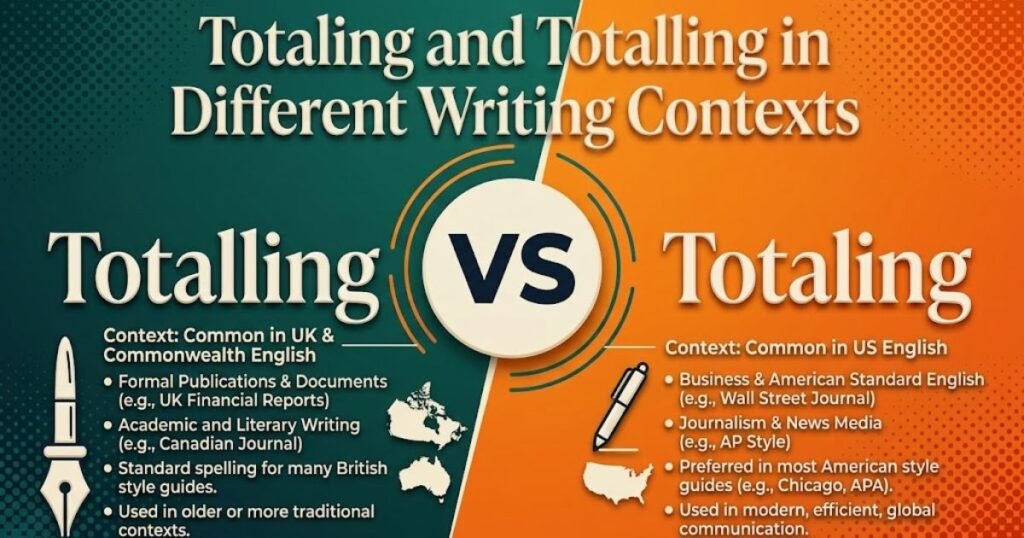
In business writing: Use whichever spelling matches your company’s primary market. A US-based firm reporting to American stakeholders should use “totaling.”
In academic writing: Match the spelling convention of your institution or target journal. Many academic style guides specify American or British spelling explicitly.
In emails: Consistency matters more than perfection. If you’ve used American spelling elsewhere in the email (color, organize, center), stick with “totaling.”
In casual conversation: Either spelling is understood, since pronunciation doesn’t change. This distinction only matters in writing.
Common Mistakes With Totaling and Totalling
Incorrect: She was totalling the bill in her American English essay for a US class. Correct: She was totaling the bill in her American English essay for a US class.
The mistake here is mixing British spelling into a document meant to follow American conventions. Pick one standard and apply it consistently throughout the piece.
Incorrect: The report used both totaling and totalling on the same page. Correct: The report used totaling throughout, since it was written for a US audience.
Inconsistency, even when both spellings are technically valid, looks careless. Editors and readers notice when a document switches dialects mid-way through.
Incorrect: Assuming “totalling” is simply a misspelling of “totaling.” Correct: Recognizing that “totalling” is the standard British spelling, not an error.
This mistake usually comes from readers who’ve only ever seen American spelling and assume anything different must be wrong. It’s a completely understandable mix-up, especially since American spell checkers often underline the British version in red.
Related Words and Spelling Patterns
This same American versus British doubling rule shows up in several other common word pairs:
- Traveling / Travelling
- Canceling / Cancelling
- Modeling / Modelling
- Labeling / Labelling
- Signaling / Signalling
If you’re comfortable choosing between these pairs based on your audience, you already understand the logic behind totaling versus totalling. The rule is consistent across all of them: American English generally keeps a single consonant, while British English doubles it.
Which Spelling Should You Use?
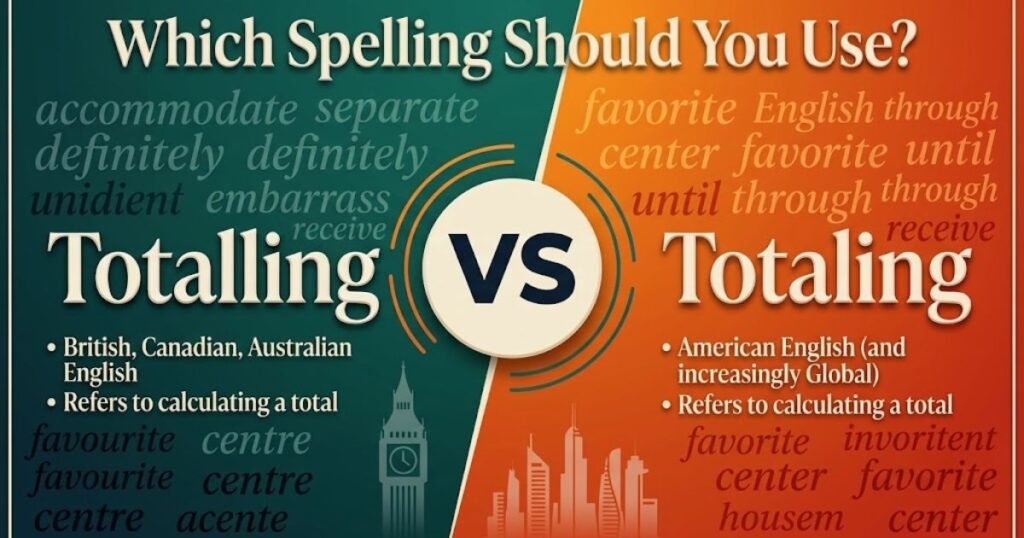
Ask yourself who you’re writing for.
- Writing for a US company, US school, or American readers: use totaling.
- Writing for a UK, Australian, Canadian, or other Commonwealth audience: use totalling.
- Writing something international or unsure of your audience: pick one spelling and stay consistent throughout the entire document.
Most word processors and spell checkers will guide you automatically once you set your language preference to either “English (US)” or “English (UK).”
Frequently Asked Questions
Is “totalling” a real word?
Yes. “Totalling” is the standard British English spelling of the present participle of “total.” It is not a misspelling.
Is “totaling” or “totalling” used in Canada?
Canadian English often leans toward British spelling for words like this, so “totalling” is common, though usage can vary by publication and style guide.
What does “totaling” mean in a sentence?
It means adding up to reach a sum, or the act of calculating a total. For example, “The bill is totaling $200” means the bill adds up to $200.
Do “totaling” and “totalling” sound different when spoken?
No. Both are pronounced the same way. The spelling difference only appears in writing.
Which spelling should I use in a resume or business email?
Match the spelling to your audience’s region. Use “totaling” for American readers and “totalling” for British or Commonwealth readers, and stay consistent throughout the document.
The Bottom Line
Both “totaling” and “totalling” are correct, and the choice simply depends on whether you’re following American or British spelling conventions. Pick the version that matches your audience, apply it consistently, and you won’t need to second-guess this word again.

Smith Jason is an SEO expert with 2–3 years of experience, sharing grammar tips, confusing words, vocabulary and writing advice.