
Many writers pause before typing this word, unsure whether it takes one R or two in the middle. The confusion is understandable, since “refer” ends in a single R. The correct spelling is referred, with a double R. “Refered” is a misspelling. This guide explains why, and how to use the word with confidence.
Referred or Refered: Which Spelling Is Correct?
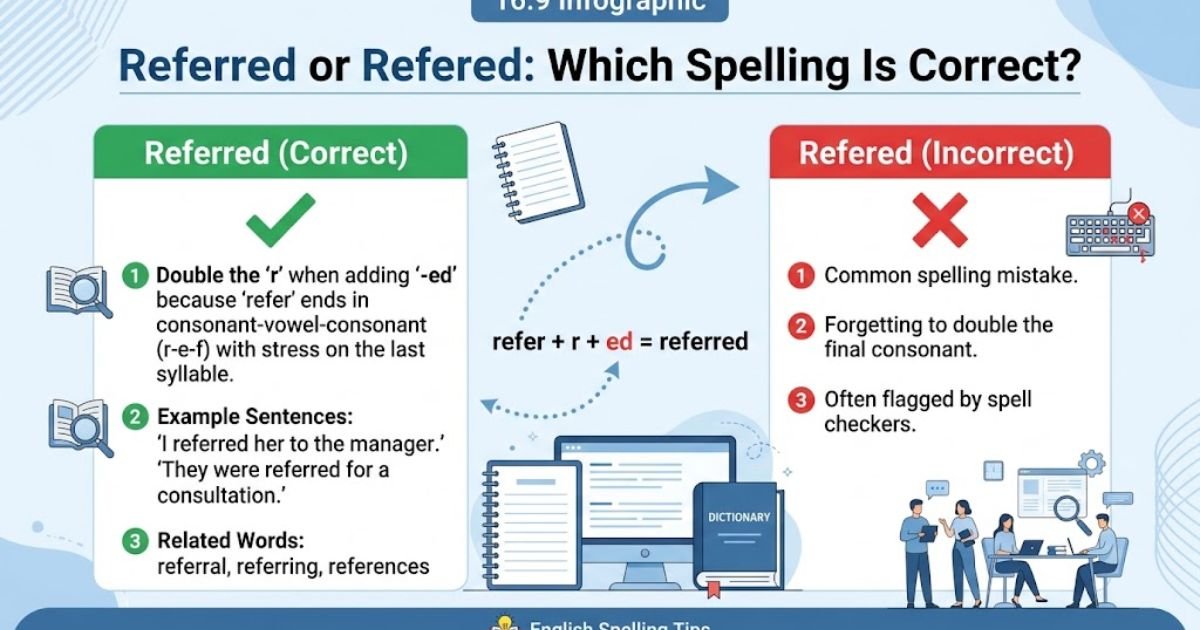
Referred is the correct spelling. Refered is always a misspelling. Referred is the past tense and past participle of the verb “refer,” and it needs two R’s because the final consonant doubles before the -ed ending.
You will not find “refered” as an accepted variant in standard American or British English. Spell checkers flag it, and editors will correct it, so it is worth getting right in emails, reports, and school assignments.
Why Does “Refered” Look Right to So Many People?
Most English verbs simply add -ed to form the past tense. Walk becomes walked, and open becomes opened. So it feels natural to write refer as “refered.”
The trap is that “refer” belongs to a group of verbs that double their last consonant first. Your eye sees the base word, your hand adds -ed, and the doubling gets skipped. This is a pattern problem, not a carelessness problem.
What Does “Referred” Mean?
“Referred” is a verb form with several related meanings, all connected to the idea of pointing toward something or someone.
- To mention or speak about something: She referred to the budget twice during the meeting.
- To send someone to another source or person: My doctor referred me to a specialist.
- To consult a source for information: He referred to his notes before answering.
- To describe or name something: People often referred to the old stadium as “the dome.”
It also works as an adjective in a few fixed phrases, such as “referred pain,” which is pain felt in a different part of the body from where it starts.
Referred vs. Refered at a Glance
| Term | Correct? | Meaning | Use |
| Referred | Yes | Past tense and past participle of “refer” | Use in all writing, formal and casual |
| Refered | No | None (a misspelling) | Never use; replace with “referred” |
| Refer | Yes | Base form of the verb | Use in the present tense |
| Referring | Yes | Present participle | Use for ongoing actions |
Read Related Post: How Long Until 12:15? A Complete Guide to Calculating Your Countdown
Why Is “Referred” Spelled With Two R’s?
English has a spelling rule for verbs that end in one vowel followed by one consonant. When the stress falls on the last syllable, the final consonant doubles before an ending that starts with a vowel, such as -ed or -ing.
Refer fits the rule perfectly. It has two syllables (re-FER), the stress lands on the second one, and it ends in a single vowel plus a single consonant. So the R doubles: refer becomes referred and referring.
Here is a simple memory trick. If you can hear the stress on the last syllable (re-FER), double the R. If the stress falls on the first syllable, as in “offer,” you do not double it, which is why “offered” has one R.
How Do You Pronounce “Referred”?
In American English, “referred” is pronounced rih-FURD. The stress falls on the second syllable, and the word has just two syllables, not three.
The double R does not change the sound. It signals the stress pattern in writing. If you say “refer” aloud with the stress on “fer,” you can hear the logic of the doubled letter.
Where Does the Word “Referred” Come From?
“Refer” traces back to the Latin verb referre, which combines re- (back) and ferre (to carry or bring). The original sense was to carry something back, and over time it grew into the idea of directing attention or sending someone back to a source.
That “carry” root shows up in other English words too, such as “transfer,” “defer,” and “confer.” It also explains why so many of these related verbs share the same doubling pattern.
How Do You Use “Referred” in a Sentence?
Here are natural examples from different settings.
Everyday conversation
- My neighbor referred me to a great plumber.
- We always referred to that corner as “the lucky spot.”
Workplace and email
- As I referred to in my last message, the deadline has moved to Friday.
- The client was referred to our support team for billing questions.
Academic writing
- The author referred to three earlier studies to support her argument.
- In the footnote, the professor referred readers to the appendix.
Formal and business writing
- The matter was referred to legal counsel for review.
- The agreement referred to in Section 4 is attached.
In the last example, “referred to in Section 4” is a participle phrase describing the agreement. It means “the agreement that is mentioned in Section 4.” This structure is very common in contracts and official documents.
Which Prepositions Go With “Referred”?
Most of the time, “referred” is followed by to. That small word matters.
- Referred to: She referred to the report. (She mentioned it.)
- Referred to: The nurse referred him to a cardiologist. (She sent him there.)
- Referred back to: Please be referred back to the original policy.
Some writers add “as” when naming something: “The area is commonly referred to as downtown.” This is correct, and it means people use that name for the area.
You do not usually say “referred about” or “referred at.” If you mean “talked about,” use “mentioned” or “referred to.”
What Are Common “Referred” and “Refered” Mistakes?
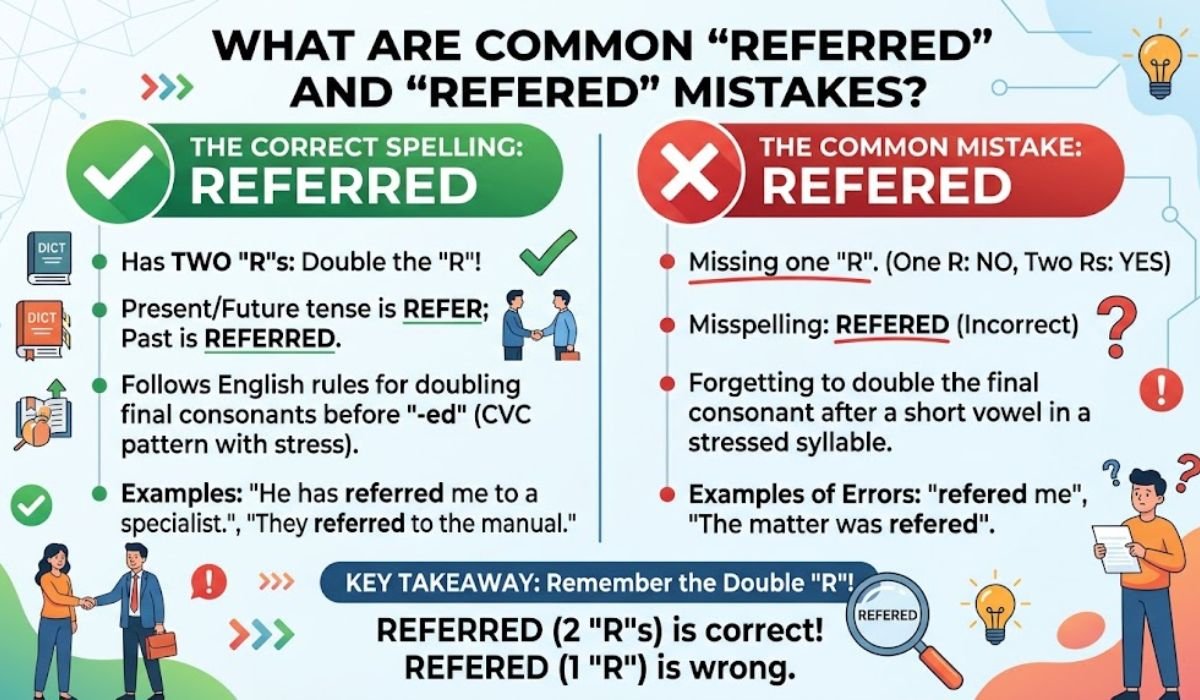
These errors come up often, and none of them is a sign of poor English. They are ordinary learning slips.
Mistake 1: Using one R
- Incorrect: My supervisor refered me to HR.
- Correct: My supervisor referred me to HR.
The final consonant must double before -ed.
Mistake 2: Dropping the double R in the -ing form
- Incorrect: She is refering to last year’s data.
- Correct: She is referring to last year’s data.
The same doubling rule applies to “referring.”
Mistake 3: Doubling the R in “reference”
- Incorrect: He gave a strong referrence.
- Correct: He gave a strong reference.
When the noun forms, the stress moves to the first syllable (REF-er-ence), so the R stays single.
Mistake 4: Confusing “referred” with “preferred”
- Incorrect: I referred the blue one.
- Correct: I preferred the blue one.
These are different words. “Preferred” means liked better, while “referred” means mentioned or sent elsewhere.
Which Related Words Follow the Same Spelling Pattern?
Once you know the rule, you can spell a whole family of verbs correctly. Each of these stresses the last syllable and doubles its final consonant.
- Preferred / preferring (from prefer)
- Transferred / transferring (from transfer)
- Deferred / deferring (from defer)
- Conferred / conferring (from confer)
- Inferred / inferring (from infer)
Words that stress the first syllable do not double the consonant: offered, differed, suffered, and entered.
Related forms of “refer” itself include referral (a noun, such as “a doctor’s referral”), referee, reference, and referable (able to be referred). Notice that “referral” keeps the double R, while “reference” and “referee” do not. The difference follows the stress pattern again.
Is “Referred” the Same in American and British English?
Yes. Both American and British English spell the word referred, and neither accepts “refered.” You will see no regional difference in this word.
British and American spelling do differ for some other doubling verbs, such as “travelled” (British) and “traveled” (American). But refer is not one of them, because the stress rule applies the same way on both sides of the Atlantic.
FAQ’s
Is “refered” ever correct?
No. “Refered” is not an accepted spelling in standard English. Always write referred for the past tense and past participle of “refer.”
What is the difference between “referred” and “referred to”?
“Referred” can stand alone when it means sent or directed, as in “She was referred by a friend.” “Referred to” is used when you mention or point toward something, as in “He referred to the manual.”
How do I use “referred” in a sentence?
Use it as a past tense verb with a subject and often “to.” For example: “The teacher referred the student to the writing center.” This tells us the teacher sent the student there.
Is “referring” spelled with one R or two?
It has two R’s in the middle: referring. The same doubling rule that applies to “referred” applies to the -ing form.
Conclusion
The spelling you want is referred, with two R’s. “Refered” never appears in standard English. If you remember that refer stresses its last syllable, the doubled R will feel logical, and the same trick will help you spell preferred, transferred, and deferred without hesitation.

Smith Jason is an SEO expert with 2–3 years of experience, sharing grammar tips, confusing words, vocabulary and writing advice.










1 thought on “Referred or Refered: How to Spell It Correctly”