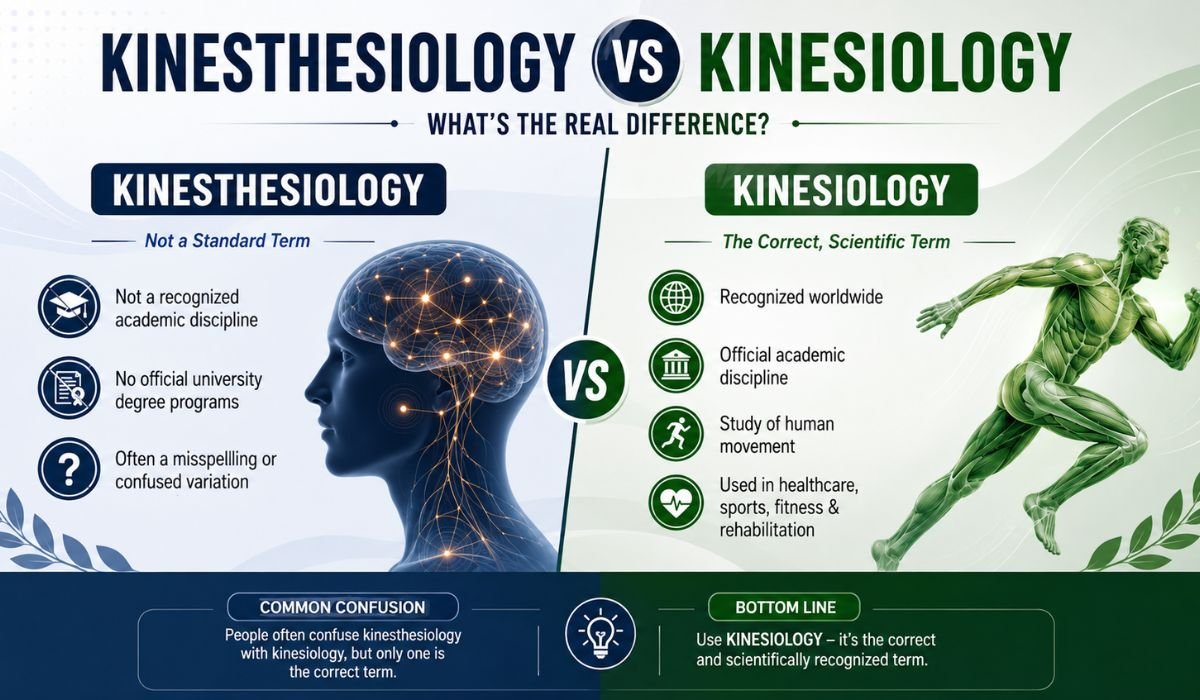
You typed “kinesthesiology” into a search bar, and now you’re wondering if you spelled it right or if you meant a different word entirely. That extra “thes” in the middle looks intentional, like it should mean something specific. It usually doesn’t. Kinesiology is the correct, standard term for the scientific study of human movement. Kinesthesiology is a rare, nonstandard variant that most dictionaries and universities don’t recognize, and in almost every case, kinesiology is the word you actually want.
The Quick Answer: Which Term Should You Use?
If you’re writing a resume, a school paper, or anything professional, use kinesiology. It’s the term you’ll find in Merriam-Webster, in university course catalogs, and on the door of every sports medicine clinic in the country. Kinesthesiology shows up occasionally online, mostly because people blend it with the related word “kinesthetic,” but it isn’t listed in major dictionaries and isn’t the accepted name of the academic field. Use kinesiology. That’s the short version.
What Kinesiology Actually Means
Kinesiology is a noun. It refers to the scientific study of human movement, including how muscles, bones, and joints work together during physical activity. It draws on anatomy, physiology, and biomechanics, and it’s the term used for college degrees, research departments, and licensed professions related to exercise science and physical therapy.
If someone says “I majored in kinesiology,” they mean they studied how the body moves, exercises, and recovers from injury. It’s a well established, widely taught field with clear academic roots.
What Kinesthesiology Is Supposed to Mean
Kinesthesiology isn’t a word you’ll find in Merriam-Webster or most standard dictionaries. A handful of smaller reference sites define it loosely as the study of how the body senses movement and position, tying it to the word “kinesthesia” (your body’s internal sense of motion and balance). But no accredited university offers a degree by this name, and no major medical or scientific body uses it as an official term.
In practice, kinesthesiology functions less like a distinct discipline and more like a word people reach for when they’re trying to describe something related to body awareness but land on the wrong spelling of kinesiology instead.
Where the Confusion Comes From
The mix-up happens because English already has a real, well established word: kinesthetic, an adjective meaning related to the sense of body movement and position. There’s also kinesthesia, the noun for that sense itself. Both are legitimate, dictionary recognized words.
“Kinesthesiology” looks like it should be the natural noun form connecting kinesthetic ideas to a field of study, similar to how “psychological” connects to “psychology.” That instinct is understandable. It’s also incorrect. The actual field is called kinesiology, full stop, whether the topic is muscle mechanics or the sense of body position.
Grammar Snapshot
Both words are nouns, but only one is standard. Here’s how they break down grammatically.
Kinesiology
- Part of speech: noun (uncountable)
- Adjective form: kinesiological
- Person who practices it: kinesiologist
- Standard in: US and UK English, academic and clinical writing
Kinesthesiology
- Part of speech: noun (uncountable), when it appears at all
- Related standard words: kinesthetic (adjective), kinesthesia (noun)
- Standard in: not recognized by major dictionaries; treat as nonstandard
Origin and History
Kinesiology comes from the Greek kinesis, meaning movement, combined with -logy, meaning the study of. That’s a clean, traditional pattern shared by words like biology and physiology, and it’s part of why kinesiology reads as a legitimate scientific term at a glance.
Kinesthesia and kinesthetic trace back to a different Greek combination: kinein (to move) plus aisthesis (sensation). That’s a real and useful word family. “Kinesthesiology” appears to be a later, informal blend of these two word families rather than a term with its own clean etymological history.
Pronunciation
- Kinesiology: kih-NEE-see-OL-oh-jee
- Kinesthesiology: kih-NES-thee-see-OL-oh-jee (when people use it)
Say kinesiology out loud a few times if the spelling keeps tripping you up. The rhythm is smoother without the extra “thes” syllable in the middle, which can help you remember the correct form.
Comparison Table
| Term | Standard? | Meaning | When to Use |
| Kinesiology | Yes, widely recognized | Scientific study of human movement, biomechanics, and exercise | Academic writing, degrees, job titles, clinical settings |
| Kinesthesiology | No, not in major dictionaries | Sometimes used loosely for body awareness or sensory feedback | Generally avoid; use kinesiology or kinesthetic instead |
Read Related Post: Midday vs Mid Day: Which Spelling Is Correct?
How to Use Kinesiology Correctly in a Sentence
Everyday conversation: “My cousin is studying kinesiology because she wants to become a physical therapist.”
Workplace communication: “The clinic just hired two new kinesiologists to run our sports rehab program.”
Academic writing: “This study examines joint mechanics through the lens of applied kinesiology.”
Email: “I’ve attached my transcript, which shows my coursework in the Kinesiology program at State University.”
Formal writing: “The Department of Kinesiology offers both undergraduate and graduate degrees in exercise science.”
Each of these sentences uses kinesiology the way a native English speaker actually would, in a context where the meaning is human movement, exercise, or physical therapy.
Common Mistakes
Incorrect: She earned her degree in kinesthesiology. Correct: She earned her degree in kinesiology.
No accredited university grants a degree by the name “kinesthesiology,” so this substitution reads as a spelling error rather than a deliberate word choice.
Incorrect: He studies kinesthesiology at the university. Correct: He studies kinesiology at the university.
Even though “kinesthesiology” sounds academic, it isn’t the accepted name for university coursework or research programs in this field.
Incorrect: The kinesthesiology department published new research on biomechanics. Correct: The kinesiology department published new research on biomechanics.
Department names, journal titles, and professional associations in this field consistently use kinesiology, not the longer variant.
These slips are easy to make. The words look almost identical, and “kinesthesiology” sounds like it should be correct because it borrows pieces from other real words. Once you know the pattern, it’s simple to catch.
Related Words Worth Knowing
- Kinesthetic: adjective describing the sense of body movement and position (a legitimate, dictionary recognized word)
- Kinesthesia: the sensory perception of movement and body position
- Kinesiologist: a professional trained in kinesiology
- Biomechanics: the study of the mechanical aspects of living organisms, closely related to kinesiology
- Exercise science: a broader umbrella term that often overlaps with kinesiology programs
Practical Guidance for Writers
When in doubt, default to kinesiology. It’s the term recognized by dictionaries, used in accredited degree programs, and understood immediately by readers in academic, medical, and fitness contexts. If you specifically mean the sensory awareness of movement, reach for kinesthetic or kinesthesia instead of inventing a hybrid word. Save kinesthesiology for situations where you’re quoting a source that used it, and even then, it’s worth a quick note that the standard term is kinesiology.
Frequently Asked Questions
Is kinesthesiology a real word?
It appears in a small number of online dictionaries like Wiktionary, but it is not listed in major references like Merriam-Webster and is not the accepted name for any academic field. Treat it as nonstandard.
What does kinesiology mean?
Kinesiology is the scientific study of human movement, covering anatomy, physiology, and biomechanics. It’s the field behind degrees, careers, and research in exercise science and physical therapy.
Why do people confuse kinesthesiology with kinesiology?
The confusion comes from the real words kinesthetic and kinesthesia, which relate to the sense of body movement. People sometimes blend those words with kinesiology, producing the nonstandard “kinesthesiology.”
Can I use kinesthesiology in academic writing?
It’s best to avoid it. Use kinesiology for the field of study, and use kinesthetic or kinesthesia if you specifically mean the sensory perception of movement.
Is kinesiology different in American and British English?
No. Kinesiology is used the same way in both American and British English, referring consistently to the scientific study of human movement.
Conclusion
The confusion between these two words comes down to one simple fact: kinesiology is the real, dictionary recognized, widely used term for the study of human movement, and kinesthesiology is not. If you remember nothing else from this guide, remember this: when you’re writing about exercise science, physical therapy, or a college degree, kinesiology is the word you want.

Smith Jason is an SEO expert with 2–3 years of experience, sharing grammar tips, confusing words, vocabulary and writing advice.