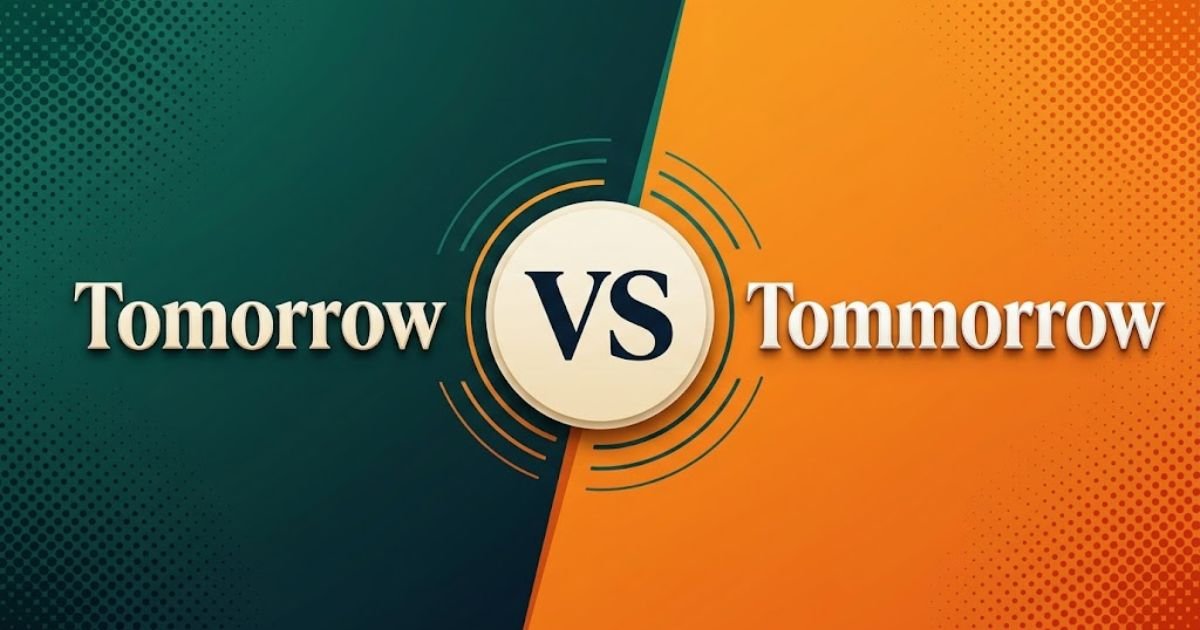
Tomorrow vs tommorrow trips up careful writers because the word sounds like it has a doubled m. It does not. Tomorrow is the only correct spelling: one m, then two r’s. Tommorrow is a misspelling with no accepted use in standard English. This guide shows why the mistake happens, how to fix it for good, and how to use tomorrow correctly in sentences.
Which Is Correct: Tomorrow or Tommorrow?
Tomorrow is correct. Tommorrow is always a spelling error.
The correct spelling has eight letters: t-o-m-o-r-r-o-w. The m stays single and the r doubles. Tommorrow flips that pattern by doubling the m and leaving the r’s out of balance, which is why it looks almost right at a glance.
No dictionary lists tommorrow as a variant, and no style guide accepts it. American and British English spell the word identically, so there is no regional exception to worry about.
What Does Tomorrow Mean?
Tomorrow means the day after today. It can also mean the near or distant future in a more general sense.
In everyday use, it works two ways. It can name a specific day (“Tomorrow is Tuesday”), or it can describe when something happens (“The report is due tomorrow”). In a broader sense, it points to what lies ahead: “Today’s students are tomorrow’s leaders.”
Since tommorrow is not a word, it has no meaning of its own. It only appears when someone intends to write tomorrow.
Tomorrow vs Tommorrow at a Glance
| Term | Correct? | Meaning | Use |
| Tomorrow | Yes | The day after today, or the future | Use in all writing and speech |
| Tommorrow | No | None (misspelling) | Replace with tomorrow |
| Tomorow | No | None (misspelling) | Replace with tomorrow |
If you remember only one row from this table, make it the first.
Read Related Post: Take Effect or Take Affect? Which Is Correct?
Why Do People Misspell Tomorrow?
English spelling does not always follow sound. When you say the word aloud, the stressed syllable falls on the second part, and that strong “mor” sound makes the m feel heavier than it looks on the page. Writers compensate by doubling it.
Another cause is pattern confusion. Many common words double the m, such as “committee,” “common,” and “summer.” The brain applies that habit to tomorrow, even though this word follows a different pattern.
Here is an easy fix: split the word into “to” and “morrow.” The first part has one m, the second part has two r’s, and the m and r never double together. Say it in chunks while you type, and the error tends to disappear.
You can also remember that the word has one m and two r’s. That single fact catches nearly every misspelling.
How Do You Pronounce Tomorrow?
Tomorrow has three syllables, with the stress on the middle one. In American English, it sounds like tuh-MAR-oh or tuh-MOR-oh. Both are common, and both are considered standard.
The first syllable is a soft “tuh,” similar to the start of “today.” The final syllable rhymes with “oh.” British speakers usually say tuh-MOR-oh, but the spelling stays the same.
Because the m is pronounced only once, the sound gives no reason to double it. Trust the single m.
What Part of Speech Is Tomorrow?
Tomorrow works as both a noun and an adverb. That flexibility is one reason it appears in so many sentences.
As a noun, it names a day or a time. It can act as a subject or object:
- Tomorrow looks busy.
- I am saving that idea for tomorrow.
As an adverb, it tells when something happens:
- We leave tomorrow.
- She will call you tomorrow morning.
A few more grammar points help:
- Plural form: Tomorrow is usually singular. The plural “tomorrows” appears in figurative writing, as in “all our tomorrows.”
- Possessive form: Add an apostrophe and s. Examples: “tomorrow’s meeting” and “tomorrow’s forecast.”
- Verb forms: Tomorrow is not a verb, so it has no past tense or verb endings.
- Tense: It usually pairs with future forms. You can say “I will finish it tomorrow,” “I am going to finish it tomorrow,” or “I am finishing it tomorrow.” Schedules often use the simple present: “The train leaves tomorrow at nine.”
Where Does the Word Tomorrow Come From?
Tomorrow has a clear and well-documented history. It grew out of the Old English phrase “to morgenne,” which meant “in the morning” or “on the morrow.” The word “morgen” was the Old English word for morning, which is why tomorrow is related to the modern word “morning.”
Over time, the phrase settled into Middle English forms like “to morwe.” Writers later spelled it as two words, “to morrow,” and then as a hyphenated word, “to-morrow.” The hyphen was common for centuries and gradually faded, leaving the single word we use today.
The old noun “morrow” still survives in phrases like “the morrow” and the archaic greeting “good morrow.” Seeing “morrow” as its own root helps explain the double r: the word is literally “to” plus “morrow.”
How Do You Use Tomorrow in a Sentence?
Here are natural examples across common contexts.
Everyday conversation:
- “Are you free tomorrow night?”
- “I’ll pick up the groceries tomorrow.”
Workplace communication:
- “Please send me the updated numbers by noon tomorrow.”
- “Tomorrow’s meeting has moved to the second floor.”
Emails:
- “Thanks for the update. I’ll review the draft tomorrow morning and reply with edits.”
- “I’m out of the office tomorrow, so please contact Dana with urgent requests.”
Academic writing:
- “Today’s research becomes tomorrow’s standard practice.”
Casual writing and texts:
- “See you tomorrow!”
- “Can’t wait for tomorrow.”
In the workplace example “by noon tomorrow,” tomorrow acts as an adverb of time and pairs with the deadline. In “tomorrow’s meeting,” the possessive form works like an adjective and tells you which meeting is meant.
Common Tomorrow Spelling Mistakes
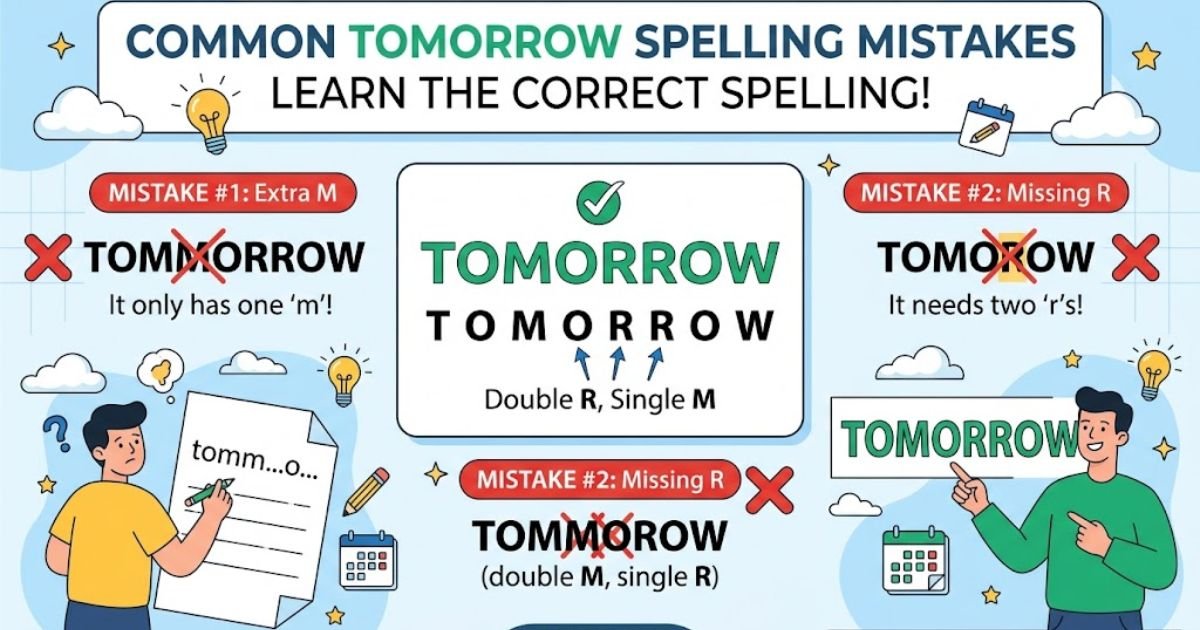
Nearly everyone has misspelled this word at some point. These are the errors that show up most often.
Doubling the m
Incorrect: I’ll finish the project tommorrow.
Correct: I’ll finish the project tomorrow.
The word has only one m. Split it into “to” and “morrow” to check.
Dropping an r
Incorrect: Tomorow is the deadline.
Correct: Tomorrow is the deadline.
The r doubles in “morrow,” just like in “sorrow” and “borrow.”
Changing a vowel
Incorrect: We’ll talk tomarrow.
Correct: We’ll talk tomorrow.
Sound can suggest an “a” here, but the spelling uses “o” in the same place as in “morrow.”
Adding an extra r
Incorrect: Let’s meet tomorrrow.
Correct: Let’s meet tomorrow.
Two r’s are enough. A third is usually a typing slip.
Writing it as two words
Incorrect: I’ll call you to morrow.
Correct: I’ll call you tomorrow.
The two-word form is historical. Modern English writes it as one word.
Does Tomorrow Need a Hyphen or a Capital Letter?
No hyphen is needed. The hyphenated “to-morrow” is a historical form and looks outdated today. Write tomorrow as one word in all modern contexts.
Capitalization follows normal rules. Use lowercase in the middle of a sentence: “We start tomorrow.” Capitalize it only when it begins a sentence or appears in a title: “Tomorrow Never Dies.”
Tomorrow is not a proper noun, so you do not capitalize it just because it feels important. The same applies to today and yesterday.
What Words and Phrases Go With Tomorrow?
Learning related terms makes the word easier to use and remember.
Time words in the same family:
- Today: the current day
- Yesterday: the day before today
- Tonight: this evening or night
- The day after tomorrow: two days from now
Common phrases with tomorrow:
- Tomorrow morning, tomorrow afternoon, tomorrow night: specific parts of the next day
- See you tomorrow: a common goodbye
- Tomorrow is another day: a saying that encourages hope after a bad day
- Never put off until tomorrow what you can do today: a well-known proverb about procrastination
Similar-meaning terms:
- The next day: used in past-tense storytelling (“The next day, we left”)
- The morrow: a literary or old-fashioned alternative
- Future: the broader sense of what comes later
Note that “the next day” replaces “tomorrow” when you are narrating events in the past, because tomorrow is relative to the moment of speaking.
FAQ’s
Is “tommorrow” ever correct?
No. Tommorrow is a misspelling, and no dictionary or style guide accepts it. The correct spelling is tomorrow, with one m and two r’s.
How do you spell tomorrow?
Tomorrow is spelled t-o-m-o-r-r-o-w. Think of it as “to” plus “morrow.”
What does tomorrow mean?
Tomorrow means the day after today. It can also refer more broadly to the future, as in “building a better tomorrow.”
Is tomorrow spelled differently in British English?
No. American and British English both use tomorrow. The only difference is a slight variation in pronunciation.
How do I use tomorrow in a sentence?
Use it as a noun or an adverb. For example: “The presentation is tomorrow,” or “I’ll send the invoice tomorrow.”
Conclusion
Tomorrow is the only correct spelling, and tommorrow is simply a common slip. Keep one m, double the r, and remember the “to” plus “morrow” split.
Once you see the pattern, the spelling stops being a guessing game. Write it once with confidence, and you will rarely have to think about it again.

Smith Jason is an SEO expert with 2–3 years of experience, sharing grammar tips, confusing words, vocabulary and writing advice.










1 thought on “Tomorrow vs Tommorrow: The Correct Spelling Explained Fast”