If you have ever paused mid-sentence wondering whether it is “lieing” or “lying,” you are not alone. The confusion makes sense: most English verbs just add “-ing” to the base form, so “lieing” looks like it should follow the same pattern. It does not.
The correct spelling is “lying.” “Lieing” is always incorrect in standard English, no matter the context. “Lying” is the present participle and gerund form of the verb “lie,” used for both “to tell an untruth” and “to recline or rest in a horizontal position.”
What Does “Lying” Actually Mean?
“Lying” carries two distinct meanings depending on context, and that is part of why people second-guess the spelling.
- Lying (dishonesty): Saying something untrue on purpose. Example: She was lying about where she spent the weekend.
- Lying (position): Being in a horizontal or resting position. Example: The cat was lying on the windowsill.
Both meanings share the same spelling, “lying,” even though they come from two different verbs with overlapping forms (“lie, lied, lied” for dishonesty and “lie, lay, lain” for reclining). English speakers rarely confuse the meanings in context, but the shared spelling is exactly why the word trips people up.
Why Do People Write “Lieing” Instead of “Lying”?
The mistake is understandable. Most verbs ending in a consonant simply take “-ing” without any changes: “play” becomes “playing,” “walk” becomes “walking.” Following that logic, “lie” would seem to become “lieing.”
But English has a specific spelling rule for verbs that end in “-ie.” That rule overrides the usual pattern, and it applies to a small, memorable group of words.
The Spelling Rule Behind Lying
Here is the rule in plain terms: when a verb ends in “-ie,” change the “ie” to “y” before adding “-ing.”
- lie → lying
- die → dying
- tie → tying
- vie → vying
This rule exists because English avoids stacking three vowels together (“lieing” would place “i,” “e,” and “i” side by side) and because doubling up on the letter “i” right after “e” creates an awkward, non-standard spelling pattern. Swapping “ie” for “y” keeps the word readable and consistent with how English handles this small verb family.
This is one of the few spelling rules with almost no exceptions, so once you learn it for “lying,” you can apply it confidently to “dying,” “tying,” and “vying” as well.
Where Does the Word “Lie” Come From?
The verb “lie” (to say something untrue) traces back to Old English “lēogan,” which meant “to deceive” or “to speak falsely.” It shares roots with the Old High German “liogan” and other Germanic languages, all carrying a similar sense of deception.
The separate verb “lie” (to recline) comes from Old English “licgan,” meaning “to be in a horizontal position.” These two words developed independently over centuries but ended up with identical spelling in modern English, which is a coincidence of language evolution rather than a shared origin.
Read Related Post: Unformal or Informal: Which Word Is Correct?
How Do You Pronounce Lying?
“Lying” is pronounced LAI-ing (rhymes with “trying” and “buying”). The stress falls on the first syllable, and the “y” carries the long “i” sound. There is no separate pronunciation for the dishonesty meaning versus the reclining meaning. Context alone tells the listener which sense is intended.
Lying vs Lieing: Comparison Table
| Term | Correct? | Meaning | Use in a Sentence |
| Lying | Yes | Telling an untruth, or being in a horizontal position | He is lying to protect his friend. |
| Lieing | No | Not a recognized English spelling | Never used in standard writing |
There is no formal or informal context where “lieing” is acceptable. It is not a regional variant, an older spelling, or a British English alternative. It is simply a spelling error.
How to Use “Lying” Correctly in a Sentence
“Lying” functions as a present participle (used with helping verbs like “is,” “was,” or “has been”) and as a gerund (acting as a noun).
- As a present participle: They are lying about the accident.
- As a gerund: Lying rarely solves the real problem.
Because “lie” is an irregular verb, its other forms are worth knowing too:
- Present: lie / lies
- Past: lied
- Past participle: lied
- Present participle/gerund: lying
This applies specifically to “lie” meaning “to say something untrue.” The reclining version of “lie” has different past forms (lie, lay, lain), which is a common source of separate confusion, but the “-ing” form stays “lying” either way.
Real-Life Examples of Lying in Context
Everyday conversation:
I could tell he was lying by the way he avoided eye contact.
Workplace communication:
The manager warned the team that lying on expense reports would lead to disciplinary action.
Academic writing:
The study examined how children develop the cognitive skills needed for lying convincingly.
Email:
I want to clarify that I was not lying when I said the shipment left on Monday.
Casual texting:
stop lying, you totally forgot our plans lol
Reclining sense, for contrast:
The dog has been lying by the fireplace all afternoon.
Each example uses “lying” the same way grammatically, even though the meaning shifts between deception and physical position based on context.
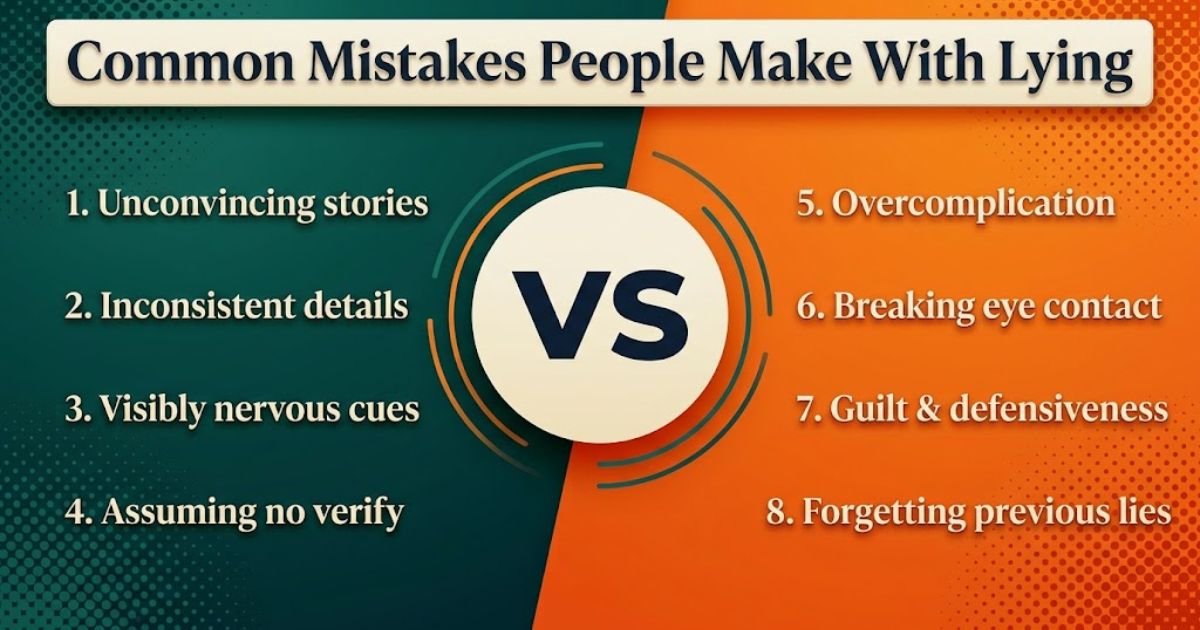
Common Mistakes People Make With Lying
Incorrect: She is always lieing about small things.
Correct: She is always lying about small things.
The “-ie” ending must change to “y” before adding “-ing.” There is no exception for this word.
Incorrect: He was laying about his whereabouts.
Correct: He was lying about his whereabouts.
“Laying” requires a direct object (you lay something down). Since there is no object here, “lying” is correct.
Incorrect: I have been lieing awake at night.
Correct: I have been lying awake at night.
This is the reclining sense of “lie,” and it follows the same “-ing” spelling rule as the dishonesty sense.
These mix-ups are extremely common, even among fluent speakers, so getting them wrong once does not mean you have a weak grasp of English. It just means this particular rule is worth locking in.
Related Words: Lie, Lay, Lied, and Lying
Understanding “lying” gets easier once you see the full word family:
- Lie (verb, to deceive): base form. Don’t lie to me.
- Lied (past tense/past participle of deceive-lie): He lied yesterday.
- Lie (verb, to recline): base form. I need to lie down.
- Lay (past tense of recline-lie): I lay down for an hour yesterday.
- Lain (past participle of recline-lie): She has lain there for hours.
- Lying (present participle/gerund of both verbs): She is lying.
Two separate verbs, one shared “-ing” form. Once that clicks, the rest of the confusion around “lie” and “lay” becomes much easier to sort out.
Quick Tips to Never Misspell Lying Again
- Remember the pattern: -ie becomes -y before adding “-ing” (lie, tie, die, vie).
- If you catch yourself typing “lieing,” pause and swap the “ie” for a “y.”
- Say the word aloud: “lying” rhymes with “trying,” which can help the correct spelling stick.
- When in doubt, picture the small group of “-ie” verbs together. Once you know one, you know them all.
FAQ’s
Is “lieing” ever correct?
No. “Lieing” is not a recognized spelling in any form of standard English, formal or informal.
What does “lying” mean?
“Lying” means either saying something untrue on purpose or being in a horizontal, resting position, depending on context.
How do I use “lying” in a sentence?
Use it after a helping verb, as in She is lying about her age, or as a gerund, as in Lying can damage trust quickly.
Why do “lie,” “die,” “tie,” and “vie” all follow the same rule?
They all end in “-ie,” and English changes “-ie” to “-y” before adding “-ing” to avoid an awkward vowel combination.
Is there a British English difference for “lying”?
No. “Lying” is spelled the same way in American and British English. There is no regional variant that uses “lieing.”
Conclusion
“Lying” is the only correct spelling, whether you mean telling an untruth or reclining somewhere. “Lieing” is a simple spelling error that comes from applying the usual “-ing” rule to a verb that follows a different pattern. Remember the swap: “-ie” becomes “-y,” and you will spell “lying,” “dying,” “tying,” and “vying” correctly every time.

Smith Jason is an SEO expert with 2–3 years of experience, sharing grammar tips, confusing words, vocabulary and writing advice.










1 thought on “Lieing or Lying: Which Spelling Is Correct?”