You typed “infront” into a sentence, paused, and wondered if it looked wrong. It does, and here’s why: your brain merged two words that English keeps separate. The correct form is in front, written as two words. “Infront” is not a recognized English word, no matter how often it shows up in casual writing.
The Quick Answer: Is It “Infront” or “In Front”?
“In front” is the only correct form. It is always written as two separate words: “in” and “front.” “Infront” (one word) is a common misspelling that does not appear in any standard dictionary, including Merriam-Webster or the Oxford English Dictionary.
If you remember nothing else from this article, remember this: two words, always.
What Does “In Front” Actually Mean?
“In front” is a prepositional phrase that describes position. It tells you where something or someone is located relative to another object, person, or place, specifically at the forward side of it.
You’ll usually see it paired with “of” to form the compound preposition in front of:
- The car parked in front of the house.
- She stood in front of the class to give her speech.
Sometimes “in front” appears without “of,” typically as an adverbial phrase describing relative position or rank:
- He was walking in front the whole race.
- The red team finished in front.
Both uses are grammatically correct. The difference lies in whether you’re comparing the position to a specific object (use “of”) or describing general placement or standing (no “of” needed).
Why Do People Write “Infront” Instead?
This mistake is extremely common, and there’s a logical reason for it. English already has several compound words built the same way: “inside,” “into,” “indoor,” “input.” Your brain pattern-matches “in front” to that same group and assumes it should merge too.
Pronunciation adds to the confusion. When people speak quickly, “in front” often sounds like a single word: “infrunt.” What you hear in casual speech does not always match how the phrase is spelled.
Is “Infront” Ever Acceptable?
No. Unlike some English words that started as errors and eventually became accepted (like “alright,” which is still debated), “infront” has not been adopted by any major dictionary or style guide. It is considered a spelling error in every context: academic writing, business communication, casual texting, and everything in between.
If you’re writing anything that another person will read and judge, whether it’s an email, a resume, a school essay, or a social media caption, “infront” will register as a mistake.
Infront vs In Front: Comparison Table
| Term | Correct? | Meaning | Use |
| In front | Yes | Positioned at the forward side of something | Standard usage in all writing and speech |
| In front of | Yes | Positioned before or facing a specific object/person | Most common form, requires an object |
| Infront | No | Not a recognized word | Never appropriate; always a misspelling |
Read Related Post: Goodmorning or Good Morning: Which One Is Correct?
Grammar Breakdown: How “In Front” Works in a Sentence
“In front” is built from two separate parts of speech working together:
- In: a preposition indicating location or position
- Front: a noun referring to the forward-facing part of something
Together, they form a prepositional phrase. When “of” is added, the full phrase “in front of” becomes a compound preposition, which needs an object to complete its meaning.
Structure: in front of + [noun/pronoun]
- in front of the store
- in front of him
- in front of the mirror
Without “of,” “in front” functions more like an adverb, modifying a verb by describing position rather than pointing to a specific object.
- She sat in front. (adverbial, describes where she sat)
- She sat in front of the teacher. (prepositional phrase with an object)
Pronunciation Guide
“In front” is pronounced /ɪn frʌnt/, roughly “in-FRUHNT.” The two words blend smoothly in fast speech, which is part of why the spelling error is so common. Slowing down and saying each word separately can help reinforce the correct two-word spelling when you write it.
Where Does “In Front” Come From?
“Front” traces back to the Latin word frons, meaning forehead or face, which entered English through Old French front around the 13th century. Over time, “front” came to describe the foremost part of anything, not just a face.
The preposition “in” has been part of English since its earliest forms, used consistently to indicate position or location. When combined, “in front” developed naturally as a way to describe something positioned at the forward-facing side of another object. There is no historical version of this phrase that was ever spelled as one word.
American English vs British English
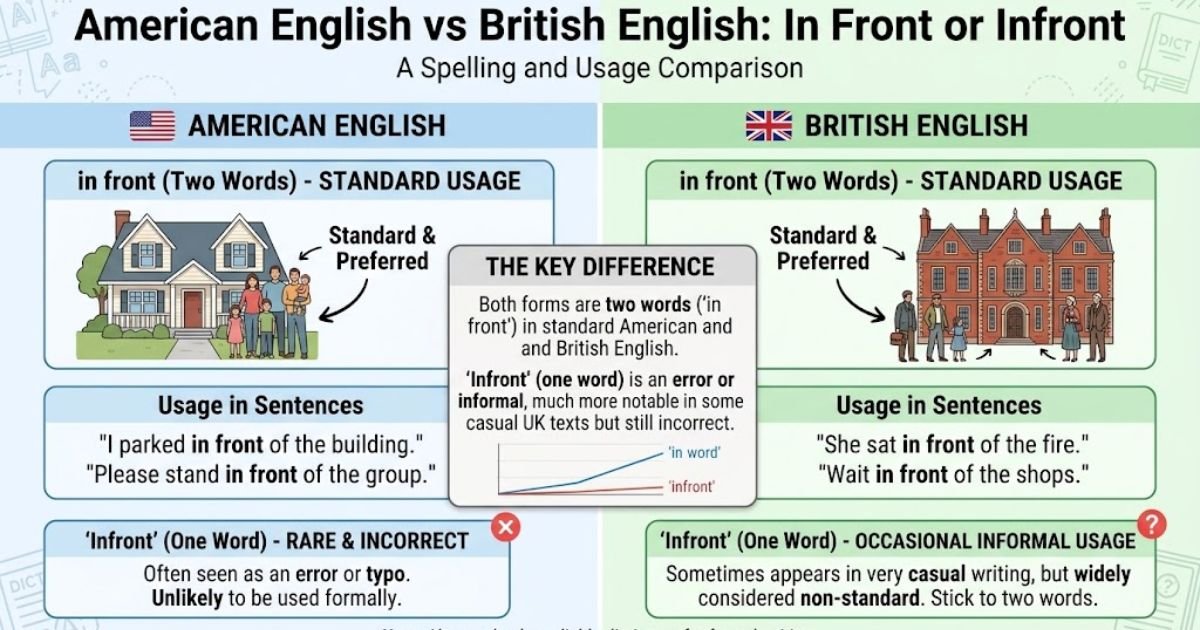
There is no difference between American and British English on this point. Both varieties spell it as two words: in front. You will not find “infront” accepted in any British dictionary either, so this is not a regional spelling variation like “color” versus “colour.”
Real Life Examples of “In Front” Used Correctly
Everyday conversation:
- “Can you move? You’re standing in front of the TV.”
Workplace communication:
- “I’ll present the quarterly numbers in front of the leadership team on Thursday.”
Academic writing:
- “The study measured how test anxiety changes when students perform in front of an audience.”
Email:
- “Please have the samples ready in front of the reception desk by 9 a.m.”
Business writing:
- “Our booth will be set up in front of the main entrance during the conference.”
Casual writing:
- “The dog just sat in front of the fridge like that would make dinner appear faster.”
Each of these sentences uses “in front” as a location marker, either describing where something is placed or where an action happens relative to a person, group, or object.
Common Mistakes to Avoid
Incorrect: She parked infront of the building. Correct: She parked in front of the building. Reason: “Infront” is never a single word. Always split it into “in” and “front.”
Incorrect: He stood infront the mirror for an hour. Correct: He stood in front of the mirror for an hour. Reason: This also drops the necessary “of” before the object. When naming a specific object, “in front” almost always needs “of” to complete the phrase.
Incorrect: Infront of everyone, she announced the news. Correct: In front of everyone, she announced the news. Reason: Even at the start of a sentence, “in front” stays two words. Capitalization doesn’t change the spelling rule.
These slips are easy to make, especially when typing quickly, and they don’t reflect a lack of understanding of English. They’re simply a spelling habit worth correcting.
Related Words and Phrases
Understanding a few related terms can help you use “in front” more precisely:
- Behind: the direct opposite, meaning positioned at the back
- Ahead of: similar to “in front of” but often implies progress or timing rather than physical position
- Facing: describes orientation toward something, related but not identical in meaning
- Before: can overlap with “in front of” in older or more formal English, especially regarding position or precedence
- Front-facing: an adjective form used to describe something oriented forward, as in “front-facing camera”
Knowing these alternatives helps you choose the most precise word for context, rather than defaulting to “in front” every time.
Practical Tips to Remember the Correct Spelling
- Think of “in” and “front” as two separate ideas: location (“in”) and object (“front”). They never fuse.
- If your spell checker flags “infront,” trust it. This is one of the rare cases where autocorrect is almost always right.
- When proofreading, search your document for “infront” specifically. It’s an easy fix once you spot it.
- Compare it to phrases like “in back,” “in between,” or “in place.” None of these merge into one word, and neither does “in front.”
Frequently Asked Questions
Is “infront” a word?
No. “Infront” is not recognized in any standard English dictionary. The correct spelling is always “in front,” written as two words.
What does “in front” mean?
“In front” describes a position at the forward side of something, often used with “of” to specify what it’s positioned before, such as “in front of the house.”
How do I use “in front” in a sentence?
Use it to describe location or order, typically followed by “of” and an object: “The bike is parked in front of the garage.”
Is it “in front of” or “in front from”?
It’s always “in front of.” “In front from” is not a standard English phrase and should not be used.
Why does “infront” look so common online?
Because it’s a frequent typing error, not because it’s correct. Casual writing, texting, and social media posts often skip proofreading, which lets common misspellings like “infront” spread even though they’re grammatically wrong.
Final Takeaway
“In front” is always two words, no exceptions. “Infront” is a spelling mistake, not an informal variant or accepted shortcut. The next time you type it, picture “in” and “front” as two separate puzzle pieces that sit next to each other but never lock into one.

Smith Jason is an SEO expert with 2–3 years of experience, sharing grammar tips, confusing words, vocabulary and writing advice.










1 thought on “Infront or In Front: Which One Is Correct? Complete Grammar Guide”