
You’re writing an email, filling out a form, or typing up a report, and suddenly you freeze on one word: is it “transferred” or “transfered”? Both look plausible once you stare at them long enough. Here’s the quick answer: “transferred” is the only correct spelling. “Transfered” is a common misspelling and has no accepted use in standard English.
The Short Answer: “Transferred” Is Correct
“Transferred” is the correct past tense and past participle of the verb “transfer.” It uses two R’s because of a spelling rule tied to how the word is stressed when you say it out loud. “Transfered,” with a single R, is simply a misspelling. It doesn’t appear in dictionaries, and no style guide recognizes it as an acceptable variant.
If you remember nothing else from this article, remember this: double the R, and you’re safe.
What Does “Transferred” Actually Mean?
“Transferred” describes the act of moving something, or someone, from one place, person, or condition to another. It’s the past tense of “transfer,” a verb you’ll see constantly in workplaces, schools, banks, and everyday conversation.
A few common contexts:
- Money: “She transferred $200 to her savings account.”
- Jobs or locations: “He transferred to the Chicago office last spring.”
- Ownership: “The property was transferred to the new owner in June.”
- Data or files: “The photos were transferred from the phone to the laptop.”
In every case, “transferred” signals that a movement or handoff already happened.
Why Do People Misspell It as “Transfered”?
The mistake usually comes from a mismatch between sound and spelling. Many English speakers assume that adding “-ed” to a word just means tacking it on, without doubling any letters, since that’s how plenty of verbs behave. Think “listened,” “opened,” or “offered.” None of those double the final consonant.
The problem is that “transfer” doesn’t follow that pattern. It follows a different rule entirely, one based on stress and syllable count.
The Grammar Rule Behind the Double R
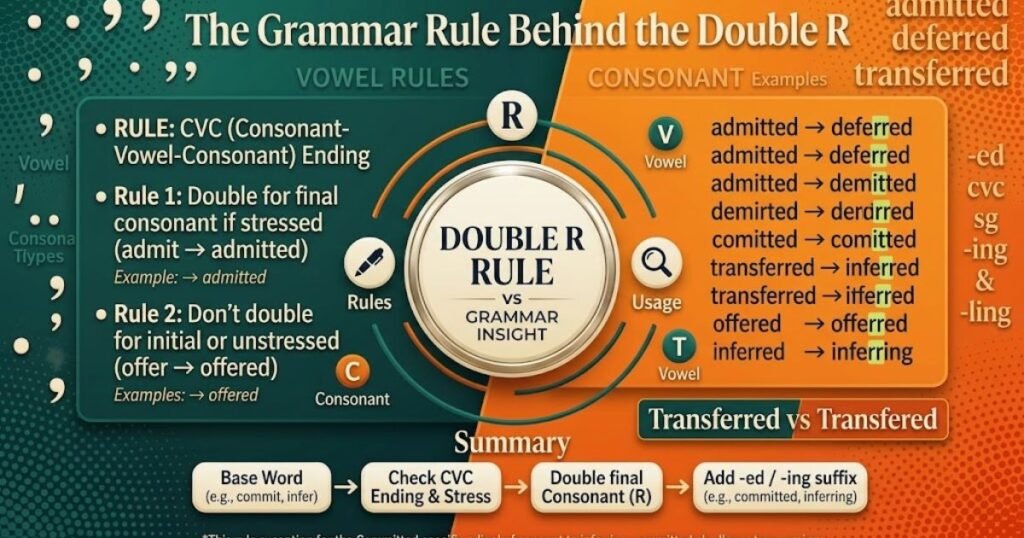
Here’s the rule that explains everything: when a two-syllable verb ends in a single consonant preceded by a single vowel, and the stress falls on the second syllable, you double that final consonant before adding “-ed,” “-ing,” or similar endings.
Say “transfer” out loud. Notice where the emphasis lands: trans-FER. The stress hits the second syllable, “fer,” which ends in a single consonant (R) after a single vowel (E). That combination triggers the doubling rule.
Compare that to a word like “offer.” You pronounce it OFF-er, with the stress on the first syllable. Because the stress lands earlier, the final consonant doesn’t double. That’s why you get “offered,” not “offerred.”
This same doubling pattern shows up in other stress-shifted verbs, like “prefer” becoming “preferred,” and “occur” becoming “occurred.” Once you notice the pattern, it stops feeling random.
Part of Speech and Verb Forms
“Transfer” functions as both a verb and a noun, which sometimes adds to the confusion.
| Form | Type | Example |
| Transfer | Base verb / noun | “Please transfer the funds.” / “I need a transfer.” |
| Transfers | Present tense (third person) | “He transfers files daily.” |
| Transferred | Past tense / past participle | “The file was transferred yesterday.” |
| Transferring | Present participle / gerund | “She is transferring departments.” |
Notice that “transferring” also doubles the R, for the exact same stress-based reason as “transferred.” If you can remember one, you can remember both.
Read Related Post: Totalling vs Totaling: Which Spelling Is Correct?
Pronunciation: How to Say “Transferred”
“Transferred” is pronounced trans-FERD, with two syllables and the stress on the second one. The double R doesn’t change how the word sounds; you’re not pronouncing two separate R sounds. It only affects the spelling.
This is a useful thing to keep in mind: English spelling rules for doubling consonants are about grammar structure, not about pronunciation changes you can hear.
Does “Transfered” Have Any Legitimate Use?
No. Unlike some word pairs where two spellings are both valid (think “gray” and “grey”), “transfered” is not a recognized alternate spelling in American or British English. It won’t appear in Merriam-Webster, Oxford, or Cambridge dictionaries. If you see it in published writing, it’s a typo, not a stylistic choice.
This is different from words with genuine regional spelling differences. “Transferred” stays the same in both American and British English, since the doubling rule applies consistently across both varieties for this particular word.
Real Life Examples of “Transferred” in Use

Seeing the word in different contexts helps it stick.
Everyday conversation: “I transferred the playlist to my new phone before I sold the old one.”
Workplace communication: “Please confirm once the client files have been transferred to the shared drive.”
Academic writing: “Responsibility for the estate was transferred to the eldest heir under the original will.”
Email: “Hi Sam, I’ve transferred the invoice details to the spreadsheet you sent over.”
Business writing: “All customer accounts were transferred to the new system without any downtime.”
Casual texting: “Just transferred you the money for dinner, check your app.”
Each of these sentences uses “transferred” as a straightforward past tense verb describing something that already happened.
Common Mistakes and How to Fix Them
Incorrect: “I transfered the money yesterday.” Correct: “I transferred the money yesterday.” The single R is the most frequent version of this mistake. Doubling it fixes the spelling completely.
Incorrect: “She is transfering to a new school next month.” Correct: “She is transferring to a new school next month.” The same doubling rule applies to “-ing” forms, not just “-ed.”
Incorrect: “The company transfer’d ownership of the building.” Correct: “The company transferred ownership of the building.” Adding an apostrophe here isn’t a standard way to form the past tense and should be avoided entirely.
None of these slips are unusual. Doubling rules are one of the trickier corners of English spelling, and plenty of fluent writers pause on this exact word.
Related Words and Terms Worth Knowing
A few related forms and terms often come up alongside “transferred”:
- Transfer (noun): the act or process of moving something, such as a bank transfer or a school transfer.
- Transferee: a person who receives something transferred, common in legal and financial writing.
- Transferor: a person who transfers something to someone else.
- Transferable: capable of being transferred, as in “a transferable skill.”
- Re-transferred: transferred a second time, sometimes hyphenated for clarity.
Learning these related words can help you use “transfer” confidently across different kinds of writing, from casual messages to formal documents.
How to Remember the Correct Spelling
A simple trick: say the word slowly and notice the stress lands on “fer,” not “trans.” When the stress lands on that final syllable, double the consonant before adding an ending. This same shortcut works for “referred,” “deferred,” and “preferred,” so learning it once pays off across several words at once.
If you’re ever unsure while typing quickly, a spell checker will almost always flag “transfered” as an error, since it isn’t a recognized word in any standard dictionary.
Frequently Asked Questions
Is “transfered” ever correct?
No. “Transfered” is always a misspelling. The correct spelling in every context is “transferred,” with two R’s.
Why does “transferred” have two R’s?
Because the stress in “transfer” falls on the second syllable (“fer”), which ends in a single consonant after a single vowel. English spelling rules require doubling that consonant before adding “-ed” or “-ing.”
Is “transferred” the same in British and American English?
Yes. Unlike some words that differ between the two, “transferred” keeps its double R in both American and British English.
How do I use “transferred” in a sentence?
Use it to describe something that has already been moved or handed off, as in: “The funds were transferred to the new account this morning.”
What is the correct spelling of “transferring”?
“Transferring” is correct, with two R’s, for the same stress based reason as “transferred.”
The Takeaway
“Transferred” is the only correct spelling and the double R comes from a real, predictable grammar rule rather than an arbitrary exception. Once you notice that the stress falls on “fer,” the spelling makes sense, and you’ll likely stop second guessing it altogether.

Smith Jason is an SEO expert with 2–3 years of experience, sharing grammar tips, confusing words, vocabulary and writing advice.