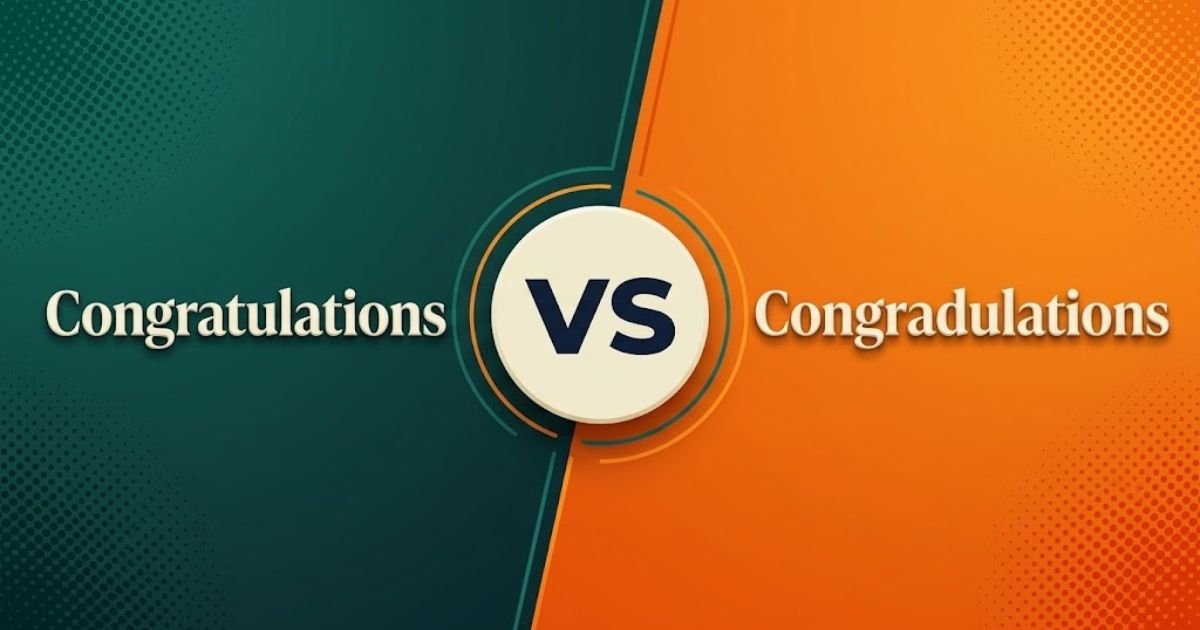
You want to send a nice note to a friend who just got engaged, landed a new job, or graduated, and suddenly you freeze on one word. Is it “congratulations” or “congradulations”? The confusion happens because the word sounds like it has a “d” sound in the middle when spoken quickly. Here is the short answer: “congratulations” is the only correct spelling. “Congradulations” is a common misspelling with no correct use in any English writing.
Congratulations Is Correct, Congradulations Is Not
“Congratulations” is the correct spelling in all forms of English, American and British alike. It is a plural noun used to express praise or happiness for someone’s achievement or good fortune. “Congradulations” is not a word. It does not appear in any dictionary, and it should never be used in writing, whether casual or formal.
The mix-up happens because of how the word is pronounced. Many speakers blend the middle syllables together, and the “t” can sound close to a “d” in fast, casual speech. That auditory shortcut leads people to spell the word the way it sounds rather than the way it is actually built.
What Congratulations Actually Means
“Congratulations” expresses praise, approval, or good wishes for something someone has accomplished or experienced. It is typically used right after a positive event: a promotion, a wedding, a new baby, passing an exam, or any other milestone worth celebrating.
As a word, it can function two ways:
- As an interjection, said or written on its own: “Congratulations!”
- As part of a noun phrase, followed by “on” or “for”: “Congratulations on your new job.”
Both uses are common in everyday US English, and both are grammatically correct.
Where “Congradulations” Comes From (And Why It’s Wrong)
“Congradulations” is not an alternate spelling, a regional variant, or an informal shortcut. It is simply an error. It happens because the correct word contains the root “grat,” related to gratitude and thanks, not “grad,” which people associate with graduation.
That association is part of the problem. Because “congratulations” is so often said at graduations, some writers assume the word must contain “grad.” It does not. The two words are unrelated in origin, even though they often appear in the same sentence.
Read Related Post: You Too or You To: What’s the Correct Grammar in 2026?
The Real Root: Gratus, Not Graduation
“Congratulations” comes from the Latin word gratus, meaning pleasing or thankful. The prefix con- means “with” or “together.” Put together, the original sense of the word was something close to “sharing in someone’s joy” or “expressing pleasure together.”
This is the same Latin root found in words like grateful, gratitude, and gracious. None of those words contain a “d” in that position either, which is a useful memory check when you are unsure how to spell “congratulations.”
“Graduate” and “graduation,” on the other hand, come from a completely different Latin root: gradus, meaning “step” or “degree.” The similarity in sound between “congratulations” and “graduation” is a coincidence of English pronunciation, not a shared origin.
How to Pronounce Congratulations Correctly
“Congratulations” is pronounced kuhn-grach-uh-LAY-shuhnz, with the stress on the fourth syllable. Notice the “t” creates a soft “ch” sound in casual speech, which is part of why it can sound like it might contain a “d.” Saying the word slowly, syllable by syllable, can help reinforce the correct spelling when you write it: con-grat-u-la-tions.
Grammar Notes: Singular, Plural, and Sentence Use
“Congratulations” is almost always used in its plural form, even though it refers to a single expression of praise. There is technically a singular form, “congratulation,” but it is rarely used in modern English outside of formal or older writing.
A few grammar points worth knowing:
- Use “on” before the achievement: “Congratulations on the award.”
- In more formal writing, you may see “for” instead: “Congratulations for your dedication.”
- The word can stand alone as a complete exclamation: “Congratulations!”
- It does not take an article like “a” or “the” before it.
There is no difference in spelling or use between American and British English here. “Congratulations” is the accepted form worldwide.
Congratulations vs Congradulations at a Glance
| Term | Correct? | Meaning | Use |
| Congratulations | Yes | Praise or good wishes for an achievement | Standard word for all writing and speech |
| Congradulations | No | Not a real word | Never correct; always a misspelling |
Real Life Examples of Congratulations in a Sentence
Everyday conversation: “Congratulations on the new puppy! He’s adorable.”
Workplace communication: “Congratulations on closing the deal. The whole team is thrilled.”
Academic writing: “Congratulations to this year’s graduating class for their hard work and perseverance.”
Email: “Hi Sarah, congratulations on your promotion to senior manager. You’ve earned it.”
Formal writing: “On behalf of the board, please accept our sincere congratulations on your retirement.”
Casual writing: “omg congratulations!! so happy for you two”
Each example uses “on” or “to” naturally, and the word works equally well in short, casual messages and longer, formal statements.
Common Mistakes to Avoid
Incorrect: Congradulations on your new house! Correct: Congratulations on your new house! The word never contains a “d” after “con.” Remember the root word “grateful,” which has no “d” either.
Incorrect: Congratulation on your wedding. Correct: Congratulations on your wedding. The plural form is standard. Using the singular sounds unnatural in nearly every context.
Incorrect: Congratulations for on your success. Correct: Congratulations on your success. Choose either “on” or “for,” never both together.
These are easy mistakes to make, especially for English learners or anyone typing quickly. Spotting the pattern is usually enough to fix it going forward.
Related Words and Terms
A few words connect naturally to “congratulations” and can help reinforce the correct spelling:
- Grateful and gratitude (same Latin root, no “d”)
- Congratulate (the verb form: “I want to congratulate you”)
- Congratulatory (the adjective form: “a congratulatory message”)
- Kudos and well done (informal synonyms)
- Felicitations (a more formal, less common synonym)
Seeing these related words together makes the “grat” spelling easier to remember, since none of them include a “d.”
Practical Tips to Remember the Correct Spelling
If you tend to second guess yourself, a few small habits can help:
- Think of “grateful” first. If that word has no “d,” neither does “congratulations.”
- Break the word into syllables when typing: con-grat-u-la-tions.
- Turn on spell check in your email and messaging apps, since “congradulations” is flagged as an error almost everywhere.
- Read the word aloud slowly before writing it in something formal, like a card or a work email.
FAQ’s
Is “congradulations” ever correct?
No. “Congradulations” is always a misspelling. There is no context, formal or informal, where it is the accepted spelling.
What does “congratulations” mean?
It means an expression of praise, approval, or good wishes for someone’s achievement or good fortune, such as a graduation, wedding, or promotion.
How do I use “congratulations” in a sentence?
Pair it with “on” followed by the achievement, as in “Congratulations on your new job,” or use it alone as an exclamation: “Congratulations!”
Why do people misspell it as “congradulations”?
The mistake usually comes from associating the word with “graduation,” since the two are often used in the same context. In reality, “congratulations” comes from the Latin word for “thankful,” not the word for “step” or “degree.”
Is there a British spelling difference?
No. “Congratulations” is spelled the same way in American and British English, with no regional variation.
Conclusion
“Congratulations” is correct, and “congradulations” is not. The easiest way to remember it is to connect the word to “grateful” and “gratitude,” both of which share the same root and neither of which contains a “d.” Once that connection clicks, the spelling becomes second nature.

Smith Jason is an SEO expert with 2–3 years of experience, sharing grammar tips, confusing words, vocabulary and writing advice.









1 thought on “Congratulations or Congradulations? Correct Spelling”