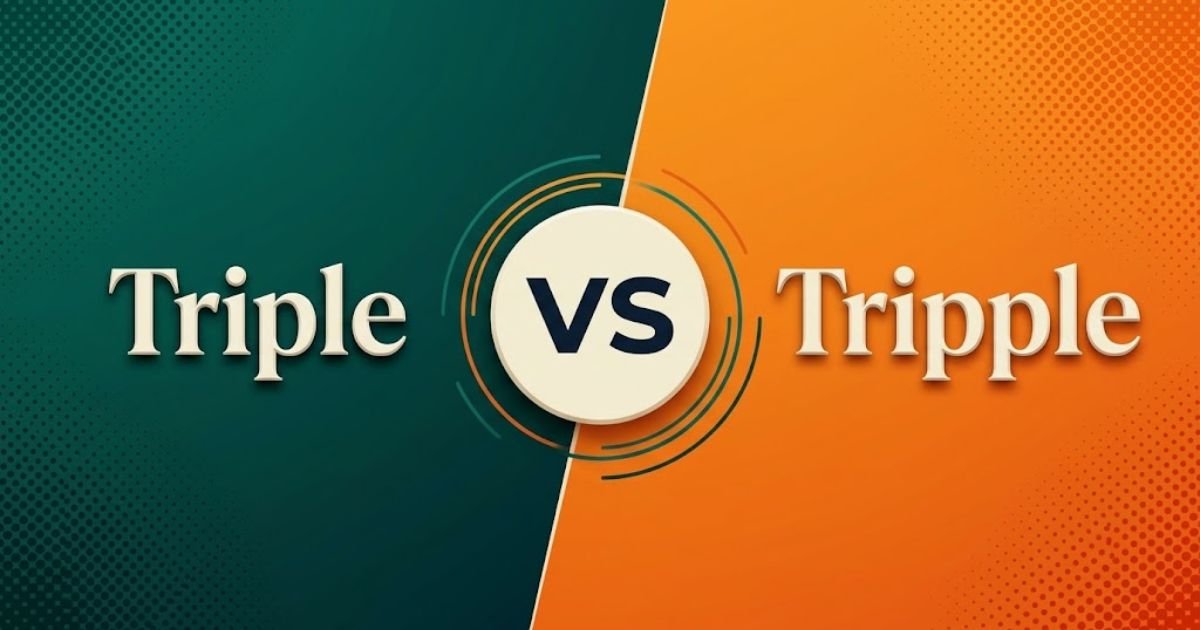
You typed “tripple” and something felt off. Maybe spell check flagged it, or maybe you just second guessed yourself. That small hesitation is common because the double consonant looks like it should belong, similar to words like “ripple” or “supple.” It does not. The correct spelling is “triple.” “Tripple” is a common misspelling and is not a recognized word in standard English.
Is It Triple or Tripple?
“Triple” is correct. It means three times the amount, three parts, or something that happens three times. “Tripple” appears nowhere in Merriam-Webster, Oxford, or any major dictionary. If you see it in writing, it is simply a spelling error, not an alternate or informal form.
This mistake usually happens because English has plenty of words where doubling a consonant is standard, like “supple,” “ripple,” and “topple.” Your brain pattern matches “triple” to that group, even though it does not belong there.
What Does Triple Mean?
“Triple” describes anything made of three parts or multiplied by three. It can function as an adjective, a noun, or a verb, depending on the sentence.
As an adjective, it describes something with three parts: a triple scoop of ice cream, a triple threat, a triple play in baseball.
As a verb, it means to multiply by three: “Sales tripled last quarter.”
As a noun, it refers to a thing consisting of three units, or specifically in baseball, a three base hit: “He hit a triple in the ninth inning.”
Triple vs Tripple: Quick Comparison
| Term | Correct? | Meaning | Use |
| Triple | Yes | Three times the amount or three parts | Standard word in all contexts |
| Tripple | No | Not a real word | Common misspelling of “triple” |
Why Does the Tripple Spelling Feel Right?
English spelling is not always logical, and doubled consonants are one of the trickiest patterns to predict. Words like “supple,” “ripple,” “topple,” and “apple” all use a double consonant before the final “e.” Since “triple” rhymes with these words, it is easy to assume it follows the same spelling pattern.
It does not, because “triple” comes from a different word family with a different history, which affects how it is spelled.
Read Related Post: Distress vs Duress: Meaning, Differences, Legal Uses, and Correct Examples
Where Does the Word Triple Come From?
“Triple” traces back to the Latin word triplus, meaning threefold, which itself combines tri- (three) and a root related to “fold” or “layer.” The word entered English through French in the late Middle Ages, keeping the single “p” spelling from its Latin and French origins.
Words that came from this same Latin root, such as “triplicate” and “triplet,” also use a single “p.” That consistency is a useful memory tool, since none of the legitimate related words double the consonant.
How Do You Pronounce Triple?
“Triple” is pronounced TRIH-puhl, with the stress on the first syllable. It rhymes with “ripple” and “nipple,” which is likely part of why the spelling confusion happens in the first place. The pronunciation itself is not the problem. The spelling is.
Grammar Breakdown of Triple
Here is how “triple” behaves across different parts of speech.
As an adjective: it comes before a noun and describes something with three parts or components. Example: “The gymnast landed a triple axel.”
As a verb: it follows standard regular verb conjugation. Present tense is “triple,” past tense is “tripled,” and the present participle is “tripling.” Example: “The company tripled its revenue in two years.”
As a noun: it refers to a set or group of three, or a specific three-unit outcome. Example: “She hit a triple to drive in two runs.”
There is no separate plural spelling issue here, since “triples” simply adds an “s” like most regular nouns and verbs.
Correct Usage of Triple in Sentences
Below are natural examples across different everyday and professional contexts.
Everyday conversation: “Can I get a triple shot of espresso this morning?”
Workplace communication: “We need to triple check these numbers before the client meeting.”
Academic writing: “The study used a triple blind method to reduce researcher bias.”
Business writing: “Our marketing budget has tripled since last fiscal year.”
Formal writing: “The committee approved a triple review process for all incoming applications.”
Casual writing: “This recipe is so good I want to triple it.”
Each of these uses “triple” in a slightly different grammatical role, but the spelling never changes, and that consistency is what makes it easy to remember once it clicks.
Common Mistakes With Triple and Tripple
Incorrect: I want to tripple my savings this year. Correct: I want to triple my savings this year.
The double “p” is the entire issue here. There is no meaning difference to worry about, since “tripple” has no accepted meaning at all.
Incorrect: She scored a tripple in the championship game. Correct: She scored a triple in the championship game.
Sports terminology follows the same standard spelling as everyday usage. There is no special “sports spelling” exception.
Incorrect: The room has tripple the space we need. Correct: The room has triple the space we need.
Even in casual, spoken style writing, the standard spelling still applies. Informal tone does not change correct spelling.
Related Words to Triple
Understanding related terms can reinforce the correct spelling, since they all share the same single “p” pattern.
Triplet: one of three offspring born from the same pregnancy, or a group of three related items.
Triplicate: made in three identical copies, often used for forms or documents.
Triangular: having three sides or angles, sharing the same “tri-” prefix.
Tripling: the present participle form of the verb “triple.”
Double: the related term for multiplying by two, useful for comparison since “double” also uses a single consonant before the final “e.”
Notice that none of these words double the “p,” which makes the pattern easier to trust once you see it across the whole word family.
Is Tripple Ever Acceptable?
No. “Tripple” is not a variant spelling, a British English form, or an informal shortcut. It is simply incorrect in every context, whether you are writing an email, a text message, an academic paper, or casual conversation. There is no situation where “tripple” is the preferred or accepted form.
How to Remember the Correct Spelling
A simple trick is to connect “triple” to its relatives: “triplet,” “triplicate,” and “triangle.” All of them use one “p,” and none of them double the consonant. If you can spell one of these correctly, you can use that same pattern to spell “triple” correctly too.
Another method is to sound out the Latin root tri-, which appears in dozens of English words related to the number three, like “triangle,” “tripod,” and “trilogy.” None of those double a consonant either, which reinforces the same rule.
Frequently Asked Questions
Is triple or tripple correct?
“Triple” is the correct spelling. “Tripple” is a misspelling with no accepted use in English.
What does triple mean?
“Triple” means three times the amount, or something made up of three parts. It can be used as an adjective, verb, or noun depending on the sentence.
How do I use triple in a sentence?
Use it to describe something multiplied by three or made of three parts, such as: “The store tripled its inventory before the holiday season.”
Why do people misspell triple as tripple?
The confusion comes from similar sounding words like “ripple” and “supple,” which do use a double consonant. “Triple” comes from a different word origin and does not follow that same pattern.
Is tripple correct in British English?
No. The spelling “triple” is standard in both American and British English. There is no regional variation for this word.
Final Takeaway
“Triple” is always the correct spelling, and “tripple” is always a mistake, regardless of context or region. The easiest way to remember it is through its word family: “triplet,” “triplicate,” and “triangle” all use a single “p,” and “triple” follows the exact same pattern.

Smith Jason is an SEO expert with 2–3 years of experience, sharing grammar tips, confusing words, vocabulary and writing advice.